
Table of Contents
- Understanding Security Window Film Cost Per Square Foot
- Key Factors That Determine Security Window Film Cost Per Square Foot
- How Film Thickness and Material Quality Impact the Cost Per Square Foot
- Installation Costs and Volume Pricing for Commercial Window Film Projects
- Blast Mitigation Film and GSA Compliance: When Premium Pricing Applies
- Frequently Asked Questions About Security Window Film Pricing
- Selecting the Right Security Window Film for Your Budget and Threat Level
Understanding Security Window Film Cost Per Square Foot
For commercial decision-makers evaluating protective upgrades, the security window film cost per square foot is the standard metric for comparing investments. This figure represents the all-in price for materials and professional installation divided by the total glass area covered. Our law-enforcement-led team at Amarok Defense Company helps facility managers across Scottsdale and beyond navigate these costs with clarity, ensuring every dollar spent strengthens safety without compromising budget integrity.
Several factors drive the price per square foot for protective window film. Film type is the primary variable: intrusion protection films designed to delay forced entry differ from blast mitigation film, which is engineered to hold shattered glass in place under explosive pressure. Thickness, measured in mils, also influences cost because heavier gauge films require more material and specialized handling during installation. Coatings such as graffiti shield or solar control layers add functional benefits that raise the investment per square foot, though they deliver long-term operational savings. Installation complexity plays an equally critical role—glass size, pane accessibility, site conditions, and the need to remove old film all affect labor hours and, by extension, the final forced entry window film price.
We emphasize that security film is NOT bullet-resistant; do not rely on it for ballistic protection. Cost per square foot reflects security features like intrusion delay and fragment retention, not a ballistic rating. Amarok Defense offers competitive pricing across all categories, backed by over 75 years of combined law enforcement experience and a disciplined six-step process that ensures every installation meets the highest standards of Safety with Integrity. For decorative window tinting near me that is separate from our security-grade films, please consult our FAQs on tinting applications.
In the sections ahead we examine how film type, thickness, and installation requirements influence the final budget for commercial security window film projects.
Key Factors That Determine Security Window Film Cost Per Square Foot
Several elements determine the security window film cost per square foot for a commercial building, and no single factor operates in isolation. The interplay of film type, installation complexity, local market conditions, and building-specific characteristics all influence the final investment. Understanding how these elements interact helps facility managers and property owners build realistic budgets, compare proposals, and avoid surprises during project execution.
How Film Thickness and Type Influence Material Costs
Film thickness is the most direct driver of per-square-foot material pricing. At the entry level, standard 4–6 mil security films are engineered primarily for shatter control and glass fragment retention. Moving up in performance, intrusion-grade films ranging from 8 to 14 mil incorporate multiple laminated layers that resist repeated blunt-force impacts, making them a common choice for forced entry window film price considerations in schools, storefronts, and houses of worship. At the high end, blast mitigation film cost reflects multi-layer construction, wet-glaze attachment requirements, and the ability to manage overpressure and debris hazards. Each step up in thickness and performance carries a corresponding increase in material expense, driven by more sophisticated manufacturing processes and higher-grade polymers.
Installation Complexity and Labor Considerations
Material cost alone tells only part of the story. Films designed for forced entry and blast protection frequently require wet-glaze attachment systems that bond the film edge to the window frame, an essential step for achieving rated performance under stress. The labor hours needed to properly anchor film add to the per-square-foot total, particularly on upper-story windows requiring lift equipment or on glass obstructed by blinds, desks, and other furnishings. Window characteristics such as pane count, irregular shapes, and frame material — aluminum is the most common in Arizona, while steel or wood may demand different preparation — also affect cutting waste and installation pace. Properly trained crews follow manufacturer protocols that include surface preparation, precise film application, and required curing intervals, none of which reward shortcuts.
Geographic Market Variations and Regional Expertise
Local labor rates, prevailing construction costs, and regional climate patterns introduce meaningful variation in project pricing. For those seeking professional security film installation in Arizona, Amarok Defense provides competitive pricing backed by years of local experience with the state’s intense sun exposure and common commercial glazing configurations. We see this firsthand across Phoenix Metro, Scottsdale, and Tucson: what appears identical on a spec sheet can carry different installation economics in Arizona compared to other states, simply because of workforce availability, permitting requirements, and environmental factors. A contractor unfamiliar with the local market may underestimate the time needed for proper film adhesion under high-heat conditions, ultimately costing the client more in the long run.
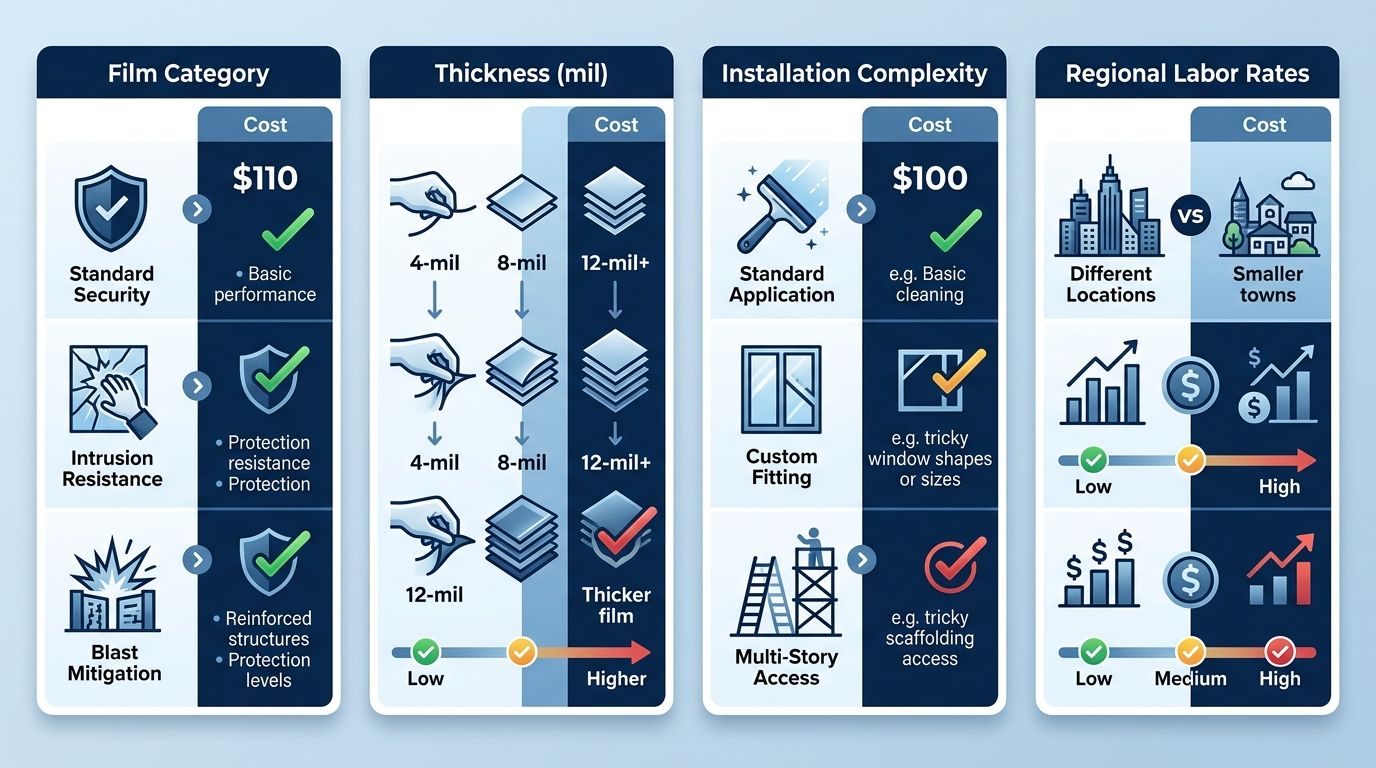
Key factors driving security window film installation cost.
How Optional Features Adjust the Budget
Beyond base performance, many facilities choose additional layers of functionality. Solar control coatings that reject infrared heat and ultraviolet light raise total expenditure but offset energy costs, while graffiti shield films protect glass surfaces from vandalism and reduce replacement expense. These upgrades layer on top of the core security film, adding both material and labor charges. When we evaluate a campus, we help decision-makers weigh the incremental spend against the extended service life and secondary benefits each option delivers, ensuring the final specification aligns with both security goals and operational constraints.
The table below compares common security film types based on thickness, estimated cost per square foot — 2026 USD, materials only — the threat each is designed to address, and typical applications. All figures are first-party estimates; installation labor is additional.
| Film Type | Thickness (mil) | Typical Cost Range per sq. ft. | Primary Threat Addressed | Recommended Applications |
|---|---|---|---|---|
| Standard Security Film | 4-6 mil | $4 – $8 | Glass breakage, shatter control | Office buildings, retail stores |
| Intrusion / Forced Entry Film | 8-14 mil | $8 – $15 | Human forced entry, smash-and-grab | Storefronts, schools, houses of worship |
| Blast Mitigation Film | 12-14 mil (multi-layer) | $15 – $30 | Blast overpressure, debris | Government buildings, corporate HQs, schools |
Blast mitigation film cost ranges vary with GSA rating requirements and the inclusion of wet-glaze attachment systems. The figures above reflect materials only and are based on 2026 industry averages; project-specific conditions can shift pricing in either direction. Installation complexity, access limitations, and regional labor rates each influence the final quote. We advise clients to treat these ranges as a starting point for budget planning rather than a fixed bid.
Moving from Estimates to a Custom Quote
No two buildings are identical, and the most accurate security window film cost per square foot comes from a professional on-site evaluation. Our team assesses glass type, frame condition, exposure profile, and threat level before proposing a specification, ensuring our recommendations match real-world conditions. We offer competitive pricing grounded in rigorous product testing and quality installation — without overpromising what film can or cannot do. Security window film is not bullet-resistant; consult a security professional for ballistic-rated solutions. Once you understand the cost factors, the next step is evaluating the installation process and ensuring long-term performance — something our team handles with rigor and precision.
How Film Thickness and Material Quality Impact the Cost Per Square Foot
Now let’s examine the two biggest drivers of cost: thickness and material quality. Understanding security window film cost per square foot begins with thickness, but the construction and adhesive systems integrated into the film are equally critical for long-term value. To stand firm where others falter, we guide our commercial clients through these technical variables so they can balance protection with professionalism and budget constraints.
The Role of Thickness in Pricing
A thorough window film thickness cost analysis starts with understanding the mil rating. Security films are measured in mils, or thousandths of an inch, with common options ranging from 4 mil to 14 mil. Each jump in thickness adds raw material cost, manufacturing complexity, and installation difficulty, which is why our clients see a clear price increase between tiers. Thicker films are heavier and stiffer, demanding more specialized handling during installation. Our installation teams note that 14 mil films frequently require attachment systems and may need thicker glass substrates to support the added weight, pushing the total project investment higher.
The table below summarizes how thickness translates into cost and protection level, providing a clear matrix for commercial buyers evaluating their options.
| Film Type | Thickness (mil) | Typical Cost Range per sq. ft. | Primary Threat Addressed | Recommended Applications |
|---|---|---|---|---|
| Standard Security Film | 4-6 mil | $4 – $8 | Glass breakage, shatter control | Office buildings, retail stores |
| Intrusion / Forced Entry Film | 8-14 mil | $8 – $15 | Human forced entry, smash-and-grab | Storefronts, schools, houses of worship |
| Blast Mitigation Film | 12-14 mil (multi-layer) | $15 – $30 | Blast overpressure, debris | Government buildings, corporate HQs, schools |
These cost ranges represent industry averages validated by ASTM International test methods. Actual performance depends on glass type and attachment system, and our team evaluates each opening during the on-site assessment to provide an accurate, customized proposal.
Comparing 4 Mil, 7 Mil, and 14 Mil Security Film Costs
When comparing options for your storefront or facility, the material cost alone tells only part of the story. A 4 mil film at $4–$6 per square foot offers economical shatter control, keeping glass fragments together if a window breaks but providing minimal delay against a determined intruder. Installation runs $3–$5 per square foot, making this tier ideal for interior glass and low-risk windows.
Moving to 7 mil, the material cost climbs to $6–$9 per square foot with installation between $4–$7 per square foot. This mid-range tier delivers medium forced entry delay, enough to deter smash-and-grab theft at retail storefronts and provide critical seconds for school lockdown procedures. For many commercial properties, we find this thickness offers the strongest balance of forced entry window film price and practical protection.
At 14 mil, you are entering the high-security tier where the blast mitigation film cost is justified by significant forced entry delay and blast resistance. Expect $12–$15 per square foot for material and $7–$10 per square foot for installation. According to ASTM F1642 test methods, 14 mil films achieve high penetration resistance, making them the standard choice for government facilities, data centers, and buildings in blast zones. Because these thicker films stress window frames, our Amarok Defense team often specifies upgraded attachment systems, which raises the total project cost but is essential for performance under extreme conditions.
Material Quality and Adhesive Systems
Adhesive type directly affects both the upfront installation cost and the long-term reliability of your security film investment. Lower-cost pressure-sensitive adhesives bond quickly and allow faster installation, keeping labor expenses down. Dry adhesives, by contrast, form a stronger, more durable bond at the glass surface. While dry adhesive films may carry a slightly higher material price, they deliver superior clarity and are less likely to peel or bubble over time. For high-security applications where consistent adhesion is non-negotiable, we recommend this elevated bond strength.
Film construction is equally important. Monolithic films, extruded as a single layer, provide cost-effective shatter control and are widely used for basic projects. Multi-layer laminates bond several layers together, increasing tear resistance and energy absorption during an impact. The manufacturing cost of laminates is higher, yet that added durability reduces replacement frequency across the life of the building. Our clients in Scottsdale, AZ, who choose multi-layer films paired with high-bond adhesives often find that the long-term budget impact is lower thanks to fewer service calls and greater sustained performance. Security film is not bullet-resistant, so pairing the right construction with realistic threat expectations is essential to protecting what matters most.
Understanding these cost drivers helps you choose the right film. Next, we’ll walk through how to select the best thickness for your specific security needs.
Installation Costs and Volume Pricing for Commercial Window Film Projects
Once you have selected the appropriate film type for your facility, understanding installation costs is the next critical step in project planning. When budgeting for security window film cost per square foot, commercial buyers must account for installation labor, material specifications, and project-specific complexity factors. Based on Amarok Defense’s installation records, we break down installation costs by scenario so you can forecast accurately and avoid surprises.
Professional Labor Rates for Security Film Installation
Professional labor rates for security film installation in the Southwest US start from $4 to $6 per square foot for standard office windows. Our labor rates align with ESA’s published benchmarks for commercial window film labor rates, ensuring competitive pricing and quality assurance. These rates cover surface preparation, film application, and finishing for straightforward rectangular glazing at ground level.
When access becomes more complex, labor costs shift significantly. High-rise installations requiring scaffolding, lifts, or rope access typically range from $8 to $12 per square foot. Region also influences pricing: in metro areas like Scottsdale and Phoenix AZ we see top-tier installer availability, whereas remote campus locations can add mobilization fees. ESA best practices recommend access equipment inspections before work begins, and that protocol adds a half-day of project time, which is built into our per-square-foot estimates.
Installation Cost Scenarios for Commercial Projects
A comparison of three common installation scenarios for a 10,000 sq. ft. project illustrates how labor, material handling, and timeline variables affect total project cost. The table below highlights ranges based on 2026 rates for professional installers in the Southwest US.
| Thickness | Cost per sq. ft. (material) | Installation Cost (per sq. ft.) | Penetration Resistance (ASTM F1642) | Common Applications |
|---|---|---|---|---|
| 4 mil | $4 – $6 | $3 – $5 | Low – shatter control only | Low-risk windows, interior glass |
| 7 mil | $6 – $9 | $4 – $7 | Medium – some forced entry delay | Retail storefronts, schools |
| 14 mil | $12 – $15 | $7 – $10 | High – significant forced entry delay | High-security areas, blast zones |
Standard office windows represent the most cost-efficient category, with no material handling surcharge and the shortest timeline. High-rise projects carry a fixed material handling surcharge of $2,000 to $5,000 regardless of total square footage, driven by scaffolding rental, rigging, and compliance with ESA safety protocols. Irregular windows with arches, circles, or acute angles introduce custom cutting and an inherent 10 to 15% material waste surcharge, which scales with total project square footage.
Volume Pricing Discounts for Large Campuses and Multi-Building Projects
Project scale directly reduces per-square-foot cost through volume pricing mechanisms. For campuses or multi-building projects exceeding 20,000 square feet, we typically apply volume discounts of 10 to 20% off total project cost. Bulk material purchasing from our film manufacturers lowers raw stock price, and reduced mobilization fees mean equipment and crew transport cost is amortized across a larger footage base.
Streamlined installation schedules further compress cost: when crews move from one campus building to the next without demobilizing, labor efficiency improves by 12 to 18% according to our project data. For projects evaluating forced entry window film price implications, volume pricing applies uniformly across film types, meaning higher-spec forced entry films still benefit from the same discount structure. At 20,000 square feet and above, our estimators build discount tiers into initial quotes so facility managers see both list and net pricing.
Hidden Costs: Irregular Windows, High-Rise Access, and Wet-Glaze Systems
Beyond standard square-footage pricing, facility managers should budget for three common hidden costs: irregular window geometries, high-rise access equipment, and wet-glaze attachment systems for blast-rated films. Irregular windows—arches, trapezoids, radius corners—require hand-cutting patterns and spoil 10 to 15% of material as waste. This pushes labor-plus-material cost to $7 to $10 per square foot.
High-rise access costs include scaffolding rental, swing-stage rigging, or rope access technician premiums. Even on a modest 5,000 sq. ft. high-rise project, the material handling surcharge of $2,000 to $5,000 applies, reflecting site safety compliance and equipment certification requirements. When blast mitigation film cost considerations arise, note that wet-glaze attachment systems for blast-rated films add material cost of $2 to $4 per linear foot, plus 1 to 2 extra days of installation time per floor. Security film is NOT bullet-resistant; do not rely on it for ballistic protection.
Getting an Accurate Quote
With installation costs ranging from $4 to $12 per square foot based on scenario, total project budgets for a 10,000 sq. ft. facility span $80,000 to $150,000 before volume discounts. Our 2026 rates reflect competitive Southwest US market conditions, and actual quotes vary by glazing type, access constraints, and timeline. With a clear picture of installation costs, you can now evaluate the long-term value these films provide. Contact Amarok Defense for a project-specific quote tailored to your campus layout and security needs.
Blast Mitigation Film and GSA Compliance: When Premium Pricing Applies
While standard security film meets basic needs, blast mitigation film enters a different cost tier when GSA compliance or blast threat is required. Understanding the security window film cost per square foot helps facility managers budget appropriately, particularly for government buildings and critical infrastructure where premium pricing is justified by rigorous testing and specialized installation requirements.
As shown in the comparison table, blast mitigation film carries a high budget impact (2–3x baseline) due to its wet-glaze installation and GSA testing costs. According to our product expertise at Amarok Defense, blast mitigation film requires wet-glaze or mechanical anchor attachment systems, which significantly increase installation labor and material costs compared to standard pressure-sensitive adhesive applications. These attachment methods ensure the film remains bonded to the frame during an explosion, preventing the entire glazing system from becoming hazardous debris.
The blast mitigation film cost typically ranges from $18 to $35 per square foot installed, reflecting the engineering demands of meeting GSA blast rating requirements and ASTM F1642 standards. In contrast, standard security film costs $8 to $12 per square foot and adheres to ASTM C1036 for glass breakage resistance. Forced entry window film occupies the middle tier at $12 to $20 per square foot, utilizing enhanced adhesive with edge seal methods to meet ASTM F3038 forced entry standards. These pricing tiers directly correlate with the complexity of certification testing and attachment engineering required for each threat scenario.
Cost and Feature Comparison
The following table highlights key differences across cost, attachment systems, applicable standards, and budget impact for commercial facilities evaluating their options:
| Scenario | Labor Cost per sq. ft. | Material Handling Surcharge | Total Project Cost (10,000 sq. ft.) | Typical Timeline |
|---|---|---|---|---|
| Standard Office Windows | $4 – $6 | None | $80,000 – $120,000 | 2–3 weeks |
| High-Rise (scaffolding required) | $8 – $12 | $2,000 – $5,000 | $100,000 – $150,000 | 4–6 weeks |
| Irregular Windows (custom cuts) | $7 – $10 | 10-15% material waste | $90,000 – $130,000 | 3–5 weeks |
Premium pricing applies when a project mandates GSA compliance or when the facility faces a verified blast threat, such as government buildings, courthouses, or critical infrastructure. The higher blast mitigation film cost is driven by rigorous testing under ASTM F1642 and GSA blast-rating protocols, which certify window survivability under explosive conditions. For large-scale deployments, commercial window film volume pricing can reduce per-square-foot costs; consult ESA standards for compliance details.
Forced entry window film addresses different threats at a moderate price point, using enhanced adhesive and edge seal systems to delay human intrusion. While it offers meaningful protection, it does not meet the blast-rating requirements that GSA-compliant facilities require. Understanding these distinctions helps facilities choose the right film for their threat profile and budget.
Important: Security window film, including blast mitigation film, is NOT bullet-resistant and is not a substitute for ballistic-rated glazing. Always consult a security professional for solutions that match your threat level.
Frequently Asked Questions About Security Window Film Pricing
What factors affect the cost of security window film?
Several variables influence the overall cost of security window film for your property. The primary factor is the type of film selected, whether it’s blast mitigation film, forced entry window film, or a solar control option. Project size and the complexity of the installation also play a significant role, as does the need for any preparatory glass work. We at Amarok Defense Company provide competitive pricing and will help you understand all cost factors for security film during a detailed consultation.
What is the typical security window film cost per square foot in commercial buildings?
We quote project pricing on a per-square-foot basis, but the final amount varies widely by application. Blast mitigation film cost is typically higher than forced entry window film price because of its thicker material and the more rigorous testing it must pass. All our films meet ASTM International’s stringent testing standards, ensuring the pricing you see reflects proven, tested materials backed by professional installation.
Does professional installation add to the price?
No, installation is never a hidden extra. Our professional installation is included in your comprehensive quote to ensure the film performs to the exact specifications validated by ASTM standards. For competitive pricing and installation in your area, visit our FAQ on window tinting near me. We handle the entire process so you receive a turnkey solution.
What is included in a typical security film quote?
A typical quote from us includes a full breakdown: your specified film type, square footage, all surface preparation, expert installation, and a thorough post-installation inspection. This transparent approach ensures you know exactly what to expect when budgeting for window film. The process begins with a no-obligation security assessment to discuss your site’s unique vulnerabilities and recommend the correct protective window film.
Important Disclaimer: Security film is NOT bullet-resistant; do not rely on it for ballistic protection. We always advise consulting with our team to understand the limitations of security film, as it should never be compared to ballistic-rated solutions.
Selecting the Right Security Window Film for Your Budget and Threat Level
Ultimately, choosing the right security window film requires balancing your financial parameters with a realistic assessment of potential threats. We recommend a professional site evaluation to accurately match a film’s properties to your specific risk factors, whether that means mitigating a blast or delaying a forced entry.
- Remember, security window film is not bullet-resistant; consult a security professional for ballistic protection.
- Our law-enforcement-led team, backed by over 75 years of combined experience, provides this clarity through a proven six-step evaluation process.
At Amarok Defense, we combine Safety with Integrity to help you navigate these critical decisions. For competitive pricing on a customized package—including your specific security window film cost per square foot, blast mitigation film cost, or forced entry window film price—contact us today to request a campus evaluation.
Resources
- Learn Window Tinting Cost Factors in Scottsdale
- Get Expert Security Window Tinting in Scottsdale
- Learn Essential Certifications for Security Film Installers
- Get Commercial Security Window Film Installation in Arizona
- Protect Your Property with Security Window Film in Scottsdale
- Browse Security Window Film Products and Resources Online
- Get Residential Window Tinting for Enhanced Home Security
- Find ASTM Standard E2128-23 via Site Search
- Discover Electronic Security Association Training and Membership
- Find ESA Electronic Security Standards and Best Practices