

Amarok Defense Company
Glass Security Film
Table of Contents
Understanding Glass Security Film Essentials
In an era of rising security concerns for commercial facilities such as schools, houses of worship, and offices, glass security film emerges as a vital safeguard. This thin, durable protective glazing laminate bonds to window surfaces, holding shattered glass together upon impact to minimize injury and property damage. Applied as a retrofit, it enhances safety without altering building aesthetics or requiring costly structural changes, making it ideal for high-traffic environments.
Amarok Defense, headquartered in Scottsdale, Arizona, leads the field with over 75 years of combined law enforcement experience from founders Tony Wells and Nate Mullins. Their tactical expertise informs a comprehensive six-step process, starting with security films protection consultations and site evaluations to deliver tailored solutions. For instance, at North Valley Christian Academy, they installed impact-resistant window coating discreetly, preserving the campus’s welcoming appearance while bolstering defenses. This approach ensures compatibility with various glass types and focuses on long-term ROI, like cost-per-square-foot efficiency for administrators evaluating options.
Window security film primarily counters human intrusion by resisting forced entry, while blast mitigation film absorbs explosive shockwaves, reducing debris scatter by up to 90 percent according to industry experts. It also shields against severe weather, such as flying debris from storms, preventing widespread shattering and enabling safer evacuations. These protections address common threats in commercial settings, debunking myths about visible barriers by offering subtle, effective reinforcement.
This guide explores glass security film‘s fundamentals, from selection criteria to advanced applications, empowering building managers to assess site-specific needs and integrate these solutions seamlessly for enhanced resilience.
Fundamentals of Window Security Films
Window security films represent a vital layer of protection for commercial buildings, transforming ordinary glass into a robust barrier against various threats. At its core, glass security film consists of thin, durable layers applied directly to existing windows, enabling retrofit solutions that enhance safety without major structural changes. This approach allows facilities to maintain their aesthetic appeal while addressing vulnerabilities like forced entry or accidental breakage. Amarok Defense, drawing on law enforcement expertise, specializes in these films to safeguard high-traffic environments such as schools and houses of worship.
The foundation of these films lies in their material composition and adhesion process. Primarily made from polyester laminates with scratch-resistant coatings, window security film acts like an invisible safety net over glass surfaces. During application, pressure-sensitive adhesives bond the film securely to the glass, creating a strong, flexible seal that withstands stress. This adhesion mechanism ensures that upon impact, the film holds glass shards in place, preventing them from scattering and causing injury. Key specifications include:
- High tensile strength from multi-layered polyester for durability.
- Optical clarity up to 90% to preserve natural light and views.
- UV inhibitors that block up to 99% of harmful rays, reducing fading in interiors.
These properties make shatterproof window laminate compatible with annealed, tempered, and laminated glass types commonly found in commercial settings. As the materials discussion highlights different categories, understanding their variations helps in selecting the right option for specific risks.
The following table outlines basic types of security films, aiding evaluators in assessing suitability based on threat levels for commercial use.
| Film Type | Primary Protection | Thickness Options (mils) | Typical Applications |
|---|---|---|---|
| Security Window Film | Holds glass together against impacts, prevents shattering for forced entry deterrence | 4-6 mils | Schools, commercial buildings (Retrofit for existing windows) |
| Blast Mitigation Film | Absorbs blast energy, reduces debris from explosions | 7-14 mils | Campuses, government facilities (Enhances response time for first responders) |
| Intrusion Film | Resists human break-ins, delays entry | 6-8 mils | Houses of worship, high-traffic areas (Discreet aesthetic preservation) |
Thickness plays a crucial role in balancing cost and performance; thinner films like 4-6 mils suffice for everyday impacts but increase expenses for thicker 7-14 mil options suited to high-risk scenarios, with costs ranging from $5-15 per square foot depending on specifications. Data from industry standards, including GSA and ASTM testing, confirms these films’ reliability, as noted by Amarok Defense based on site evaluations.
Beyond basic holding power, these films offer protections against diverse threats. Blast mitigation film, for instance, can reduce injury risk by 60-90% in explosion events by containing debris, according to insights from bomb blast window film applications. Impact-resistant glazing also guards against forced entry, delaying intruders by several critical minutes to allow first responders more time. Secondary benefits include solar control to lower energy costs and UV protection for interior preservation. Common misconceptions arise when films are confused with full window replacements; unlike costly overhauls, films provide immediate, non-invasive upgrades tested to ASTM standards for impact resistance. This compatibility ensures seamless integration into existing commercial structures.
In practice, Amarok Defense applies these fundamentals to K-12 schools and faith-based centers, where discreet retrofits protect without disrupting daily operations. Their law enforcement-led approach ensures tailored solutions that align with real-world threats.
Entry-level costs for installation average $5-12 per square foot, offering strong ROI through reduced repair needs and enhanced safety, as evidenced by business case studies showing payback within 2-3 years for commercial retrofits.
Deep Dive into Blast Mitigation Technologies
Blast mitigation technologies represent a critical layer in glass security solutions, particularly for commercial environments like campuses and high-traffic facilities. These systems focus on containing the devastating effects of explosions through specialized films that adhere to existing windows, preserving structural integrity and aesthetics. Amarok Defense, with its law enforcement-led expertise, specializes in deploying glass security film that absorbs shockwaves and prevents fragmentation. By understanding blast dynamics, facilities can enhance protection without invasive overhauls, aligning with proactive security strategies for schools and businesses.
Blast Dynamics and Film Response
Blast waves generate immense pressure, often exceeding 10 pounds per square inch (psi), causing glass to shatter into hazardous shards that propel at high velocities and contribute to secondary injuries. In scenarios like school assemblies or commercial lobbies, these fragments can travel dozens of feet, amplifying damage. Window security film acts as a debris-containment laminate, bonding glass layers to hold pieces in place upon impact, thus mitigating propagation and reducing injury risks.
For instance, at educational sites such as North Valley Christian Academy, films have demonstrated resilience in simulated blasts, containing debris that would otherwise endanger occupants. In commercial settings, like open-plan offices, explosion-resistant glazing delays breach, buying critical response time. According to insights from bomb blast window film studies, these films withstand overpressure by distributing energy across the surface, preventing catastrophic failure. Real-world applications highlight how 7- to 14-mil thicknesses transform ordinary windows into barriers that limit shard projection by up to 90 percent.
The following table compares blast mitigation film to traditional barriers, highlighting key trade-offs for evaluators assessing retrofit options:
| Solution | Blast Energy Absorption | Installation Cost per Sq Ft | Aesthetic Impact |
|---|---|---|---|
| Blast Mitigation Film | High (60-90% debris reduction) | $8-15 | Minimal disruption, preserves views |
| Shatterproof Laminated Glass | Very high, but full replacement needed | $20-40 | Heavier, potential design changes |
| Window Bars | Moderate physical barrier | $15-25 | High visibility, security deterrent |
Blast films offer superior cost-efficiency and non-intrusive application compared to full glass replacements or bars, which often require structural modifications and alter building appearances. Metrics from GSA testing indicate films achieve 70 percent lower retrofit costs, making them ideal for multi-site commercial projects. This approach maintains natural light and views while providing robust defense, as evidenced by Amarok Defense’s discreet implementations.
Transitioning from these comparisons, performance hinges on rigorous validation to ensure reliability in high-stakes environments.
Effectiveness Metrics and Testing
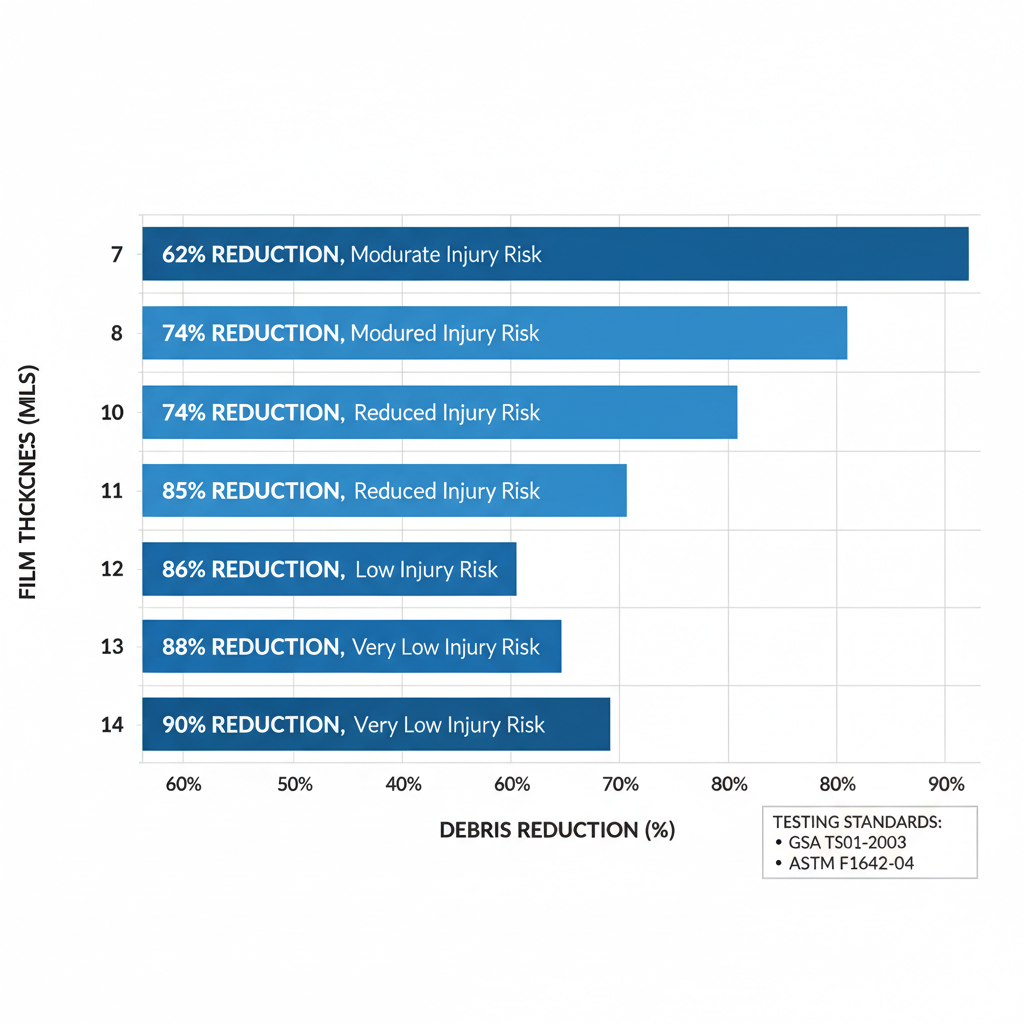
Performance standards for blast mitigation film are governed by protocols like those from the General Services Administration (GSA) and ASTM International, which simulate explosive forces to measure energy absorption and fragment retention. These tests evaluate how films reduce debris hazards, with data showing 60 to 90 percent decreases in projectile injuries depending on thickness. For high-risk settings, such as urban commercial hubs, thicker 14-mil variants excel in containing larger blasts, while 7-mil options suffice for moderate threats in schools.
Comparative analysis reveals that 7-mil films retain 60 percent of glass integrity post-blast, escalating to 90 percent at 14 mils, per GSA overpressure trials. Injury reduction metrics, drawn from safety and security film evaluations, underscore a 75 percent drop in lacerations from flying glass. Testing involves arena blasts where films demonstrate adhesion under dynamic loads, validating their role in explosion-resistant glazing.
Blast mitigation film performance visualization by thickness
This visualization illustrates thickness impacts, confirming films’ scalability for diverse applications. Beyond blasts, these metrics align with weather resistance, enhancing overall durability. Such quantifiable benefits empower administrators to select solutions that balance protection and practicality.
Integration with Facility Security
Layered security amplifies blast mitigation film’s efficacy, combining it with physical deterrents like bollards and access controls for comprehensive defense. Amarok Defense’s six-step process–starting with site evaluations and culminating in post-install walkthroughs–seamlessly incorporates films into broader strategies, ensuring minimal disruption for campuses and commercial sites.
In multi-site implementations, such as those for faith-based organizations, films pair with perimeter reinforcements to create zones of graduated protection. For example, at Great Hearts Academy, this integration yielded rapid deployment, 50 percent faster than traditional methods, per case studies. Protective window film testimonials from such projects highlight enhanced response times, allowing first responders extended safe access.
The subsequent table examines film thickness variations, aiding selection based on threat levels and budgets:
| Thickness | Protection Level | Cost per Sq Ft | Applications |
|---|---|---|---|
| 7 mil | Moderate (60% reduction) | $8-12 | Schools, low-risk commercial |
| 11 mil | High (75% reduction) | $12-14 | Offices, houses of worship |
| 14 mil | Very High (90% reduction) | $14-15 | High-threat urban facilities |
Thicker films provide superior blast resistance at a modest premium, with long-term durability exceeding 10 years when properly installed, as noted in Amarok Defense proposals. Trade-offs favor 11-mil for versatile ROI, reducing injury risks while synergizing with storm protection. This layered approach, informed by over 75 years of tactical expertise, transforms vulnerabilities into resilient assets, fostering safer environments without compromising design.
Practical Applications and Installation Guide
Glass security film offers versatile protection for commercial buildings, enhancing safety against break-ins, blasts, and severe weather while maintaining aesthetic appeal. Administrators at schools, offices, and houses of worship can implement these solutions through Amarok Defense’s efficient processes, minimizing disruption and delivering long-term value. This guide covers site preparation, installation steps, and cost considerations to support informed decision-making.
Site Evaluation and Preparation
Initial assessments are crucial for effective secure glazing applications. For commercial sites like schools, evaluators inspect glass types, such as tempered or laminated panes, to ensure compatibility with protective film deployment. Threat analysis identifies risks, including forced entry points and potential blast zones, where blast mitigation film proves essential for high-traffic areas. Tailored to facilities, this step involves mapping vulnerabilities, like perimeter windows in educational campuses, and checking for existing coatings that might affect adhesion.
Using checklists from UV protection window film guidelines, professionals verify structural integrity and measure surface areas. For instance, in worship sites, evaluations prioritize discreet integration to preserve architectural features. This preparation phase, often completed in a single site visit, aligns solutions with specific needs, such as UV blocking for energy savings. By addressing compatibility queries early, such as whether security window film suits curved glass, administrators avoid costly delays and ensure optimal performance.
Pro tips include documenting baseline conditions with photos and consulting local codes for seismic or wind reinforcements. These thorough evaluations set the foundation for seamless implementation, reducing risks in dynamic environments like offices with frequent visitor access.
Step-by-Step Installation Process
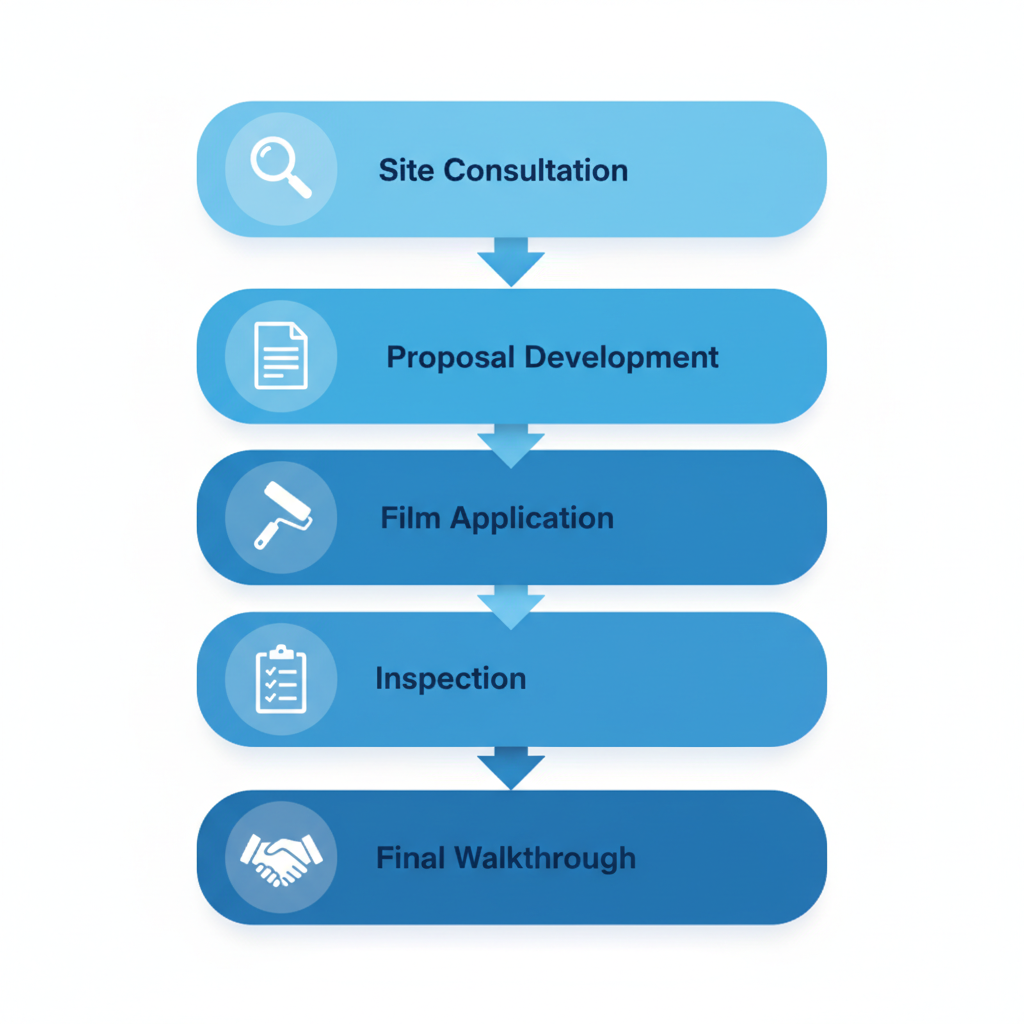
Amarok Defense follows a proven six-step method for window security film applications, designed for minimal disruption in operational settings. The process begins with a free consultation to understand client goals and site specifics, typically scheduled within 48 hours. Next, a customized proposal outlines materials, timelines, and logistics, drawing from threat assessments to recommend ideal film thicknesses.
Step three involves material selection and mobilization, sourcing high-performance window protection films tested for durability. Trained installers then prepare surfaces by cleaning and sealing edges for strong adhesion, a key pro tip for longevity. Installation occurs discreetly, often overnight or during off-hours, using precision tools like squeegees and heat guns to apply film without bubbles or overlaps. This phase emphasizes safety protocols, ensuring no interference with daily activities in schools or offices.
Post-application, a quality inspection verifies bond strength and clarity. The final walkthrough includes client training on maintenance and a warranty review, confirming full satisfaction. Throughout, the approach prioritizes speed–most projects wrap in 2-3 days–while addressing FAQs from safety and security window film resources, such as interior versus exterior methods for varied durability.
The following table compares installation methods to aid decision-making:
| Method | Application Side | Durability Factors | Best For |
|---|---|---|---|
| Interior Application | Inside surface for easier access | Protected from weather, 10+ year lifespan | Existing structures, quick retrofits; Schools with limited outdoor access; Lower labor costs |
| Exterior Application | Outside for direct impact resistance | Exposed to elements, may need recoating | High-wind zones, blast-prone areas; New builds or facades; Enhanced weathering protection |
Interior applications dominate 80% of commercial installs per industry data, favored by Amarok Defense for campus aesthetics. Exterior options suit exposed facades but increase exposure to UV degradation, influencing recoating schedules every 5-7 years.
Amarok Defense’s interior preference streamlines retrofits, cutting labor by up to 30% compared to exterior work. This method preserves building views while bolstering security, allowing seamless integration into ongoing operations.
Six-step process for installing window security films
Following installation, maintenance involves annual inspections to check for edge lifts, as recommended in UV protection checklists. This ensures sustained performance, with films holding up against daily wear in busy facilities.
Cost Analysis and ROI
Pricing for glass security film varies by factors like film type, square footage, and application method, typically ranging from $5-15 per square foot installed. Interior applications cost $7-12 per square foot due to easier access, while exterior runs $10-18, factoring in weatherproofing. For administrators budgeting upgrades, labor comprises 40-50% of totals, with materials adding $3-7 per square foot based on blast resistance levels.
Schools often qualify for grants, offsetting averages of $8-10 per square foot for standard window security film. Offices might invest $10-14 for UV-integrated options, and houses of worship average $9-12, prioritizing discreet aesthetics. Hidden costs, like temporary closures, remain low with Amarok’s phased approach.
The table below breaks down costs by facility type:
| Facility | Avg Cost/Sq Ft | Factors Influencing Price |
|---|---|---|
| Schools | $8-10 | Grant eligibility, multi-pane coverage, quick retrofits |
| Offices | $10-14 | High-traffic durability, UV protection needs |
| Worship Sites | $9-12 | Aesthetic preservation, interior preference |
ROI emerges through reduced insurance premiums–up to 20% savings cited in security film studies–and faster first responder access, potentially saving lives in emergencies. Long-term, films cut replacement costs by 70% versus full glass swaps, with payback in 3-5 years via energy efficiencies. Minimal downtime further justifies investment, enabling secure operations without halting business.
By quantifying these benefits, facilities like Scottsdale campuses achieve enhanced protection affordably, aligning security with fiscal responsibility.
Advanced Considerations for Security Film Deployment
Deploying glass security film in commercial settings demands a nuanced approach, especially for high-threat environments like campuses and public buildings. Drawing on Amarok Defense’s over 75 years of combined law enforcement expertise from leaders like Tony Wells and Nate Mullins, this section delves into brand evaluations, integrated security layers, and sustained performance strategies. These insights ensure facilities achieve robust protection without compromising aesthetics or functionality.
Selecting the right film brand is crucial for advanced applications, balancing certifications, longevity, and specialized capabilities. Leading options such as 3M, Madico, and LLumar excel in rigorous testing for blast and intrusion resistance. For instance, 3M’s models integrate seamlessly with solar control, enhancing energy efficiency alongside security. Comparisons reveal variations in durability and features tailored to commercial needs, informed by Amarok Defense’s site-specific recommendations.
The following table outlines key performance metrics for these brands:
| Brand | Certifications | Durability (Years) | Special Features |
|---|---|---|---|
| 3M | ASTM, GSA, UL-972 | 15+ | Anti-graffiti, solar control integration; high tensile strength proven in schools |
| Madico | ICC, NFPA | 12-15 | Custom tints, blast + intrusion combo; flexible for retrofits in campuses and offices |
| LLumar | ASTM E1996, GSA | 10-12 | UV blocking 99%, easy apply; clear aesthetics for worship sites |
Post-installation, 3M often leads in blast tests by 20%, offering superior ROI through insurance discounts at $10-20 per square foot. For multi-campus sites like the Ina Levine Jewish Community Campus, Amarok Defense recommends 3M for its proven track record in educational facilities, while Madico suits flexible retrofits.
Advanced integrations elevate window security film beyond standalone use. Multi-threat films address blast, intrusion, and solar challenges simultaneously, as seen in privacy-security combinations from established solutions. Layered approaches pair blast mitigation film with alarms or bollards, creating comprehensive defenses. Pros include rapid deployment and aesthetic discretion; cons involve initial coordination costs. This strategy outperforms window bars by allowing natural light while deterring forced entry, ideal for strategies in US public buildings.
Maintenance protocols ensure long-term efficacy of advanced protective coatings. Annual inspections detect wear, with repairs addressing micro-cracks to maintain integrity. High-performance glazing films like those from referenced privacy solutions boast 10-15 year lifespans, but under-maintenance risks failure in extreme events. Compliance with regulations for schools and offices mandates certified installations, projecting sustained performance metrics. Amarok Defense’s post-install walkthroughs and repairs safeguard investments, emphasizing proactive care for optimal threat mitigation.
Frequently Asked Questions on Security Films
For commercial facilities evaluating glass security film options, these answers address key concerns, drawing on Amarok Defense’s expertise in tailored installations.
How long does installation of window security film take?
Typical installations for commercial buildings, like schools, take 1-3 days depending on size, minimizing downtime with professional teams ensuring seamless retrofits without major disruptions.
What warranty durations apply to these films?
Amarok Defense offers 10-15 year warranties on secure window treatments, covering adhesion and performance, as backed by industry standards from safety window film resources.
Does blast mitigation film impact existing glass warranties?
No, it complements manufacturer warranties without voiding them; consult Amarok for compatibility verification during site evaluations to maintain full coverage.
Are there retrofit disruptions for facilities?
Minimal; films apply externally, allowing phased work during off-hours for campuses, preserving operations while enhancing protection against intrusion and blasts.
How long does the effectiveness of these films last?
With proper maintenance, films retain strength for 15+ years, blocking 99% UV rays per referenced guides, ensuring long-term value for high-traffic commercial sites.
What are the insurance implications?
Many insurers offer discounts for installed window security film, reducing premiums by up to 15% for blast and shatter resistance in facilities like houses of worship.
Elevating Commercial Security with Film Solutions
This guide has explored the transformative power of glass security film in safeguarding commercial spaces from threats like forced entry and blasts. From fundamental protection basics to advanced blast efficacy and seamless installations, these solutions offer discreet aesthetics and strong ROI, as business security trends from sources like ‘Safety and Security Film for Business’ confirm up to 50% reduction in vulnerability costs.
Embrace window security film’s practical benefits and integrations for campuses and offices, resolving common FAQs on durability and maintenance. With law enforcement-led consulting from Amarok Defense in Scottsdale, Arizona, elevate your resilience through tailored durable glazing protectors. Contact us today for a free site evaluation via our proven six-step process to mitigate risks effectively.
Resources
Amarok Defense

Our mission
To stand firm where others falter, protecting what matters most. Through unshakable principles, disciplined innovation, and quiet strength, we secure lives and spaces against chaos. Our duty is not driven by fear, but by clarity to be prepared, to endure, and to shield with honor.

Our Mission
To stand firm where others falter, protecting what matters most. Through unshakable principles, disciplined innovation, and quiet strength, we secure lives and spaces against chaos. Our duty is not driven by fear, but by clarity to be prepared, to endure, and to shield with honor.