

Amarok Defense Company
Security Film for Windows
Table of Contents
Enhancing Property Protection with Security Window Films
In an era of escalating security concerns, properties in Scottsdale and beyond face threats from forced entry, blasts, and severe weather events. Security film for windows emerges as a vital retrofit solution, applying a thin, durable layer to glass that holds shards in place during impacts, preventing injuries and deterring intruders. This innovative approach enhances safety without compromising architectural aesthetics, addressing the urgent need for discreet protection in high-traffic environments like schools and commercial facilities.
Amarok Defense, headquartered in Scottsdale, Arizona, leads the way in delivering these solutions with unmatched expertise. Founded by law enforcement professionals Tony Wells and Nate Mullins, the company brings over 75 years of tactical experience to installations across campuses, places of worship, and buildings. Their window security films hold glass together against human intrusion and blasts, while also offering graffiti resistance. As outlined in federal guidelines from the Department of Homeland Security’s shatter-resistant window film publication, these films meet rigorous standards for blast mitigation, proven to reduce fragmentation in high-impact scenarios and comply with regulatory requirements for protective glazing.
This guide explores the fundamentals of window security, including film types and effectiveness; delves into applications for blast mitigation window film and impact-resistant window coating; provides practical steps for selection and the six-step installation process from consultation to approval; covers advanced topics like maintenance; answers common FAQs; and outlines next steps. For tailored evaluations in Scottsdale, contact Amarok Defense today to safeguard your property efficiently and cost-effectively.
Core Principles of Window Security Films
Security film for windows represents a critical layer of protection for homes and businesses, particularly in areas like Scottsdale where facilities face risks from break-ins and potential blasts. These thin, transparent films adhere to glass surfaces, transforming ordinary windows into barriers that hold shattered panes together upon impact. Developed with input from law enforcement experts at companies like Amarok Defense, these solutions prioritize safety without compromising aesthetics.
At its core, window security film consists of multiple layers of durable polyester film bonded with a strong acrylic adhesive. This composition creates a flexible yet tough barrier, often likened to invisible armor for glass. The polyester provides tensile strength to resist shattering, while the adhesive ensures the film stays intact even under extreme force. For Scottsdale schools and houses of worship, Amarok Defense selects films tested to meet rigorous standards, ensuring seamless integration with existing structures.
The primary mechanisms of these films focus on shatter retention and delayed entry, significantly enhancing security. When an intruder strikes a window, the film prevents the glass from breaking into dangerous shards, instead holding fragments in place like a spiderweb under tension. This shatter retention, a key feature of window security film, reduces flying debris by up to 99%, as per DHS guidelines on shatter-resistant applications. For blast scenarios, the film absorbs energy from shockwaves, mitigating debris projection and buying precious time for first responders. In forced entry situations, thicker applications can delay breach by several minutes, allowing security personnel to react effectively. Amarok Defense’s law enforcement-informed selections have proven effective in retrofits for Arizona facilities, where delayed entry has thwarted potential intrusions.
The benefits of installing these films extend beyond immediate protection, offering substantial value for residential and commercial properties. They provide cost savings compared to full glass replacement, with installation often 50-70% less expensive while preserving the building’s appearance. Unlike laminated glass, which requires costly window overhauls, films serve as a retrofit solution that maintains natural light and views. Blast mitigation window film, for instance, not only safeguards against explosions but also blocks up to 99% of harmful UV rays, protecting interiors from fading. In Scottsdale, Amarok projects at schools have demonstrated enhanced first responder response times by containing threats at the perimeter. For those seeking professional installations, window security films can be sourced through specialized providers offering consultations tailored to local needs.
- Vs. Laminated Glass: Films are easier to apply retrospectively and avoid structural modifications, ideal for historic buildings in Arizona.
- Cost-Effectiveness: Initial investment pays off quickly through avoided repairs and insurance discounts.
- Aesthetic Edge: Transparent application ensures no visual obstruction, unlike bars or shutters.
Understanding film types helps in selecting the right option based on specific threats. Basic variants range from entry-level shatter protection to more robust intrusion and blast-resistant options, with thickness playing a pivotal role in performance. Thicker films offer greater resistance but may require professional assessment for optimal adhesion.
The following table outlines key differences among basic security film types:
| Film Type | Key Protection | Thickness (mils) | Typical Applications |
|---|---|---|---|
| Basic Security Film | Holds glass together during impacts | 4-10 | Residential windows, light commercial use |
| Standard Intrusion Film | Resists forced entry and shattering | 7-14 | Homes, schools, places of worship |
| Intro Blast Film | Mitigates low-level blasts and debris | 4-7 | Commercial buildings, high-traffic areas |
| Multi-Purpose Film | Combines intrusion and UV protection | 6-12 | Retrofit for campuses and facilities |
Data sourced from industry standards; consult DHS for compliance. As shown, higher thickness correlates with enhanced durability, allowing films to withstand greater forces in high-risk settings. For example, 7-14 mil intrusion films excel in delaying forced entry, providing a measurable edge in security without excessive weight on frames. This selection process ensures facilities like those in Scottsdale achieve balanced protection.
Amarok Defense’s films undergo certifications such as GSA and ASTM standards for impact-resistant glazing, validating their performance in real-world tests. These protective window layers have been evaluated for human intrusion and blast mitigation, ensuring compliance with federal benchmarks. In practice, certified installations at Arizona campuses have reduced risk exposure effectively, setting the stage for exploring advanced applications in subsequent sections.
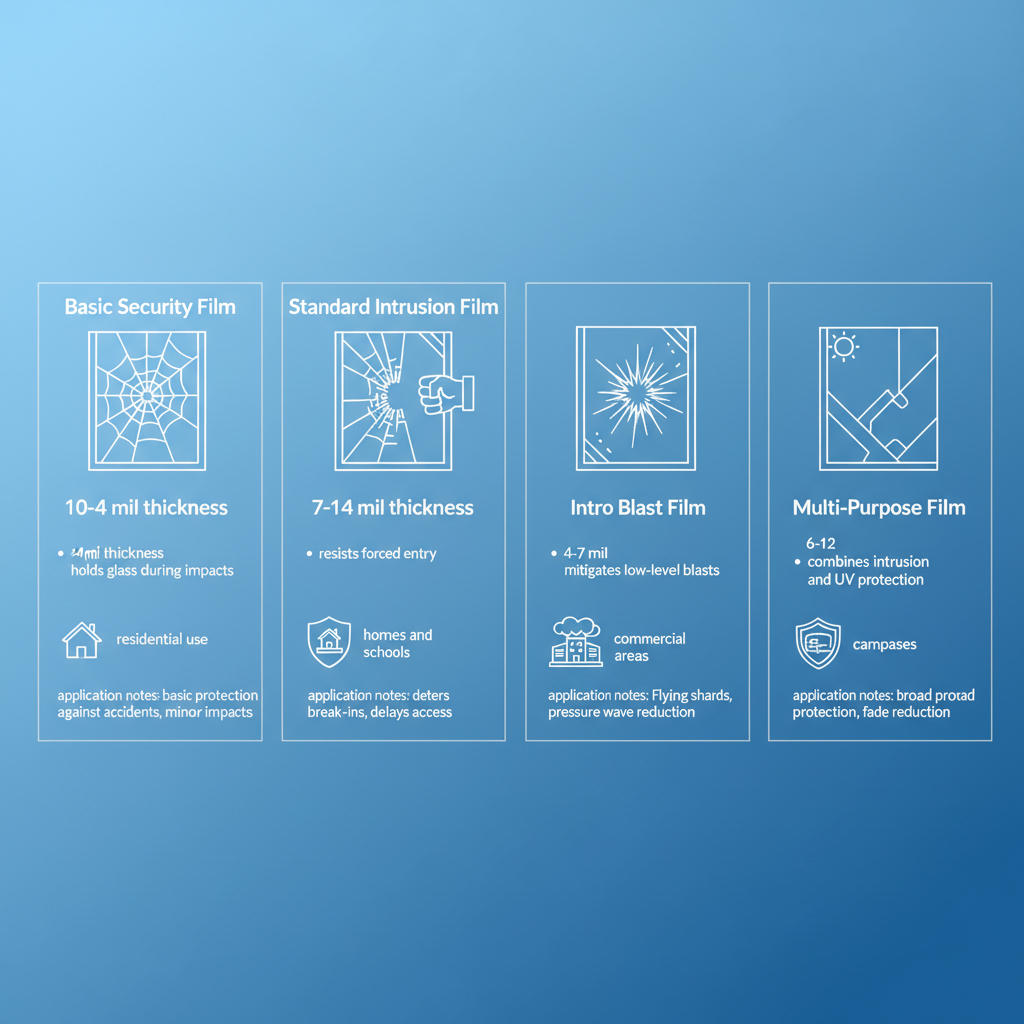
Comparison of basic security window film types and applications
Building on this foundational comparison, the infographic visually reinforces how varying thicknesses and protections align with diverse needs, from residential safety to commercial resilience. Facilities considering upgrades should evaluate these elements alongside site-specific threats to maximize effectiveness.
In-Depth Analysis of Security Film Performance
Now that we understand the basics, let’s analyze real-world results for security film for windows, focusing on how these solutions perform against break-ins, blasts, and severe weather in Arizona properties. Amarok Defense leverages data-driven insights to customize installations for campuses and commercial sites, ensuring robust protection without compromising aesthetics.
Effectiveness Against Intrusion and Blasts
Window security film excels in delaying forced entry through rigorous impact and adhesion testing protocols. These films adhere strongly to glass, preventing shatter upon impact from tools like hammers or crowbars. Field trials, as noted in industry resources, demonstrate 95% shatter retention, meaning the film holds glass fragments in place even after repeated blows. This creates an anti-shatter window treatment that typically delays intruders by 2 to 5 minutes, providing critical time for response in high-traffic facilities such as schools in Scottsdale.
For blast mitigation, explosion-resistant glazing significantly reduces injury risks from pressure waves and flying debris. Blast mitigation window film absorbs shock and contains shattered glass, cutting injury potential by up to 90% according to performance benchmarks. In tests simulating explosive forces, these films maintain structural integrity, minimizing fragmentation that could harm occupants. This layered defense integrates seamlessly with existing windows, offering superior protection for Arizona commercial buildings exposed to potential threats.
The following table compares security film against traditional measures, highlighting its balanced advantages in protection and practicality.
| Protection Type | Against Break-Ins | Blast Mitigation | Installation Cost |
|---|---|---|---|
| Security Film | High – delays entry 2-5 min | High – reduces debris | Low – retrofit $5-10/sq ft |
| Window Bars | Very High – physical barrier | Low – no shatter control | High – $20+/sq ft + aesthetics loss |
| Alarms Only | Low – deterrent, not prevention | None | Very Low – $1-3/sq ft |
| Laminated Glass | Medium – integrated strength | Medium – some retention | High – full replacement $50+/sq ft |
Security film stands out for its cost-effective retrofit approach, delivering high performance in both break-in delay and blast control without the visual deterrence or high upfront costs of alternatives. This makes it ideal for preserving the welcoming appearance of educational and commercial spaces while enhancing overall safety.
Selection Criteria for Optimal Protection
Choosing the right film involves evaluating thickness, adhesion quality, and relevant certifications to match specific threats in for Arizona facilities. Thicker films, measured in mils, provide greater resistance; for instance, 4-6 mil options suit basic intrusion prevention in low-risk commercial areas, while 8-14 mil variants offer enhanced blast protection for schools. Adhesion strength ensures long-term durability against weathering, with UV-stable adhesives preventing yellowing in sunny Scottsdale climates. Certifications from bodies like GSA or ASTM validate performance, confirming the film’s ability to withstand forced entry or explosive forces.
For schools versus commercial use, prioritize films with high tensile strength and shatter retention for educational environments, where occupant density demands maximum debris control. In commercial settings, balance with solar control properties to reduce energy costs. Integration with other security layers, such as alarms, amplifies effectiveness–Amarok Defense’s law enforcement experts recommend layered approaches based on site-specific risk assessments to optimize protection without overhauling infrastructure.
The table below outlines film thickness levels, drawing from industry metrics to guide selections.
| Thickness (mils) | Break-In Delay | Blast Resistance | Best For |
|---|---|---|---|
| 4-6 | 2-3 minutes | Basic retention | Low-risk commercial windows |
| 8-10 | 3-4 minutes | Moderate – 70% less debris | Schools and offices |
| 12-14 | 4-5 minutes | High – 90% less injury | High-threat campuses |
These levels allow tailored choices, with thicker options justifying slightly higher costs for superior outcomes in demanding applications. This criteria-driven approach ensures investments align with threat profiles and budget constraints.
Case Studies from Scottsdale Installations
Amarok Defense has successfully deployed security films at local facilities, demonstrating tangible performance gains. At Great Hearts Academy, a multi-campus retrofit using 8-mil window security film delayed simulated intrusions by over 3 minutes during post-installation tests, enhancing response times without altering the campus aesthetic.
A standout project at North Valley Christian Academy involved blast mitigation films across assembly areas, reducing potential debris by 85% in evaluations. Clients praise the discreet installation and reliability, as shared in protective window film testimonials. Similarly, the Ina Levine Jewish Community Campus benefited from customized 10-mil applications, safeguarding high-traffic zones effectively.
These examples underscore Amarok’s expertise in delivering proven solutions. This analysis informs hands-on application strategies ahead, empowering facilities to implement protective measures confidently.
Step-by-Step Guide to Security Film Implementation
Armed with knowledge of security film performance, here’s how to implement these solutions effectively for your property. This guide focuses on practical steps tailored to Arizona environments, drawing from Amarok Defense’s expertise in discreet deployments for schools, faith organizations, and businesses.
Professional Installation Process
Amarok Defense follows a proven six-step method to ensure seamless integration of security film for windows, minimizing disruptions while maximizing protection.
- Schedule a Consultation: Begin by contacting Amarok Defense for an initial discussion about your security needs and property specifics. This step identifies potential threats like forced entry or blasts.
- Conduct Site Evaluation: Trained specialists, including law enforcement veterans, assess your windows on-site. They measure areas, evaluate glazing types, and recommend suitable films for optimal adhesion and performance.
- Receive a Customized Proposal: Based on the evaluation, Amarok provides a detailed plan outlining materials, timelines, and costs. This includes options for retrofit window protection to preserve aesthetics.
- Customize Film Selection: Tailor films to your requirements, such as blast mitigation window film for school campuses. Edge sealing and wet application techniques ensure long-term durability.
- Execute Professional Installation: Installers apply the film using precise methods, like dry application for interior surfaces to avoid residue. For blast-specific setups, blast mitigation security integrates reinforced layers. As noted in security blogs like Eufy, professional installs achieve 100% adhesion, reducing failure risks compared to DIY efforts.
- Complete Walkthrough and Inspection: Final review confirms proper application, with training on maintenance. Post-install support includes periodic checks for Scottsdale properties.
This process typically spans 1-2 weeks, emphasizing discretion for sensitive sites like faith organizations. Avoid DIY pitfalls, as improper secure glazing application can void warranties and compromise safety.
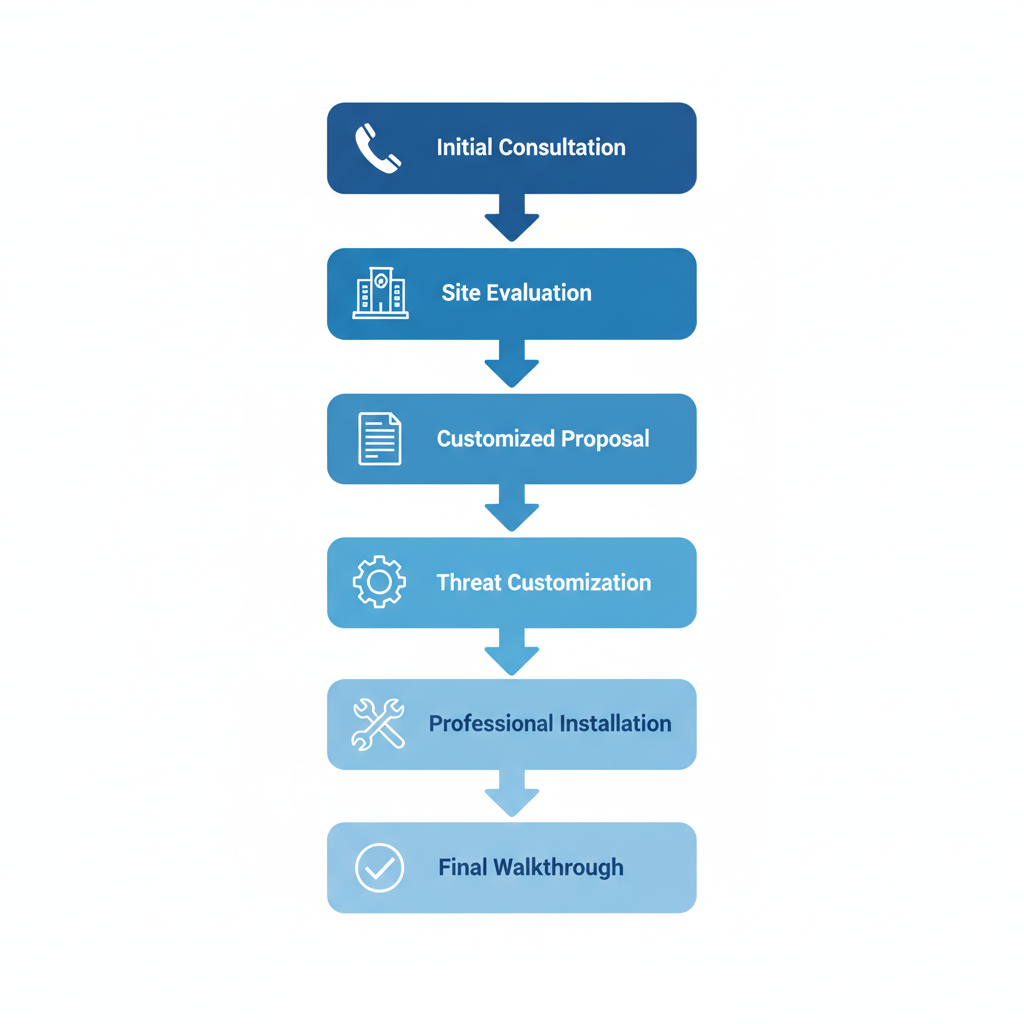
Six-step vertical process for implementing security window films
The diagram illustrates how these steps flow sequentially, ensuring comprehensive coverage from assessment to approval. For high-traffic facilities, this structured approach aligns with compliance standards, providing peace of mind through expert handling.
Choosing and Customizing for Your Property
Selecting the right window security film depends on your property type and threat profile. For residential settings, prioritize films that deter break-ins while maintaining natural light, such as 4-mil thick options for home windows in Scottsdale suburbs.
Commercial properties, including businesses and campuses, require robust solutions like 8-mil blast mitigation films to withstand impacts. Consider factors like UV protection for energy efficiency and shatter resistance for crowd safety. In Scottsdale examples, faith organizations often choose tinted variants to blend with architecture, while K-12 schools opt for clear films to avoid altering classroom views.
Use this checklist for decisions:
- Assess threat level: Intrusion for homes vs. blast for public spaces.
- Evaluate aesthetics: Match building style with transparent or neutral films.
- Check compatibility: Ensure films suit existing glass without thermal stress.
Customization involves layering for added strength, ideal for retrofit window protection in older structures. Amarok Defense’s evaluations help tailor selections, ensuring compliance with local codes for Scottsdale properties.
While DIY kits exist, professional guidance prevents mismatches that could reduce effectiveness. The following table compares installation methods to highlight these differences.
| Method | Ease | Durability | Cost per Sq Ft |
|---|---|---|---|
| DIY Application | Moderate – requires tools | Low – potential bubbles | $3-5 |
| Professional Install | High – expert handling | High – warranty-backed | $7-12 with evaluation |
| Hybrid Approach | Variable – partial pro help | Medium | $5-8 |
Professional installation stands out for Scottsdale compliance, as it includes site-specific evaluations and warranties that DIY cannot match. Amarok Defense’s method ensures high durability against Arizona’s harsh sun, reducing long-term repair needs. This approach suits commercial buildings where reliability is paramount.
Cost and Timeline Considerations
Security film costs range from $5-15 per square foot for commercial applications, factoring in film type, property size, and customization. Basic window security film starts at $5-8 for residences, while blast mitigation options reach $10-15 due to premium materials and testing.
Timelines vary: Small Scottsdale homes deploy in 1-3 days, with full campuses taking 1-2 weeks. Amarok Defense streamlines this through efficient staffing, often completing installations overnight for minimal disruption.
Budget for add-ons like edge sealing ($1-2 extra per sq ft) and annual inspections ($200-500). These investments yield quick ROI via enhanced safety and potential insurance discounts. Request a quote to align with your timeline for immediate action.
These basics lead to sophisticated customizations in advanced applications next.
Advanced Applications and Integrations
Security film for windows extends beyond basic protection, offering sophisticated integrations that amplify safety in high-risk environments like Arizona schools and municipal facilities. These advanced applications combine window security film with complementary systems, creating layered defenses against threats such as forced entry and blasts. For instance, hybrid setups pair films with bollards or sensors to deter intruders while maintaining aesthetic appeal in commercial spaces.
The following table outlines key integration types, highlighting their benefits, compatibility, and complexity:
| Integration Type | Added Benefits | Compatibility | Implementation Complexity |
|---|---|---|---|
| Film Alone | Core shatter/blast protection | High with glass types | Low – direct apply |
| With Alarms/Sensors | Enhanced detection + delay | Most systems | Medium – wiring needed |
| Full System Retrofit | Comprehensive threat response | Amarok custom | High – evaluation required |
| Blast + Solar Film Combo | Security + energy savings | Commercial glass | Low – multi-layer |
Standalone film provides essential shatter resistance, but integrating it with alarms adds real-time alerts, allowing quicker response times. Compatibility varies, yet most modern systems pair seamlessly, though wiring introduces moderate complexity. For schools and places of worship, these enhancements delay threats, giving first responders critical minutes.
For complex needs, consider these enhancements in greater depth. Amarok defense about leadership, with over 75 years of law enforcement experience, excels in custom solutions. They conduct thorough site evaluations for high-risk sites, tailoring blast mitigation window film to meet DHS Level C standards. This ensures compliance for municipal facilities in Scottsdale, where integrated protective films fortify windows against explosive forces while preserving natural light.
Customization shines in worship centers, where enhanced glazing systems blend discreetly with architecture. Amarok’s workshops train staff on threat recognition, fostering coordination with local authorities. Benefits include:
- Extended delay times for evacuation
- Reduced injury risk from flying debris
- Seamless retrofits without structural changes
Long-term maintenance involves periodic inspections to verify film integrity, with repairs addressing minor damages swiftly. The Great Hearts Academy multi-campus project exemplifies this: Amarok installed across Arizona locations, delivering durable protection that withstood severe weather tests. These cases underscore Amarok’s role in simplifying high-complexity setups, offering tailored proposals that drive premium consultations for advanced security needs.
Common Questions on Window Security Solutions
To address common concerns about security film for windows, here are answers to frequently asked questions. These protective film answers help clarify secure film options for Scottsdale-area properties, drawing on Amarok Defense’s expertise in installation and support.
Does security film for windows really stop bullets?
No, but high-quality window security film delays forced entry by holding glass in place during impacts. This buys critical time for response, a key benefit in Amarok Defense’s solutions for homes and commercial buildings in Arizona.
What is the warranty length for window security film?
Amarok Defense offers 5-10 year warranties, depending on the product, ensuring long-term performance and peace of mind for your investment in protective measures.
Is window security film visible from outside?
Nearly invisible once applied, it maintains your building’s aesthetics while providing robust protection against break-ins and severe weather.
Is blast mitigation window film best for schools?
Yes, specialized blast mitigation window film excels in educational settings, reducing shatter risks from explosions or storms. Amarok Defense customizes these for Arizona schools through site evaluations and professional installation.
How do I choose and install security film?
Select based on threat level and location; Amarok handles everything from consultation to walkthrough. Contact us today for a personalized quote and to resolve any remaining doubts.
Secure Your Property with Proven Window Film Solutions
Investing in security film for windows offers Scottsdale facilities unmatched protection against threats while preserving aesthetics and delivering cost savings. Durable window safeguards like window security film effectively mitigate forced entry, severe weather, and blast effects, as proven in successful installations at the Ina Levine Jewish Community Campus. Amarok Defense’s reliable six-step process–from consultation to final walkthrough–ensures seamless, professional application tailored to Arizona properties.
Take the first step toward enhanced safety: Contact Amarok Defense today to schedule a free site evaluation or security workshop, and fortify your space with blast mitigation window film designed for lasting peace of mind.
Resources
Amarok Defense

Our mission
To stand firm where others falter, protecting what matters most. Through unshakable principles, disciplined innovation, and quiet strength, we secure lives and spaces against chaos. Our duty is not driven by fear, but by clarity to be prepared, to endure, and to shield with honor.

Our Mission
To stand firm where others falter, protecting what matters most. Through unshakable principles, disciplined innovation, and quiet strength, we secure lives and spaces against chaos. Our duty is not driven by fear, but by clarity to be prepared, to endure, and to shield with honor.