

Amarok Defense Company
Bulletproof Glass
Table of Contents
Bulletproof Glass Essentials
In an era of escalating security threats, protecting vulnerable spaces has become paramount for schools, commercial buildings, and houses of worship. Bulletproof glass emerges as a vital safeguard, offering discreet protection without altering architectural appeal. Amarok Defense, with its law enforcement-led expertise, specializes in retrofitting these solutions to fortify facilities across the US, ensuring safety integrates seamlessly into daily life.
Bulletproof glass, often termed bullet resistant glass or ballistic glass, is a multi-layered composite material engineered to withstand high-velocity impacts. Developed from early 20th-century laminates to today’s standards-compliant systems, it absorbs and dissipates projectile energy through interlayer deflection, much like a car’s suspension handling road shocks. As explained by HowStuffWorks, this process involves polycarbonate and glass layers that deform on impact, spreading force to prevent penetration and reduce spall, safeguarding occupants behind. Amarok Defense incorporates such ballistic resistant glazing alongside security films in window defense products window defense products, enhancing layered defenses for campuses and commercial properties. This guide explores its fundamentals, applications, and selection best practices to empower informed security choices.
From Amarok’s installations at educational campuses like North Valley Christian Academy, these impact-resistant window materials demonstrate real-world efficacy in maintaining aesthetics while bolstering resilience. Delving deeper into composition and mechanics will equip administrators and managers with the knowledge to evaluate options effectively, transforming potential vulnerabilities into fortified assets.
Fundamentals of Bulletproof Glass
In an era where active shooter incidents and forced entry threats dominate security concerns, understanding the fundamentals of Bulletproof Glass becomes essential for protecting vulnerable facilities like schools and houses of worship. This layered security material, often referred to as bullet resistant glass, prevents projectiles from penetrating by absorbing and dispersing their energy, offering a critical barrier that buys time for response. Amarok Defense leverages these principles in its comprehensive approach to safeguarding communities through expert evaluations and installations.
Bulletproof glass is constructed from multiple layers of glass plies bonded with flexible interlayers, such as polyvinyl butyral (PVB) or polycarbonate, creating a robust composite that enhances impact resistance. According to the Guide to Bullet-Resistant Glass Levels from TGlass, common materials include annealed or tempered glass for rigidity and polycarbonate sheets for flexibility, allowing the assembly to flex under stress without shattering. These ballistic protective glazing systems vary in thickness, typically from 0.75 to 1.5 inches for basic applications, ensuring clarity while providing foundational defense. Key components often listed as:
- Glass plies: Provide initial hardness to deform the projectile.
- PVB interlayers: Hold fragments together upon impact.
- Polycarbonate layers: Add ductility to absorb remaining energy.
This multi-layered design, akin to a football team’s layered defense where each player absorbs part of the offensive push, ensures that even if a bullet cracks the outer surface, the inner structure contains it effectively.
When selecting foundational types of bulletproof glass, facilities must consider everyday threats like handguns or low-velocity rifles, which demand balanced protection without compromising aesthetics or visibility. The following table outlines basic variants, drawing from UL 752 standards to highlight material compositions, resistance capabilities, and suitable uses for initial security planning.
| Type | Primary Materials | Basic Resistance Level | Typical Applications |
|---|---|---|---|
| Laminated Glass | Multiple glass layers bonded with PVB interlayer | Level 1 (Handgun): 9mm bullets at 1,245 fps | Residential and low-risk commercial windows: Schools entry points, office lobbies |
| Acrylic-Layered | Polycarbonate or acrylic sheets alternated with glass | Level 2-3 (Rifle low-velocity): .357 Magnum at 1,400 fps | Houses of worship, retail storefronts: Visible areas needing clarity and impact resistance |
| Composite Panels | Glass, polycarbonate, and acrylic hybrid | Level UL 752 1-3: Standard handgun and low rifle threats | Campus facilities, municipal buildings: Retrofit solutions preserving aesthetics |
Data sourced from UL 752 standards for resistance levels confirms that Level 1-3 configurations handle most initial threats effectively, with Amarok Defense recommending these for preliminary assessments in high-traffic environments. Installation costs vary by thickness, typically 1-1.5 inches for basic levels, emphasizing the need for professional consultation to align with specific site vulnerabilities.
Building on these foundational types, bulletproof glass functions through a sophisticated energy dissipation process. Upon impact, the outer glass layer cracks and deforms the bullet’s shape, while the ballistic glass interlayers stretch like a trampoline to absorb kinetic energy, converting it into heat and deformation rather than penetration. The Standards for Bulletproofing from US Bulletproofing detail testing protocols, requiring certified ammunition at velocities like 1,245 fps for 9mm rounds to validate performance. This containment prevents shards from becoming secondary projectiles, a key factor in maintaining safety during incidents. However, it’s worth noting that no bulletproof glass is truly impenetrable; higher threats may require thicker assemblies or advanced variants.
The UL 752 classification system standardizes bullet resistant glass protection, with Level 1 addressing handgun threats like 9mm and .44 Magnum, escalating to Level 8 for high-powered rifles such as .308 Winchester. These levels ensure consistent testing across materials, focusing on both ballistic and physical attack resistance. For most facilities, starting with Levels 1-3 provides adequate coverage against common risks, as validated by industry benchmarks.
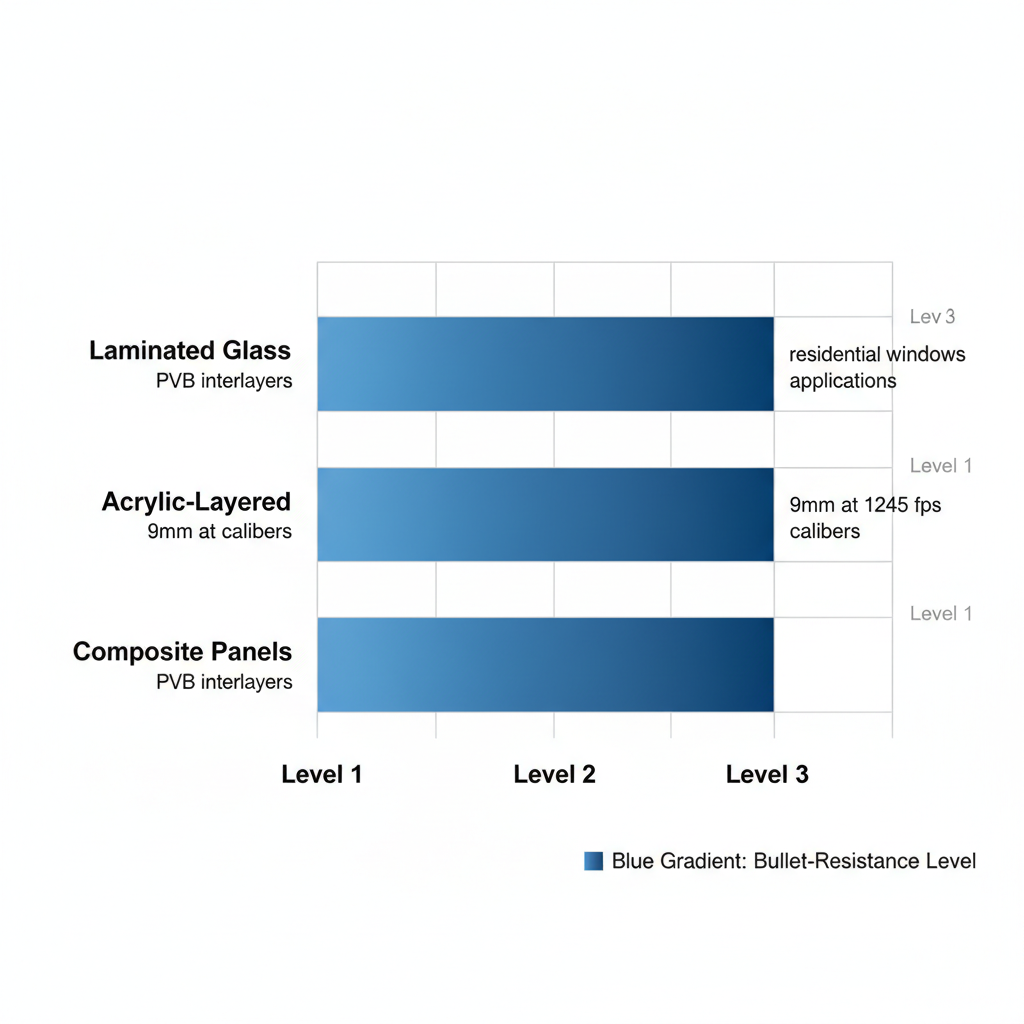
Comparison of basic bulletproof glass types and resistance levels
These fundamentals underscore the importance of tailored window protection solutions to address evolving threats, setting the stage for exploring advanced configurations and integration strategies in facility security.
In-Depth Analysis of Bulletproof Glass
Bulletproof glass represents a critical advancement in security glazing, offering layered protection against ballistic threats through engineered materials and rigorous testing. This section examines the composition, standards, and performance realities of these systems, highlighting how amarok defense about customizes solutions for campuses and commercial facilities to address specific vulnerabilities.
Layers and Materials in Bulletproof Glass
Bulletproof Glass typically consists of multiple layers of glass and interlayers designed to absorb and dissipate projectile energy. Polyvinyl butyral (PVB) serves as a primary interlayer, providing strong adhesion between glass panes while allowing flexibility to prevent shattering upon impact. For enhanced ductility, polycarbonate sheets are often integrated, offering superior resistance to penetration due to their high tensile strength and ability to deform without breaking.
These materials contribute to ballistic performance by creating multiple deformation zones that slow and stop bullets. Thinner configurations, around 3/4 inch, suit handgun threats, while thicker assemblies exceeding 2 inches handle rifle rounds. According to insights from security experts, five common types include monolithic polycarbonate for lightweight applications, glass-clad polycarbonate for balanced rigidity, and all-glass laminates with PVB for transparency. Hybrid setups, such as projectile-deflecting laminates combining PVB with polycarbonate, increase stopping power by distributing impact forces across layers, ensuring multi-hit resistant glazing maintains integrity in dynamic scenarios. Amarok Defense evaluates these combinations during site assessments to optimize for facility aesthetics and threat levels.
Protection Levels and Testing Standards
Protection levels for bulletproof and bullet resistant glass are governed by standards like UL 752 and NIJ 0108.01, which classify resistance based on caliber, velocity, and shot count. UL 752 Level 1 protects against 9mm full metal jacket rounds at 1,245 feet per second, suitable for low-threat environments, while Level 3 withstands .44 Magnum at 1,400 fps, ideal for rifle-equipped risks in educational settings. Higher tiers, such as Level 8, counter .30-06 armor-piercing ammunition at 2,750 fps, requiring robust constructions for high-security sites.
Testing involves certified labs firing velocity-calibrated rounds at panels, simulating real-world scenarios like close-range handgun assaults in offices or multi-shot barrages on school windows. NIJ standards emphasize single-hit focus for bullet resistant glass, contrasting with bulletproof variants designed for repeated impacts. Layering mechanics work by the outer glass cracking to absorb initial energy, interlayers deforming to capture fragments, and inner layers providing backup containment. Environmental factors, including UV degradation, are assessed to ensure long-term efficacy, with hybridization using security films adding shatter resistance. These classifications help facilities determine needs, such as Level 3 for campuses vulnerable to opportunistic threats.
Standard interpretations under UL 752 provide a benchmark for comparing protection across glazing types, ensuring consistent performance metrics for security integrators.
| Protection Level | Caliber/Velocity | Bulletproof Glass Thickness | Bullet Resistant Applications |
|---|---|---|---|
| UL Level 1 | 9mm FMJ at 1,245 fps | 3/4 inch min. | Handgun threats in offices; Commercial buildings, low-risk areas; Retrofit for quick deployment |
| UL Level 3 | .44 Magnum at 1,400 fps | 1-1/4 inches | Rifle protection for schools; Campuses, houses of worship; Layered with security films |
| UL Level 8 | .30-06 AP at 2,750 fps | 3+ inches | High-threat military/commercial; Specialized facilities; Custom Amarok Defense solutions |
This comparison underscores how thickness correlates with threat resistance, based on UL 752 and NIJ 0108.01 standards where panels endure at least three shots. For facility retrofits, Amarok Defense leverages this data to recommend optimal levels, balancing cost and protection; for instance, Level 1 upgrades in low-risk commercial spaces via security films enhance response times without full replacement, while Level 8 customizations safeguard high-value assets in specialized environments.
Myths and Realities of Ballistic Performance
A common misconception is that ballistic glass is fully shatterproof, rendering it invincible to all attacks; in reality, it deforms and cracks strategically to absorb energy, prioritizing containment over pristine appearance. Another myth claims single-hit resistance equates to unlimited durability, yet repeated impacts can compromise integrity, especially if spaced closely, as interlayers fatigue under successive stresses.
Environmental degradation, like UV exposure weakening PVB adhesion over time, further influences performance, necessitating periodic inspections by experts. Ballistic glass excels in controlled tests but varies in field conditions, such as angled shots reducing penetration risk. Amarok Defense addresses these realities through consultations that debunk oversimplifications, emphasizing factors like installation quality and maintenance. Multi-hit resistant glazing, for example, handles clustered threats better than basic laminates, but no system is impervious–hybrid solutions with security films mitigate risks like spalling. Understanding these nuances empowers informed decisions for durable protection in US commercial buildings and campuses.
Applying Bulletproof Glass in Real Scenarios
Bulletproof glass solutions transform theoretical security into tangible protection across diverse environments. By integrating advanced materials like layered polycarbonate and glass composites, facilities can achieve robust defense against threats while preserving functionality and aesthetics. This section explores real-world applications, highlighting how Amarok Defense’s expertise ensures efficient installations tailored to specific needs.
Bulletproof Glass for Educational Facilities
Educational institutions prioritize safety amid rising concerns over active threats, making bullet resistant glass a critical upgrade for schools. At North Valley Academy, a retrofit installation preserved expansive views through existing windows, enhancing security without altering the campus’s welcoming atmosphere. Compliance with OSHA and state regulations demands materials that withstand forced entry and ballistics, often starting with UL Level 3 protection for classrooms and administrative areas.
Retrofit challenges include minimizing disruptions during school hours, which Amarok Defense addresses through their six-step process: initial consultation, site evaluation, custom proposal, material selection, professional installation, and final walkthrough. Facility-specific ballistic shielding integrates seamlessly, using security films over standard glass to meet active threat protocols. Benefits include extended response time for law enforcement and reduced injury risk from shattering debris. Maintenance involves annual inspections to ensure film adhesion and clarity, costing around $50 per square foot for basic retrofits. These measures not only safeguard students and staff but also foster a sense of security in learning environments across the US.
Commercial and Vehicular Uses
In commercial settings, ballistic glass fortifies high-traffic areas like lobbies and storefronts against intrusion and blasts. Custom security glazing in office towers incorporates solar control layers, reducing energy costs by up to 20% while providing UL Level 1-3 resistance. For vehicles, such as armored transport fleets, thinner UL Level 2 panels emphasize lightweight polycarbonate to maintain mobility without compromising safety.
Integration with existing structures requires precise site evaluations to avoid operational downtime; Amarok Defense deploys trained teams for discreet nighttime installs. Vehicular applications, common for executive protection, involve specialized retrofits that balance weight and durability, with costs ranging from $5,000 to $15,000 per unit including labor. Maintenance protocols include quarterly checks for cracks and film integrity, ensuring long-term performance in dynamic conditions. These solutions deter threats effectively, from urban break-ins to high-speed pursuits, while enhancing overall property resilience.
Selecting the right bulletproof glass begins with assessing threat levels specific to schools, offices, or vehicles. The following table outlines practical applications, protection needs, and installation insights to guide informed choices.
| Facility Type | Recommended Level | Key Benefits | Installation Notes |
|---|---|---|---|
| Schools/Campuses | UL Level 3-4 | Forced entry and ballistic resistance | Retrofit films over existing glass, discreet aesthetics; 1-2 days per building with post-inspection |
| Commercial Buildings | UL Level 1-3 | Blast and intrusion protection | Solar control integration for energy savings; custom proposals with site evaluation, minimal disruption by trained installers |
| Vehicles | UL Level 2 (thinner for mobility) | Lightweight ballistic shielding | Polycarbonate emphasis for weight; specialized retrofit for fleet, $5k-15k per unit |
This comparison draws from UL standards and Amarok Defense case studies, emphasizing rapid deployment for schools and energy-efficient options for commercial sites. Labor costs vary from $50-100 per square foot, influenced by level and area.
Amarok Defense’s tailored evaluations ensure these applications align with unique facility demands, providing multi-campus expertise that minimizes costs and maximizes protection. For instance, their process includes threat modeling to recommend optimal levels, preventing over-investment in low-risk areas.
Transitioning from these overviews, visual aids clarify how levels correlate with benefits across scenarios. Such infographics aid administrators in communicating upgrades to stakeholders.
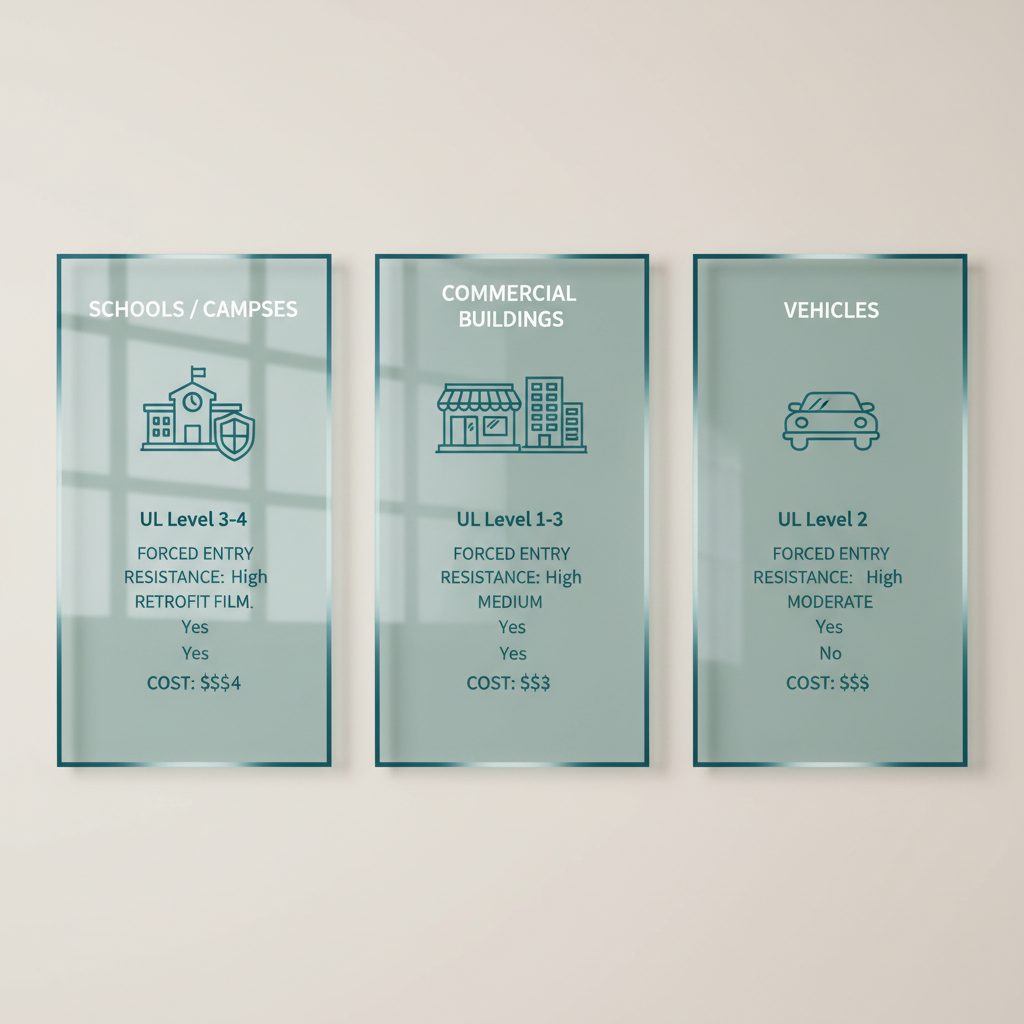
Bulletproof glass applications by facility type with security levels and benefits
Understanding these visuals underscores the versatility of solutions, paving the way for strategic planning in high-stakes environments.
Selection and Cost Considerations
Assessing needs starts with a threat assessment: identify potential risks like active shooters for schools or vandalism for commercial spaces. Reference guides like the TGlass resource on bullet-resistant levels help correlate thickness (e.g., 1-3 inches for UL 3) with material costs, informing budgets from $50-150 per square foot.
- Conduct site evaluation to measure areas and evaluate structures.
- Review UL ratings against local codes.
- Obtain customized quotes from specialists like Amarok Defense.
- Factor in labor, materials, and ongoing maintenance.
- Secure approvals and schedule discreet installation.
For security films contact tailored to your facility, reach out for a free consultation from their Scottsdale base, serving nationwide. Budgeting accounts for retrofit premiums in historic buildings, with total projects ranging $10,000-$100,000 depending on scale. This structured approach ensures cost-effective, compliant enhancements that prioritize safety and longevity.
Advanced Bulletproof Glass Strategies
Bulletproof Glass represents a critical layer in modern security, yet it has defined limits against advanced threats. While engineered to withstand initial high-velocity impacts from handguns or rifles, vulnerabilities emerge with sustained attacks, such as repeated shots from high-caliber firearms or blunt force from tools like sledgehammers. According to NIJ and UL extended testing standards, breakage typically requires prolonged exposure, weakening interlayers over time and potentially compromising integrity after multiple hits within a short window. These scenarios underscore the need for layered defenses in high-risk environments like campuses or commercial buildings, where first responders require extended time to intervene. Real risks involve not just ballistic threats but also environmental factors and installation flaws that accelerate degradation.
The following table outlines key factors affecting Bulletproof Glass durability, drawing from US Bulletproofing standards and Amarok Defense’s practical insights.
| Factor | Impact on Durability | Mitigation Strategy | Amarok Defense Approach |
|---|---|---|---|
| Repeated Impacts | Weakens interlayers over time | Level upgrade + spacing, Layered film reinforcements | Multi-hit testing in proposals, Post-install inspections |
| Environmental Exposure | UV/heat causes delamination | UV-resistant PVB, Solar control film integration | Annual maintenance plans, Trained staff evaluations |
| Installation Quality | Poor bonding leads to failure | Certified installers, Final walkthroughs | Six-step process documentation, Client approval checkpoints |
Amarok Defense leverages over 75 years of law enforcement insight to mitigate these risks through integrated solutions. By combining bullet resistant glass with intrusion films, facilities gain enhanced protection without aesthetic disruption, aligning with GSA and ASTM standards for federal compliance.
Advanced strategies focus on hybrid systems that extend response times for first responders. Consider these key tactics:
- Pair ballistic glass with security films for forced entry resistance, customizing thickness for specific threat models.
- Conduct site-specific risk assessments to tailor solutions, incorporating advanced ballistic laminates for multi-threat scenarios.
- Integrate durable security panels with solar control features, preserving functionality while boosting long-term performance through 10+ year testing protocols.
This approach, informed by Amarok’s retrofit expertise, addresses what can break bulletproof glass by emphasizing proactive layering over standalone reliance.
For certifications beyond UL 752, ballistic glass must meet rigorous GSA requirements for blast and ballistic resistance, ensuring reliability in critical infrastructure. Best practices include facility-specific enhancements like aesthetic customizations and staff training workshops, drawing from Amarok’s documented six-step process. Professionals recommend annual evaluations to maintain efficacy, with window film testimonials highlighting successful implementations at sites like North Valley Christian Academy. By modeling threats through conditional assessments, organizations can select optimal protection levels, fostering preparedness without unnecessary alarm.
Common Questions on Bulletproof Glass
What is bulletproof glass?
Bulletproof glass, often called bullet resistant glass, consists of multiple layers of glass and polycarbonate that absorb projectile energy on impact.
How does ballistic glass work?
Ballistic glass functions by deforming and distributing the force of bullets, preventing penetration while minimizing spalling, as explained in resources debunking myths about its impenetrability.
What are the protection levels for bullet resistant glass?
Levels range from UL 752 Level 1 for handguns to Level 8 for high-powered rifles, tailored to specific threats in schools or commercial settings.
Is bulletproof glass suitable for vehicles?
Yes, bullet resistant glass in vehicles provides discreet protection for high-risk transport, integrated via Amarok Defense’s retrofit processes.
How much does ballistic glass cost?
Costs typically range from $50 to $200 per square foot, depending on level and installation, with Amarok offering customized evaluations.
Can bulletproof glass break?
While highly durable, sustained fire or tools can eventually breach it; myths from ballistic glass resources clarify it’s resistant, not invincible.
What applications suit protective window systems?
Ideal for school retrofits, commercial buildings, and houses of worship; contact Amarok Defense for site-specific consultations to enhance security.
Enhancing Security with Bulletproof Glass
Bulletproof Glass stands as a cornerstone of modern security, offering layered protection through its engineered composition of polycarbonate and glass that absorbs impacts and prevents penetration. This bullet resistant glass excels in schools and commercial settings, where ballistic glass meets UL-level standards tailored via site assessments to balance transparency and defense.
Key benefits include deterring threats while preserving aesthetics, addressing limitations through layered secure glazing options for comprehensive risk reduction. Amarok Defense empowers facilities with expert installations, ensuring long-term safety and peace of mind.
Ready to fortify your space? Contact Amarok Defense today for a personalized consultation and elevate your security strategy.
Enhancing Security with Bulletproof Glass
Bulletproof Glass stands as a cornerstone of modern security, offering layered protection through its engineered composition of polycarbonate and glass that absorbs impacts and prevents penetration. This bullet resistant glass excels in schools and commercial settings, where ballistic glass meets UL-level standards tailored via site assessments to balance transparency and defense.
Key benefits include deterring threats while preserving aesthetics, addressing limitations through layered secure glazing options for comprehensive risk reduction. Amarok Defense empowers facilities with expert installations, ensuring long-term safety and peace of mind.
Ready to fortify your space? Contact Amarok Defense today for a personalized consultation and elevate your security strategy.
Resources
Amarok Defense

Our mission
To stand firm where others falter, protecting what matters most. Through unshakable principles, disciplined innovation, and quiet strength, we secure lives and spaces against chaos. Our duty is not driven by fear, but by clarity to be prepared, to endure, and to shield with honor.

Our Mission
To stand firm where others falter, protecting what matters most. Through unshakable principles, disciplined innovation, and quiet strength, we secure lives and spaces against chaos. Our duty is not driven by fear, but by clarity to be prepared, to endure, and to shield with honor.