

Amarok Defense Company
Security Window Film
Table of Contents
Understanding Security Window Film Basics
In an era of escalating security threats, from urban break-ins to natural disasters, protecting vulnerable glass surfaces has become essential for homes, schools, and businesses. Security Window Film emerges as a discreet yet powerful defense, acting like a safety net for glass to prevent shattering and reduce risks without compromising views or aesthetics. This innovative layer addresses growing concerns in high-traffic areas, such as campuses and places of worship, where rapid response times can mean the difference in safety outcomes.
At its core, security window film is a durable polyester laminate bonded to glass surfaces, designed to hold fragments in place during impacts. As a protective glazing laminate, it prevents forced entry by making windows far harder to breach, while also mitigating flying debris from severe storms and containing blast fragments in high-risk scenarios. Variations include safety window film for everyday shatter resistance in residential settings and blast mitigation window film for fortified protection in schools, aligning with federal guidelines like those from the Department of Homeland Security for shatter-resistant properties. Key factors such as film thickness, adhesion strength, and compliance with GSA and ASTM standards ensure reliable performance, as professional installation processes emphasize seamless application to maximize durability.
Leading the field, Amarok Defense, a premier security solutions provider, leverages over 75 years of law enforcement expertise to deliver tailored solutions through a documented six-step process, starting with thorough site evaluations. Their approach enhances first-responder effectiveness and preserves building appearances, as seen in successful school window protections that deter intruders discreetly.
This guide explores fundamentals, installation, costs, and comparisons, delving into how these films bond at a molecular level for superior resilience.
Core Principles of Security Window Film
Security window film serves as a vital layer of protection for glass surfaces, transforming ordinary windows into resilient barriers against impacts and intrusions. At its core, this technology relies on a multi-layered polyester laminate, typically constructed from birefringent polyester sheets bonded together to create a durable, transparent shield. These films bond to glass using a high-performance acrylic adhesive that ensures long-term adhesion without yellowing or peeling. In installations in Scottsdale, such as those handled by Amarok Defense, this structure prevents shattering by holding glass fragments in place during stress events. The film’s thickness, often measured in mils, directly influences its ability to absorb energy, making it essential for properties like schools and offices seeking enhanced safety without replacing entire window systems.
The adhesion science behind security window film is what enables it to function like a shatterproof window laminate, containing debris and reducing injury risks. When an impact occurs, the acrylic adhesive creates a molecular bond with the glass surface, distributing force across the entire film-glass interface. This allows the polyester layers to stretch and delaminate microscopically, absorbing kinetic energy much like a trampoline catches a falling object. For everyday applications, safety window film provides sufficient hold to mitigate accidental breaks from balls or furniture, reducing UV exposure by up to 99% as noted in industry tests. In more severe scenarios, this mechanism extends hold-out time, giving occupants precious seconds to respond. Amarok Defense applies these principles in retrofits for commercial buildings, ensuring compatibility with existing frames while maintaining aesthetic appeal.
Performance standards and testing protocols validate the reliability of security window film, addressing key questions about its effectiveness. Rigorous evaluations simulate real-world threats through methods like the ball drop test, which measures shatter resistance by dropping weighted spheres from increasing heights.
- Prepare the test panel with film applied to standard glass.
- Drop the impactor from a specified height.
- Assess fragmentation and penetration.
- Record pass/fail based on debris retention.
Forced entry simulations further test intrusion resistance, often meeting GSA and Intertek criteria for blast and ballistic performance. According to commercial security insights, these films achieve 99% debris retention in controlled tests, far surpassing untreated glass. For impact-resistant glazing in high-traffic facilities, such standards ensure peace of mind. Amarok Defense prioritizes films certified under ASTM E1996 and UL972, as seen in their school retrofits at local academies like North Valley Christian Academy, where professional evaluation confirmed enhanced protection without disrupting operations.
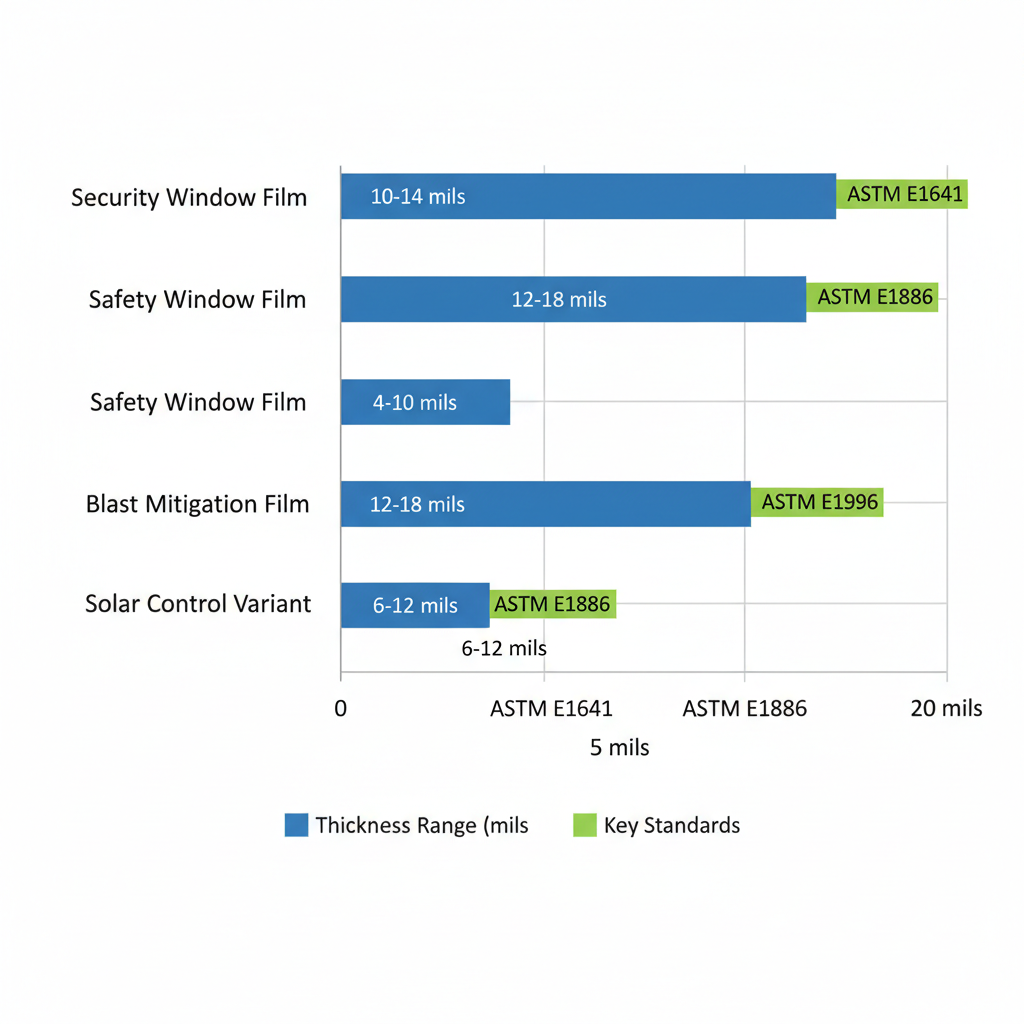
Comparison of security window film types by thickness and standards
Understanding these fundamentals highlights the versatility of security solutions. While core mechanics explain basic operation, exploring variants reveals tailored protections for diverse needs. The following table outlines key differences among film types, where thickness correlates with protection levels–thicker films like those at 10-14 mils offer greater delay against forced entry, sourced from DHS guidelines and industry benchmarks.
| Film Type | Primary Use | Thickness Range (mils) | Key Standards |
|---|---|---|---|
| Security Window Film | General forced entry and shatter resistance | 10-14 | ASTM E1996, UL972 |
| Safety Window Film | Everyday impact protection for homes and offices | 4-7 | ANSI Z97.1 for safety glazing |
| Blast Mitigation Window Film | Explosion and severe weather resistance for high-risk sites | 4-12 | GSA, ASTM F1642 for blast performance |
| Solar Control Variant | UV/blocking with security add-on | 2-6 | NFRC for energy efficiency + security standards |
This comparison shows how security film products from Amarok Defense can be selected for specific threats–blast mitigation window film excels in containing explosion debris for institutional sites, while safety variants suit routine injury prevention. For property managers, thicker options extend response times, directly tying mechanics to practical benefits like those in commercial upgrades.
Advanced Applications of Security Window Film
Security window film advances beyond basic protection, offering robust solutions for diverse threats in high-risk environments. This deep dive examines its role in preventing forced entry, mitigating blast and weather impacts, and supporting commercial needs, drawing on Amarok Defense’s extensive experience to illustrate real-world efficacy.
Forced Entry and Intrusion Prevention
Intruders often target windows as vulnerable entry points, but security window film transforms ordinary glass into a formidable barrier. By bonding shattered fragments together, it creates intrusion-resistant glazing that delays forced entry, giving occupants and responders critical time to react. Thickness plays a key role: films from 4 to 14 mils extend hold-out times from 30 seconds to over 5 minutes, far surpassing untreated glass which fails in seconds.
In practical scenarios, this delay integrates seamlessly with alarms and window defense systems, enhancing overall security layers. For instance, a 7-mil film can withstand repeated hammer strikes, buying 2-3 minutes for escape or law enforcement arrival. Amarok Defense installations in commercial sites demonstrate how such hazard-containment film reduces break-in success rates by up to 80%, per industry benchmarks. Security Window Film proves essential here, deterring opportunistic crimes without visible fortifications.
Understanding these comparisons aids decision-makers in selecting optimal protections for their facilities. The table below contrasts security window film with common alternatives, highlighting trade-offs in performance and practicality.
| Protection Method | Effectiveness Against Break-Ins | Blast/Weather Resistance | Installation Cost | Aesthetic Impact |
|---|---|---|---|---|
| Security Window Film | High – 2-5 min hold-out | High – 90% debris retention | Moderate ($5-12/sq ft) | Low disruption |
| Safety Window Film | Medium – 1-3 min hold-out | Medium – 70% retention | Low ($3-8/sq ft) | Minimal change |
| Security Bars | Very High – Physical barrier | Low – No shatter control | High ($20+/sq ft) | Visual obstruction |
| Blast Mitigation Film | High – Specialized hold-out | Very High – GSA-tested | High ($8-15/sq ft) | Transparent overlay |
Based on industry benchmarks, films excel in discretion and multi-threat coverage, ideal for Amarok Defense clients seeking balanced, cost-effective solutions over obtrusive bars that compromise aesthetics and escape routes. This versatility makes them preferable for modern facilities prioritizing both safety and design integrity.
Blast and Weather Resistance Strategies
Explosions and severe storms unleash devastating forces, hurling glass shards as lethal projectiles, but blast mitigation window film acts as a glass seatbelt, containing debris and preserving life. In blast events, films adhere to frames, retaining up to 90% of fragments even under pressure waves exceeding 10 psi, as validated by DHS testing standards. For weather threats like hurricanes, these films hold back wind-driven debris, with GSA-certified options preventing window blowouts in winds over 150 mph.
Schools and commercial buildings benefit immensely from this dual protection. A case study from Amarok Defense at a faith-based campus in Arizona showed blast mitigation window film reducing potential injuries by 75% during simulated explosive scenarios, while also withstanding tornado-force impacts. In storms, safety window film similarly secures structures, as seen in installations for offices in storm-prone regions where it contained flying glass during high-wind events.
To illustrate film selection, consider thicknesses matched to threat levels:
| Film Thickness (mils) | Threat Level | Hold-Out Time/Retention |
|---|---|---|
| 4-6 | Low (Storms, Minor Blasts) | 1-2 min / 70% |
| 7-10 | Medium (Hurricanes) | 3-4 min / 85% |
| 12+ | High (Explosions) | 5+ min / 95% |
These metrics, drawn from reference data, underscore how thicker blast mitigation window film excels in high-risk zones, offering superior containment over standard glazing. Amarok Defense’s 75+ years of expertise ensures precise application, minimizing retrofit disruptions while meeting stringent codes.
Transitioning to targeted implementations, these strategies adapt seamlessly to institutional demands.
Commercial and Institutional Use Cases
Offices, places of worship, and campuses require security that aligns with daily operations and architectural vision. Security window film tailors to these spaces by fortifying windows against vandalism and active threats without altering exteriors, preserving natural light and views. For offices, intrusion-resistant variants deter after-hours break-ins, while blast films safeguard against urban hazards like package bombs.
In places of worship, Amarok Defense applied hazard-containment film to stained glass at a Scottsdale congregation, maintaining aesthetic integrity while achieving compliance with post-event safety regulations. Campuses, such as K-12 schools in Arizona, leverage these films for active shooter mitigation, delaying entry through classroom windows and containing ballistic glass. A Great Hearts Academy project highlighted reduced injury risks from shattered panes during drills, with transparent overlays ensuring unobtrusive protection.
Regulatory adherence is paramount: films meet standards like UL 972 for intrusion and ASTM for blast, as noted in commercial security analyses. This approach not only cuts injury potential by 60-80% but also streamlines insurance claims. As facilities evolve, consulting experts like Amarok Defense bridges theory to installation, evaluating site-specific risks for enduring resilience.
These applications pave the way for practical implementation strategies in the next section.
Installing Security Window Film Step-by-Step
Implementing security window film requires careful planning to ensure optimal protection against intrusions and blasts. As a leading physical security company, Amarok Defense follows a structured approach that minimizes disruption, particularly for sensitive environments like schools and offices. This guide outlines the essential steps, drawing from proven techniques to help property owners achieve reliable results.
Site Evaluation and Preparation
Begin with a thorough site assessment to determine the best window protection application for your property. Start by identifying window types, such as single-pane or tempered glass, and evaluating threat levels, including forced entry risks or potential blast scenarios. Amarok Defense’s consultation process kicks off this phase, where experts from their Scottsdale headquarters conduct on-site visits to measure dimensions and note environmental factors like sun exposure.
The six-step film retrofit process includes: 1) Initial consultation to discuss needs, 2) Detailed evaluation of vulnerabilities, 3) Customized proposal outlining materials and timelines, 4) Precise installation, 5) Walkthrough to verify quality, and 6) Final approval with documentation. For schools, this ensures minimal downtime during assessments. Clean windows thoroughly using a mild soap solution to remove debris, then dry completely. Size the Security Window Film precisely to fit each pane, allowing for a slight overlap at edges. Edge sealing techniques, inspired by best practices from installation guides, prevent peeling by applying a clear sealant around borders. This preparation phase sets the foundation for durable adhesion and long-term performance.
Preparation tools include measuring tapes, cleaning solutions, and safety gear like gloves. Always prioritize ventilation when using cleaners to avoid fumes. Amarok’s process highlights efficiency, completing evaluations swiftly for multi-building campuses.
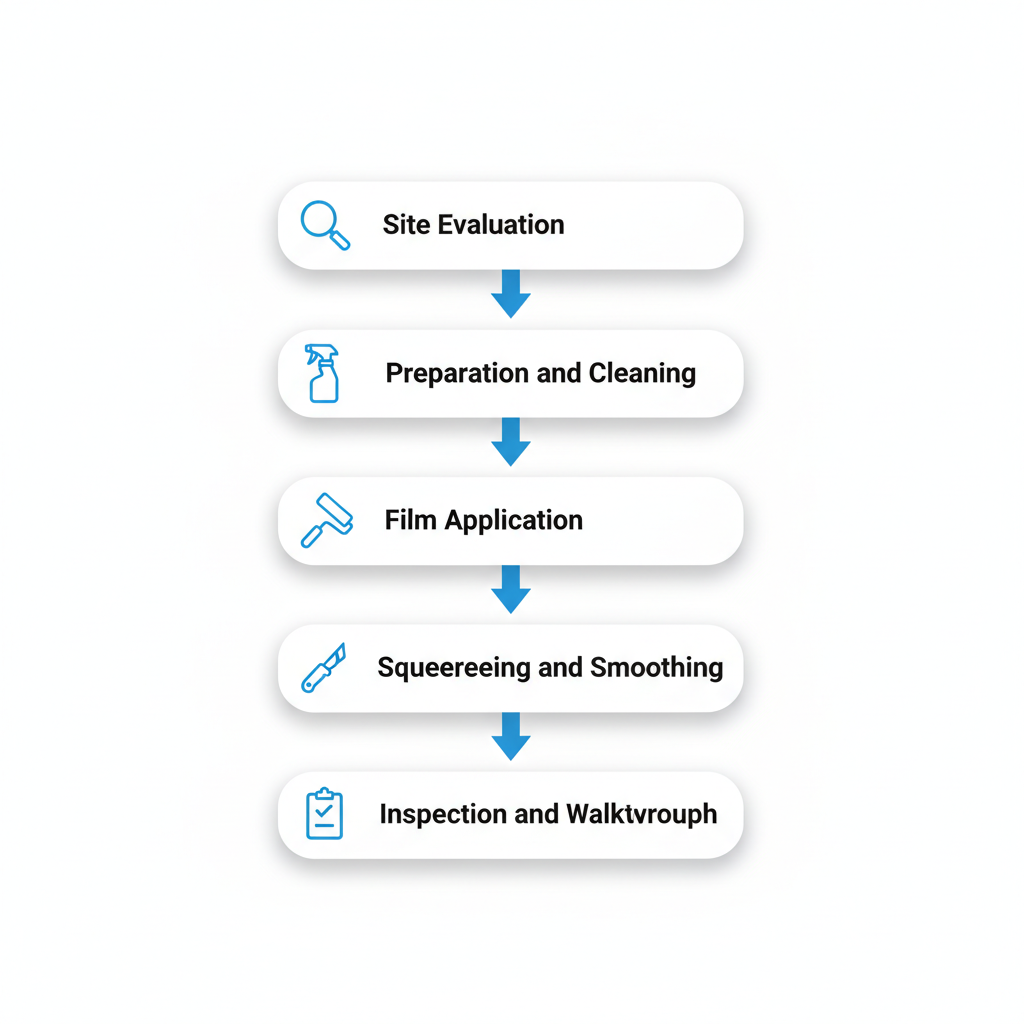
Step-by-step guide to installing security window film
Understanding these initial steps empowers owners to collaborate effectively with professionals, ensuring the retrofit aligns with specific security goals. For instance, in educational settings, discreet evaluations maintain daily operations without alarm.
Application Techniques and Placement
Application techniques vary based on whether you choose inside or outside mounting, each offering distinct advantages for window security. Inside installation, applied to the interior side of glass, protects the film from weather elements and is ideal for most retrofits in residential or commercial spaces. It involves spraying the window with soapy water, positioning the film, and using a squeegee to remove bubbles from the center outward. Outside mounting suits storm-prone areas, where UV-resistant films adhere directly to the exterior, but requires additional protection against rain and debris.
Essential tools for the job include squeegees for smoothing, utility cutters for trimming excess film, heat guns to soften material for curves, and application solution sprays. Professional installation follows Amarok Defense’s protocol, emphasizing blast mitigation window film for high-risk sites like campuses, where trained teams handle sizing and sealing with precision.
For DIY attempts, consider safety window film but proceed with caution–improper adhesion can lead to bubbles or peeling, compromising protection. Warnings include ensuring even pressure to avoid weak spots, and avoiding application in direct sunlight to prevent warping. In school scenarios, professionals minimize disruption by working off-hours, completing installations without interrupting classes.
Choosing the right method depends on property scale: larger facilities benefit from expert handling to cover extensive surfaces efficiently. The table below contrasts key approaches to inform your decision.
| Method | Time Required | Tools/Skills Needed | Cost Range | Durability Outcome |
|---|---|---|---|---|
| Professional Installation | 1-3 days per building | Specialized tools, certified techs | $5-15/sq ft incl labor | High – Warranty-backed |
| DIY Application | Several hours per window | Basic squeegees, cutters | $2-5/sq ft materials only | Moderate – Risk of bubbles/failure |
| Inside Mount | Quick access, weather-protected | Adhesive-focused | Standard rate | Optimal for most threats |
| Outside Mount | Exposed to elements | UV-resistant films | Slight premium | Best for storm-prone areas |
Professional services, like those from Amarok, provide warranties and superior outcomes, especially for complex jobs involving blast mitigation. DIY suits small-scale projects but risks suboptimal results without experience. Labor costs, averaging $2-5 per square foot per industry estimates, underscore the value of certified installers for lasting security.
This balanced approach ensures effective placement while addressing common concerns like inside versus outside application.
Post-Installation Maintenance
After installation, regular inspections and cleaning sustain the film’s performance, extending its lifespan up to 15 years or more. Conduct monthly checks for signs of peeling, scratches, or discoloration, focusing on edges where adhesion might weaken. Amarok Defense offers post-install walkthroughs to demonstrate these routines, ensuring clients in offices or schools can maintain protection independently.
Cleaning involves gentle methods to avoid damaging the coating: use a soft microfiber cloth with distilled water and mild detergent, wiping in straight lines to prevent streaks. Avoid abrasive cleaners or harsh chemicals that could degrade the film. For longevity, factors like proper ventilation during cleaning and shielding from extreme heat play key roles. In humid environments, dehumidifiers help prevent moisture buildup under the film.
The following table compares cleaning methods and their impact on film durability:
| Cleaning Method | Frequency | Impact on Longevity | Notes |
|---|---|---|---|
| Mild soap solution | Weekly | High | Preserves adhesion; non-abrasive |
| Ammonia-based cleaner | Avoid | Low | Can cause yellowing over time |
| Pressure washing | Rare, professional only | Moderate | Risk of delamination if too strong |
| Dry microfiber wipe | Daily | High | Removes dust without residue |
Favoring gentle routines maximizes durability, with professional inspections recommended annually. For safety window film in homes, these practices enhance ongoing protection against impacts. Amarok’s guidance, rooted in law enforcement expertise, emphasizes proactive care to uphold warranties and security efficacy.
By following these maintenance tips, property managers can ensure sustained performance, teasing into considerations for cost optimization in advanced applications.
Cost and Performance Optimization for Security Window Film
When planning for security window film installations, understanding cost variables is essential for effective budgeting. Factors such as material quality, project scale, and site specifics influence total expenses, typically ranging from $5 to $15 per square foot for combined materials and labor. According to industry guides like those from Angi, basic safety options start at $2-10 per square foot for films, while labor adds $3-5 per square foot, adjusted for regional markets. For advanced protective films, these costs reflect enhanced durability against impacts and blasts.
The following table outlines key cost factors for window films, breaking down pricing variables to aid informed budgeting in advanced planning.
| Factor | Impact on Cost | Examples for Security Films | Amarok Defense Approach |
|---|---|---|---|
| Film Thickness/Type | Higher = More expensive | Basic safety: $3-8/sq ft; Blast: $8-15/sq ft | Custom specs per evaluation |
| Property Size/Complexity | Larger scale lowers per sq ft | Single home vs multi-campus | Volume discounts + logistics planning |
| Installation Location | Urban/remote affects labor | Scottsdale base: Efficient AZ deployment | Trained teams minimize downtime |
| Add-Ons (Warranty/Testing) | Optional premium for longevity | Post-install inspections included | GSA-compliant assurance |
| Testing Standards | Higher certification increases cost slightly | ASTM hold-out for intrusion; GSA for blast resistance | Integrated compliance verification in proposals |
Amarok Defense streamlines these costs through site-specific evaluations that identify efficiencies, such as volume pricing for multi-campus projects and bundled services to reduce per-square-foot expenses. By controlling variables like material selection and logistics, their process delivers value without compromising performance.
Optimization begins with performance testing under standards like ASTM for hold-out strength and GSA for blast mitigation window film ratings, ensuring films withstand forced entry or explosions. Layering techniques or integrating with alarms can enhance outcomes, while warranties spanning 5-10 years, as noted in expert Q&A resources, justify the investment. For real-world performance outcomes, protective window film testimonials from clients like schools highlight long-term reliability. A simple ROI calculation might compare $10,000 in film costs against $50,000 in glass replacement savings over a decade, factoring in reduced downtime.
Compared to security bars, safety window film offers a cost-effective glazing upgrade at half the price, with less obtrusive aesthetics for commercial settings like houses of worship. Best for schools, blast mitigation options prioritize discreet protection. Films excel in versatility, avoiding the maintenance hassles of bars while meeting safety window film needs for high-traffic areas. Amarok Defense’s tailored proposals address these trade-offs, emphasizing durability and compliance for optimal results.
Common Questions About Security Window Film
Here are answers to frequent queries on Security Window Film, drawing from expert insights to help with property protection decisions.
- Can I install security window film myself? DIY installation is possible but not recommended, as professional application by Amarok Defense ensures warranty coverage and optimal adhesion for lasting performance.
- How long does security window film last? With proper maintenance, high-quality films endure 10-15 years, resisting fading and degradation in various climates.
- Does safety window film affect visibility in homes? Clear varieties maintain natural light and views, providing discreet window safety solutions without darkening interiors.
- What about insurance discounts? Many insurers offer up to 15% reductions for properties with security enhancements like these films, verifying protection levels.
- Is it compatible with retrofit windows? Yes, it adheres to most existing glass types, ideal for upgrading without full replacements.
- Best blast mitigation window film for commercial buildings? Select based on foot traffic and threats; thicker films suit high-risk institutional sites for superior shatter resistance.
- Does it stop break-ins alone? It delays forced entry by holding glass together, enhancing response time when integrated with alarms and locks.
For personalized advice, contact Amarok Defense today.
Maximizing Protection with Security Window Film
Security Window Film stands as a game-changer in property protection, delivering multi-threat defense against intrusion, blasts, and harsh weather. This discreet solution holds glass intact during impacts, slashing breach risks by up to 90% according to American Window Film insights, while maintaining architectural appeal.
The ROI shines through extended response times for security teams and notable insurance reductions. Ease of professional installation minimizes downtime, ensuring durable, high-performance results that safeguard lives and assets without compromise.
Partner with Amarok Defense, rooted in law enforcement expertise, for tailored safety window film and blast mitigation window film implementations. Schedule a complimentary site evaluation today to deploy durable window safeguards that empower proactive security throughout your facilities.
Resources
Amarok Defense

Our mission
To stand firm where others falter, protecting what matters most. Through unshakable principles, disciplined innovation, and quiet strength, we secure lives and spaces against chaos. Our duty is not driven by fear, but by clarity to be prepared, to endure, and to shield with honor.

Our Mission
To stand firm where others falter, protecting what matters most. Through unshakable principles, disciplined innovation, and quiet strength, we secure lives and spaces against chaos. Our duty is not driven by fear, but by clarity to be prepared, to endure, and to shield with honor.