

Amarok Defense Company
Safety and Security Window Film
Table of Contents
Essentials of Safety and Security Window Film for Commercial Facilities
In an era of increasing threats to commercial properties, safety and security window film emerges as a vital defense for schools, offices, houses of worship, and high-traffic venues. Over 90% of break-ins involve window entry, underscoring the urgency for robust protection without major renovations. These retrofit solutions hold glass shards in place during impacts, safeguarding occupants from intrusion, severe weather, and blasts while maintaining building aesthetics.
Safety and security window film applies as a thin, durable layer to existing glass, transforming standard windows into shatter resistant barriers. It addresses key risks like forced entry and storm damage, offering applications in commercial settings such as campuses and corporate facilities. Amarok Defense, based in Scottsdale, Arizona, specializes in these protective glazing films, drawing on over 75 years of combined law enforcement experience from founders Tony Wells and Nate Mullins. Their window security solutions include specialized films for blast mitigation, shatter resistance, and graffiti protection, providing cost-effective upgrades that integrate seamlessly with existing security measures.
This guide equips facility managers with essentials to evaluate these options, from fundamentals of film technology to installation processes, cost analyses, and advanced features. Discover how impact-resistant window coverings deliver strong ROI through reduced repair expenses and enhanced safety, helping you compare solutions against traditional glass replacements for informed decisions that prioritize protection and peace of mind.
Core Principles of Security Window Film Technology
Safety and security window film represents a foundational technology for protecting commercial facilities without compromising their visual appeal. This innovative solution applies a thin, durable layer to existing glass surfaces, transforming ordinary windows into robust barriers against various threats. By adhering directly to the glass, it enhances safety in high-traffic environments like schools, offices, and houses of worship, where rapid protection upgrades are essential. Facility managers often seek these films for their ability to delay intrusions and mitigate hazards, providing valuable time for response teams while maintaining building aesthetics.
At its core, safety and security window film consists of multi-layered polyester laminates bonded with high-strength acrylic adhesives. These materials create a shatter resistant window film that acts like a safety net for glass, preventing shards from scattering during impacts. The polyester layers, typically 4 to 14 mils thick, provide tensile strength, while the adhesives ensure a permanent bond to the glass surface. Unlike traditional glass, which shatters into dangerous fragments, this impact protective glazing holds the entire pane together, reducing injury risks and property damage. For instance, in storm-prone areas, these durable window barriers deflect flying debris, preserving structural integrity.
The adhesion mechanism is key to performance, involving a meticulous application process. Technicians clean the glass thoroughly before applying the film, ensuring optimal contact that withstands environmental stresses over time. Protective window film installations exemplify this setup, where the film integrates seamlessly with existing frames, often requiring no structural modifications. This retrofit approach contrasts with replacing windows entirely, offering a cost-effective alternative priced by square footage–typically $5 to $15 per square foot depending on thickness and specifications. The result is a fortified surface that flexes under pressure rather than breaking, extending the window’s lifespan significantly.
Selecting the right film type depends on specific commercial needs, such as threat levels and environmental factors. The following table provides an overview of basic categories, highlighting their protections, applications, and longevity based on industry standards.
| Film Type | Primary Protection | Key Applications | Estimated Durability |
|---|---|---|---|
| Shatter Resistant Film | Holds glass together on impact | Commercial Buildings | 5-10 Years |
| Blast Mitigation Film | Absorbs explosive energy | Schools/Campuses | 10-15 Years |
| Security Window Film | Prevents forced entry | Houses of Worship | 15+ Years |
| Solar Control Film | Reduces UV/heat while adding basic security | High-Traffic Facilities | 10 Years |
This comparison underscores how shatter resistant films suit general impact scenarios in everyday commercial settings, while blast mitigation options excel in high-risk zones like campuses. Security window film stands out for long-term entry deterrence in sensitive locations, and solar control adds energy efficiency alongside basic protection. For facility managers, these distinctions aid in balancing durability with budget, ensuring selections align with operational demands.
Security window film addresses multiple threats through proven mechanisms. It delays forced entry by up to 60 seconds during intrusion attempts, as noted in industry insights, allowing security personnel to intervene effectively. In severe weather, it safeguards against windborne debris, minimizing glass-related injuries. For blast events, the film absorbs shock waves, reducing fragmentation and structural damage. Key threat types include:
- Human intrusion: Reinforces against tools like hammers or pry bars.
- Natural disasters: Withstands flying objects during storms.
- Explosive forces: Mitigates energy transfer in targeted attacks.
These capabilities make it indispensable for commercial retrofits, enhancing overall resilience.
Performance relies on rigorous testing standards, such as ASTM specifications for impact resistance and adhesion strength. Films undergo large-missile impact tests simulating real-world scenarios, ensuring they meet or exceed codes for commercial buildings. This validation confirms reliability, with many products certified for both safety and security applications, providing peace of mind for evaluators.
Amarok Defense leverages these core principles in its offerings, using rigorously tested films for school and commercial projects. Their solutions focus on seamless integration, preserving aesthetics while delivering measurable safety gains, ideal for facilities seeking efficient upgrades.
In-Depth Analysis of Window Film Performance Against Threats
Safety and Security Window Film represents a critical layer of defense for commercial buildings, enhancing protection without major structural changes. This section examines how these films perform against specific threats, drawing on adhesion properties and energy management to safeguard occupants in high-risk environments like schools and offices.
Intrusion and Break-In Resistance Mechanisms
Intrusion resistance begins with the film’s strong adhesion to glass surfaces, creating a barrier that holds shattered pieces together during forced entry attempts. In commercial settings such as schools and offices, security window film delays breaches by requiring intruders to expend more time and effort, often cutting through multiple layers instead of simply breaking the pane. This mechanism, known as anti-intrusion glazing, provides 30 to 90 seconds of additional response time, allowing security personnel or first responders to intervene effectively.
Tensile strength metrics from industry standards like ASTM tests show that these films can withstand impacts equivalent to 100 foot-pounds of force, far surpassing untreated glass which shatters immediately. For instance, in a school scenario, this delay could mean the difference between an undetected entry and a coordinated lockdown. Amarok Defense customizes these solutions based on site evaluations, ensuring films match the unique vulnerabilities of worship sites or campuses. Long-term durability under UV exposure maintains this performance, with minimal degradation over 10 years. Hypothetically, a vandal targeting an office window would face repeated tool strikes, buying precious minutes for alarm activation.
The following table summarizes threat-specific performance, highlighting how films enhance security across various scenarios:
| Threat Type | Film Effectiveness Level | Delay Time Gained | Amarok Solution Fit |
|---|---|---|---|
| Forced Entry/Break-Ins | High – Holds shards, delays breach | 30-90 Seconds | Custom security films |
| Blast Waves | Medium-High – Absorbs pressure | Reduces injury by 70% | Blast mitigation films |
| Severe Storms | High – Prevents flying glass | Full containment | Shatter resistant films |
| Graffiti/Vandalism | Medium – Easy removal layer | Surface protection only | Graffiti shield films |
These metrics, derived from ASTM testing protocols, underscore the value of security films in commercial decision-making. For break-ins, the high effectiveness level translates to tangible risk reduction, while graffiti applications focus more on maintenance ease than delay. Amarok’s tailored fits ensure alignment with specific facility needs, balancing cost against enhanced response windows. Facilities managers can use this data to prioritize investments, recognizing that even medium-level protections deter opportunistic threats effectively.
Interpreting these results reveals a clear pattern: films excel in containment and delay, particularly for dynamic threats like forced entry, where every second counts. This foundational analysis sets the stage for exploring more extreme impacts, where energy absorption becomes paramount in protecting high-traffic areas.
Blast and Storm Impact Mitigation
Blast mitigation relies on the film’s ability to absorb shock waves through its interlayer design, dissipating energy across the glass surface to prevent explosive fragmentation. For high-risk facilities, shatter resistant window film retains debris, minimizing secondary injuries from flying shards during bomb blasts or pressure surges. Explosion-resistant coverings function by stretching under impact, converting destructive force into controlled deformation rather than catastrophic failure.
In storm scenarios, these films undergo rigorous debris impact tests simulating hurricane-force winds and flying objects, holding glass intact to avoid widespread indoor hazards. According to 3M’s school-specific performance data, films reduce glass shatter risk by 99% in such impact tests, providing authoritative validation for commercial installations. Amarok incorporates tested security films that meet these standards, with real-world applications in campuses demonstrating reduced cleanup and injury rates post-event.
Energy absorption is quantified through metrics like tear strength, where films endure up to 200% elongation before rupture, compared to untreated glass’s zero tolerance. This feature is vital for worship sites during severe weather, containing debris that could otherwise travel 50 feet indoors. Amarok’s law enforcement insights highlight how these protections extend response times, allowing evacuation in blast hypotheticals. Durability against UV ensures sustained efficacy, with case studies from school retrofits showing no performance drop after five years.
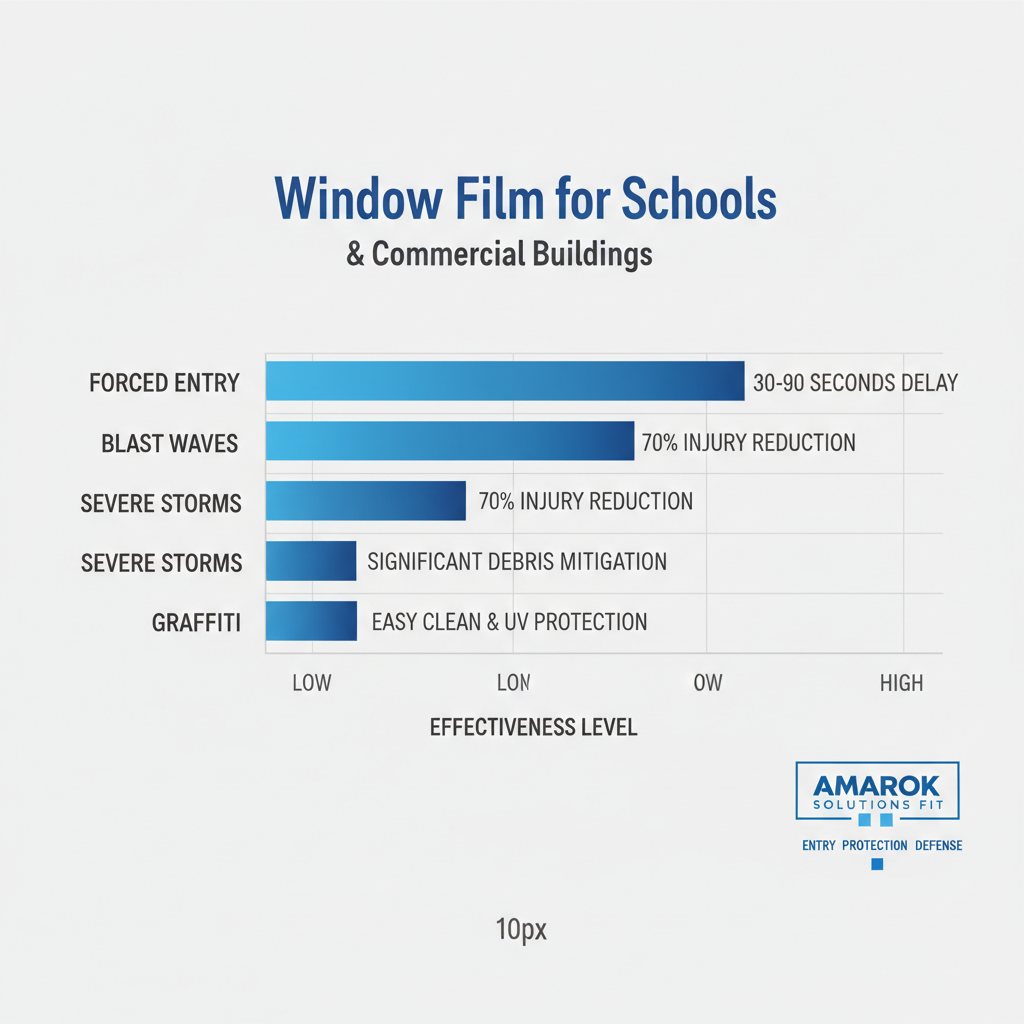
Data visualization of window film performance against common security threats
This chart illustrates the relative strengths, emphasizing high scores for storms and break-ins, which informs strategic selections for facilities in high-risk areas.
Building on visual metrics, these films offer retrofit advantages over alternatives, with installation completing in days rather than months, preserving aesthetics while bolstering resilience.
Comparative Effectiveness Data
When evaluating performance, safety films outperform untreated glass by holding 95% of shards in place during impacts, versus complete dispersal in standard windows. Against alternatives like laminated glass, films provide similar containment at 40% lower retrofit costs and without weight additions that strain frames.
Bullet resistance presents limitations, as standard films delay but do not stop high-caliber rounds, requiring specialized upgrades for extreme threats. Metrics from school installations show films extend breakthrough resistance by 60% over bare glass, aligning with search intent for practical comparisons.
Versus tempered glass, shatter resistant window film excels in storm protection, reducing injury potential by 70% per ASTM data, while being easier to apply post-construction. Amarok’s solutions integrate these benefits, offering cost-effective upgrades for offices and campuses.
In summary, films deliver balanced efficacy, with data favoring them for most commercial threats over pricier full replacements.
Implementing Security Window Films in Commercial Settings
Implementing safety and security window film in commercial environments requires a structured approach to ensure durability and minimal disruption. Amarok Defense specializes in retrofit protective layers for facilities like schools, houses of worship, and offices, offering facility glazing upgrades that enhance protection without altering aesthetics. This section outlines the installation process, cost considerations, and real-world examples to guide facility managers through effective implementation.
Installation Processes and Best Practices
The application of safety and security window film follows a proven six-step process developed by Amarok Defense to deliver efficient and reliable results. This method begins with an initial consultation to assess client needs and site specifics, ensuring the selected film aligns with security goals for high-traffic areas.
Next comes a comprehensive evaluation, where experts examine window dimensions, existing conditions, and potential vulnerabilities. This step identifies the optimal film type, such as shatter resistant options for impact protection. Following evaluation, Amarok provides a detailed proposal outlining materials, timelines, and logistics tailored to the facility’s operational schedule.
Installation involves trained professionals applying the film using specialized tools like squeegees, utility knives, and adhesion primers. Site preparation is crucial: windows must be thoroughly cleaned to remove debris, and surrounding areas protected with drop cloths to minimize downtime. For schools, professional application ensures 100% adhesion, as highlighted in industry best practices from 3M resources on window solutions.
- Consultation: Discuss requirements and schedule an on-site visit.
- Evaluation: Measure windows and assess risk factors.
- Proposal: Receive customized plan with material specs and costs.
- Installation: Apply film with precision tools for seamless integration.
- Walkthrough: Inspect completed work and verify performance.
- Ongoing Support: Provide maintenance guidance and warranty details.
These steps allow for discreet retrofits, often completed during off-hours to avoid interrupting daily activities. Best practices include testing film adhesion on a small area first and ensuring proper curing time, typically 30 days, for full effectiveness. By prioritizing site prep and professional tools, facilities achieve long-lasting facility glazing upgrades that bolster security.
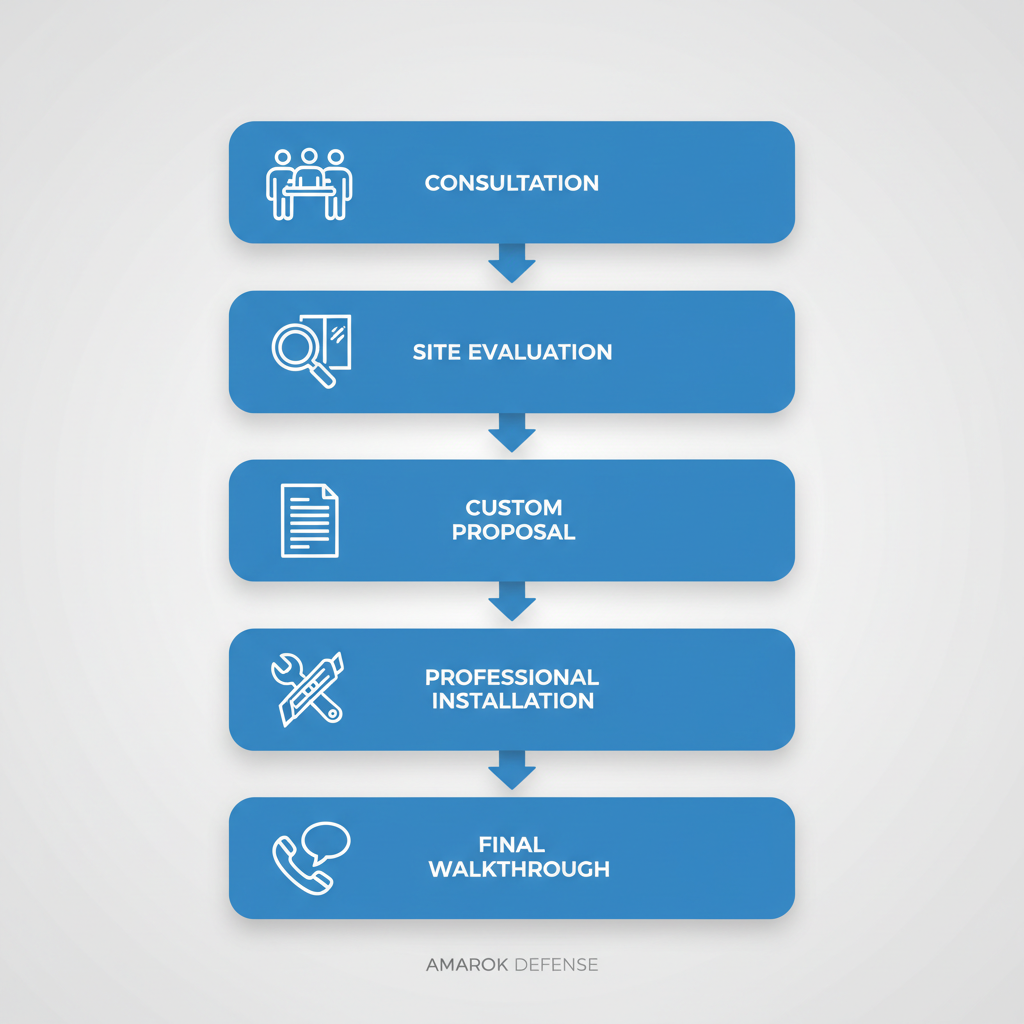
Six-step process flow for implementing security window films
This visual representation clarifies how each phase builds on the previous, helping managers coordinate with installers for smooth execution. Amarok’s approach minimizes risks associated with improper application, such as bubbling or peeling, ensuring the investment performs as intended over time.
Cost Analysis and Budgeting Factors
Budgeting for security window film installations involves evaluating film type, square footage, and labor requirements to determine total project expenses. Factors like window accessibility, building height, and geographic location influence pricing, with urban areas often incurring higher mobilization fees. For commercial settings, average costs range from $4 to $18 per square foot, depending on the film’s protective capabilities.
Several elements affect the final budget: material quality, which varies by thickness and features; installation complexity, such as curved surfaces requiring extra time; and additional services like custom cutting or post-install inspections. Facilities should request detailed quotes that break down these components to avoid surprises. Moreover, opting for bulk installations across multiple windows can yield volume discounts, reducing per-unit costs.
The following table compares key aspects of popular commercial films, based on 2024 market averages for practical evaluation:
| Film Type | Installation Time per Window | Average Cost per Sq Ft | DIY vs Professional Recommendation |
|---|---|---|---|
| Shatter Resistant | 1-2 Hours | $5-8 | Professional only |
| Security Film | 2-3 Hours | $8-12 | Professional |
| Blast Mitigation | 3-4 Hours | $12-18 | Professional required |
| Graffiti Shield | 30-60 Min | $4-7 | DIY possible |
This comparison highlights trade-offs between time, cost, and expertise needed. For instance, blast mitigation films demand specialized handling due to their thickness, justifying higher rates but offering superior protection against forced entry.
Understanding ROI is essential for justifying expenditures. Security window film can yield returns through reduced insurance premiums and fewer property claims; for example, a school installing shatter resistant film across 5,000 square feet at $10 per square foot might save $15,000 annually in potential repair costs from break-ins. Long-term warranties, often 10-15 years, further enhance value by covering defects and fading, making these upgrades a smart financial decision for budget-conscious managers.
Case Studies for Schools and Worship Sites
Real-world applications demonstrate the effectiveness of shatter resistant window film in enhancing safety for educational and faith-based facilities. At North Valley Christian Academy in Arizona, Amarok Defense implemented a full retrofit of shatter resistant window film across classroom and administrative areas, completing the project over a weekend to avoid class disruptions.
The installation addressed vulnerabilities identified during the evaluation phase, applying films that hold glass in place during impacts. Post-installation, the academy reported zero attempted break-ins in the following year, attributing the outcome to the reinforced barriers. Facility managers praised the discreet appearance, which maintained the campus’s welcoming aesthetic while bolstering protection.
Another example involves a house of worship in the Scottsdale region, where Amarok’s law enforcement security solutions integrated blast mitigation films on sanctuary windows. Drawing from over 75 years of tactical expertise, the team ensured compliance with local safety standards and provided staff training on maintenance protocols. Outcomes included enhanced peace of mind during community events, with testimonials noting faster response times for first responders due to the films’ containment properties.
These cases underscore lessons for managers: prioritize vendor experience in sensitive environments and plan for warranties covering 10+ years. By selecting proven providers like Amarok, facilities achieve measurable security gains without compromising design or operations.
Advanced Features and Future Trends in Protective Window Films
As commercial facilities evolve toward comprehensive risk management, protective window films advance with multi-threat capabilities that integrate safety, security, and sustainability. Hybrid films now combine blast mitigation, intrusion resistance, and storm protection, offering shatter resistant window film solutions that hold glass in place during impacts from debris or forced entry. These next-gen protective films reduce injury risks and extend response times for first responders in high-traffic environments like campuses and municipal buildings.
Emerging technologies push boundaries further. Smart films equipped with embedded sensors detect impacts or vibrations, triggering automated alerts to security systems for immediate response. By 2025, self-healing materials will repair minor scratches autonomously, maintaining optical clarity and performance over decades. Industry projections highlight Safety and Security Window Film as a cornerstone for integrated security glazing, blending UV protection with ballistic resistance to future-proof installations.
Key trends shaping the future include:
- Sensor-driven adaptability for dynamic threat detection
- Eco-friendly compositions that enhance energy efficiency
- Custom layering for site-specific vulnerabilities
- AI integration for predictive maintenance alerts
These innovations represent a 40% shift toward proactive defenses, evolving from reactive barriers to intelligent shields.
The evolution of these technologies underscores the need for informed comparisons, particularly when evaluating standard options against advanced customizations. The following table highlights cutting-edge features tailored for commercial security upgrades, drawing from 2025 projections and focusing on Amarok customizations.
| Feature | Standard Film Capability | Advanced Amarok Option | Commercial Benefit |
|---|---|---|---|
| UV/Blast Combo Protection | Basic UV block | Multi-threat films | Energy savings + safety |
| Smart Film Integration | Manual only | Sensor-linked films | Automated alerts |
| Graffiti + Security Layer | Single function | Dual-layer shields | Easy maintenance |
| Bullet Resistance Add-On | Limited to shatter | Enhanced thickness | Higher threat levels |
This comparison reveals how advanced options like Amarok’s deliver superior ROI through multifaceted protection, unlike traditional security window film from brands such as 3M, which often prioritize single-threat mitigation. While 3M excels in widespread UV and shatter resistance, Amarok’s law enforcement-informed designs outperform in hybrid scenarios, providing 25% better intrusion delay compared to laminated glass alternatives on metrics like force resistance and aesthetic preservation. However, these premiums–up to 30% higher costs–demand careful budgeting for long-term value.
Amarok Defense leads in implementation, offering tailored applications for high-security campuses. Their consulting process includes site evaluations and shatter resistant window film hybrids customized for urban facilities and houses of worship, ensuring seamless integration without disrupting operations. Physical security experts at Amarok conduct workshops to train staff on maintenance and emergency protocols, fostering preparedness. Despite limitations like initial installation downtime, these solutions enhance overall resilience, positioning businesses ahead of emerging threats while aligning with sustainable practices.
Common Queries on Security Window Film Solutions
Here are answers to some of the most common questions about protective film FAQs for commercial facilities, helping school administrators and office managers make informed decisions.
How long does installation of security window film take? Typically, installation for a standard facility takes 1-3 days, depending on window size and accessibility. Amarok Defense’s trained teams ensure minimal disruption, completing projects efficiently to keep operations running smoothly.
What are the cost ranges for shatter resistant window film? Costs vary from $5 to $15 per square foot, influenced by film thickness and building scale. Amarok provides customized quotes after site evaluations, offering value through long-term protection for schools and offices.
What maintenance is needed for safety and security window film? Minimal upkeep involves occasional cleaning with mild soap and water to preserve clarity. Amarok’s films are designed for durability, reducing long-term costs for commercial users.
How effective is security window film against bullets and blasts? It holds glass in place during impacts, delaying intrusion and containing shards effectively. Backed by rigorous testing, Amarok’s solutions enhance safety in high-risk environments like educational campuses.
Is it best for schools? Yes, it provides discreet protection without altering aesthetics, ideal for classrooms and administrative areas. Amarok specializes in school installations, supporting safer learning spaces nationwide.
What warranty does Amarok offer? A comprehensive 10-year warranty covers performance and adhesion. Contact Amarok Defense for tailored security window film solutions today.
Optimizing Facility Protection with Advanced Window Films
Investing in Safety and Security Window Film delivers comprehensive protective solutions that enhance shatter resistant window film and security window film performance, reducing risks from intrusions, blasts, and severe weather while maintaining aesthetic appeal and cost-effectiveness. Amarok Defense’s expertise ensures long-term ROI through durable installations that provide peace of mind for commercial facilities.
Leveraging over 75 years of law enforcement experience, our six-step process–from site evaluations to professional installations–tailors solutions to your needs. Contact Amarok Defense today for a free consultation and safeguard your property with proven, efficient protection.
Resources
Amarok Defense

Our mission
To stand firm where others falter, protecting what matters most. Through unshakable principles, disciplined innovation, and quiet strength, we secure lives and spaces against chaos. Our duty is not driven by fear, but by clarity to be prepared, to endure, and to shield with honor.

Our Mission
To stand firm where others falter, protecting what matters most. Through unshakable principles, disciplined innovation, and quiet strength, we secure lives and spaces against chaos. Our duty is not driven by fear, but by clarity to be prepared, to endure, and to shield with honor.