

Amarok Defense Company
Bullet Resistant Glass
Table of Contents
Understanding Bullet-Resistant Glass Essentials
In today’s world of rising security concerns, imagine a school administrator facing an active threat, relying on barriers that buy precious time for evacuation. Bullet Resistant Glass emerges as a critical defense, engineered to stop or slow projectiles in high-stakes environments like campuses and places of worship. This layered technology ensures safety without compromising natural light or building aesthetics.
Bullet-resistant glass, often mistakenly called bulletproof glass, is a multi-layered composite of glass, polycarbonate, and polymers designed to absorb and disperse the energy of incoming bullets. Unlike the myth of total invulnerability, it resists penetration, delaying threats to allow response. The term bulletproof glass is a misnomer; true ballistic-resistant glazing withstands impacts based on certified standards rather than guaranteeing absolute protection. Historically, it evolved from simple laminates in the early 20th century to advanced integrations today, addressing common handgun and rifle rounds through rigorous testing.
These impact-protective windows find essential applications in educational facilities and houses of worship, where discreet protection is paramount. Amarok Defense, led by law enforcement veterans with over 75 years of tactical experience, specializes in tailored installations. By integrating bullet-resistant glass with window security solutions, they enhance existing structures for comprehensive site safety in Scottsdale and beyond.
Fundamentals include UL 752 protection levels from 1 to 10, calibrated for various threats, with thicknesses ranging from 0.75 inches for low-caliber handguns to over 2 inches for high-powered rifles. Amarok Defense assesses specific needs to recommend optimal configurations, ensuring reliable performance.
Core Principles of Bullet-Resistant Glass
Bullet-resistant glass forms a critical line of defense in secure environments like schools and commercial buildings, engineered to stop projectiles without shattering dangerously. But how does bulletproof glass work? At its core, it relies on sophisticated energy absorption mechanics that transform a bullet’s kinetic force into manageable deformation and heat, preventing penetration.
Mechanics Overview
Imagine a bullet striking a layered cake: each slice flexes and crumbles independently, dissipating the impact across the whole rather than letting it slice through cleanly. This is the physics of bullet resistance. When a projectile hits, the outer glass layer cracks and fragments, but inner polycarbonate or acrylic sheets deform flexibly, stretching to absorb shock waves. Interlayers like polyvinyl butyral (PVB) bond these components, distributing energy through delamination and viscoelastic damping. According to UL 752 testing protocols, this multi-stage dissipation can halt handgun rounds at Level 1 by converting over 90% of the bullet’s velocity into harmless vibration and heat, as validated in impact simulations on polycarbonate durability and interlayer adhesion. Bullet Resistant Glass thus prioritizes containment over rigid strength, ensuring fragments stay contained to minimize secondary hazards. This principle addresses common myths around bulletproof glass, which isn’t truly impenetrable but remarkably effective at energy management.
Materials Breakdown
What materials are used in bullet-resistant glass? The composition blends rigid and flexible elements into ballistic laminate systems. Traditional glass provides the initial hard barrier, cracking on impact to blunt the bullet’s nose. Polycarbonate sheets add toughness and flexibility, bending without breaking to absorb residual force. PVB interlayers act as adhesives, enhancing shatter resistance and flexibility under stress. Acrylic offers lightweight clarity as an alternative to polycarbonate, ideal for visibility-focused applications.
Selecting these protective glazing composites involves balancing durability, transparency, and cost. Thicker configurations, like 1-inch laminates for basic handgun protection, incorporate multiple layers tailored to threat levels.
Material TypeKey PropertiesCommon Use Cases
| Glass | High hardness, initial impact resistance | Outer layers in schools and offices |
| Polycarbonate | Flexible, shatterproof, UV resistant | Core flex layers for commercial barriers |
| PVB Interlayer | Strong bonding, energy absorption | Adhesives in high-traffic facilities |
| Acrylic | Lightweight, optical clarity | Retrofit windows in budget-conscious builds |
Glass excels in clarity but weighs more, while polycarbonate reduces costs yet may yellow over time. Acrylic trades some impact strength for easier handling, guiding choices based on site-specific needs like weight limits versus threat exposure. These trade-offs ensure optimal performance without excessive expense.
What is bulletproof glass made of in practice? Manufacturing begins with cutting glass and plastic sheets to precise sizes, then stacking them with PVB interlayers in a controlled sequence. The assembly enters an autoclave, where heat up to 300°F and pressures around 200 psi fuse layers into a monolithic sheet over 2-4 hours. Post-lamination, edges are sealed and tested for integrity, mimicking real-world ballistic stresses.
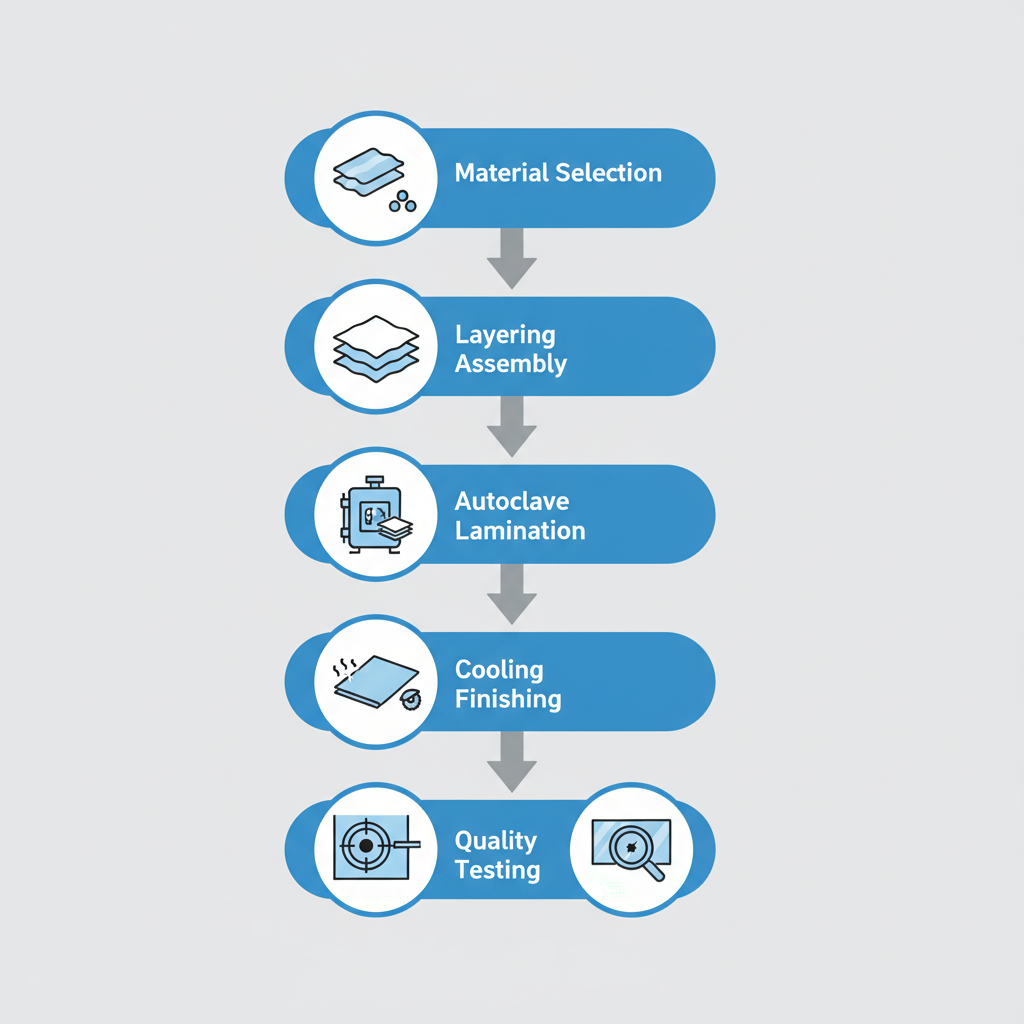
Five-stage manufacturing process for bullet-resistant glass
This autoclave lamination creates seamless bonds, as confirmed by UL 752’s adhesion tests, ensuring longevity under duress.
Environmental Considerations
Bullet-resistant glass must withstand real-world exposures beyond ballistics. UV resistance in polycarbonate prevents degradation, maintaining clarity for decades in sunny climates. Temperature swings test interlayer stability; PVB holds firm from -40°F to 194°F, avoiding delamination. Humidity can affect acrylic, so sealed edges mitigate moisture ingress. These factors, proven in UL simulations, ensure reliable performance in diverse settings like Arizona installations, where solar intensity demands robust formulations.
Application Ties
These principles extend to practical retrofits, enhancing bulletproof windows in existing structures. For seamless upgrades, consider security films protection from specialists like Amarok Defense, blending compatibility with minimal disruption for schools and offices.
In-Depth Analysis of Protection Levels
Bullet resistant glass provides tiered ballistic protection essential for safeguarding facilities against various threats. The UL 752 standard sets the benchmark for rated security glazing, categorizing levels based on the types of firearms and ammunition they can withstand. This framework ensures consistent performance, helping organizations select appropriate solutions for their risk profiles. From low-threat environments like schools to high-security installations, understanding these levels guides effective protection strategies.
UL 752 Standard Levels Explained
The UL 752 standard defines protection levels from 1 to 10, progressing from basic handgun resistance to advanced rifle and armor-piercing threats. Level 1 offers entry-level defense against common handguns such as .22 LR, .38 Special, and 9mm rounds, tested with three shots fired at a distance of 3-5 meters. This level suits low-risk settings where everyday carry weapons pose the primary concern, emphasizing accessibility without excessive material costs.
As threats escalate, Level 3 addresses medium-caliber handguns like .44 Magnum and .357 Magnum, also requiring resistance to three shots under similar conditions. Higher tiers, such as Level 8, target high-powered rifles including 7.62mm (.30-06 equivalent), demanding the material withstand 12 or more shots. Testing protocols involve multiple impacts to simulate sustained attacks, verifying no penetration or excessive spalling occurs. Each level builds on the previous, incorporating denser laminations to handle increased velocity and energy.
This progression addresses key questions about bullet resistant glass levels, debunking myths around bulletproof glass as an absolute barrier. Instead, it highlights graduated capabilities, where Level 1 might suffice for administrative offices, while Level 8 protects critical infrastructure. UL 752 requires stringent certification, ensuring reliability in real-world scenarios.
The following table compares key differences in threat resistance across select UL levels for informed selection:
Protection LevelCaliber/ThreatMinimum Thickness (inches)Shots WithstoodTypical Applications
| Level 1 | .22 LR, .38 Special, 9mm | 0.75-1.00 | 3 shots | Schools, Offices (low threat) |
| Level 3 | .44 Magnum, .357 Magnum | 1.25-1.50 | 3 shots | Commercial Buildings (medium threat) |
| Level 8 | 7.62mm Rifle (.30-06) | 2.50+ | 12+ shots | High-Security Facilities (high threat) |
UL 752 is the industry standard for ballistic resistance; levels tested with multiple shots from specified firearms at 3-5 meters; higher levels increase weight and cost proportionally. This comparison underscores how each level aligns with specific vulnerabilities, aiding in threat-matched deployments.
Amarok Defense leverages these standards in site evaluations, recommending levels that balance protection with practicality for clients in diverse sectors.
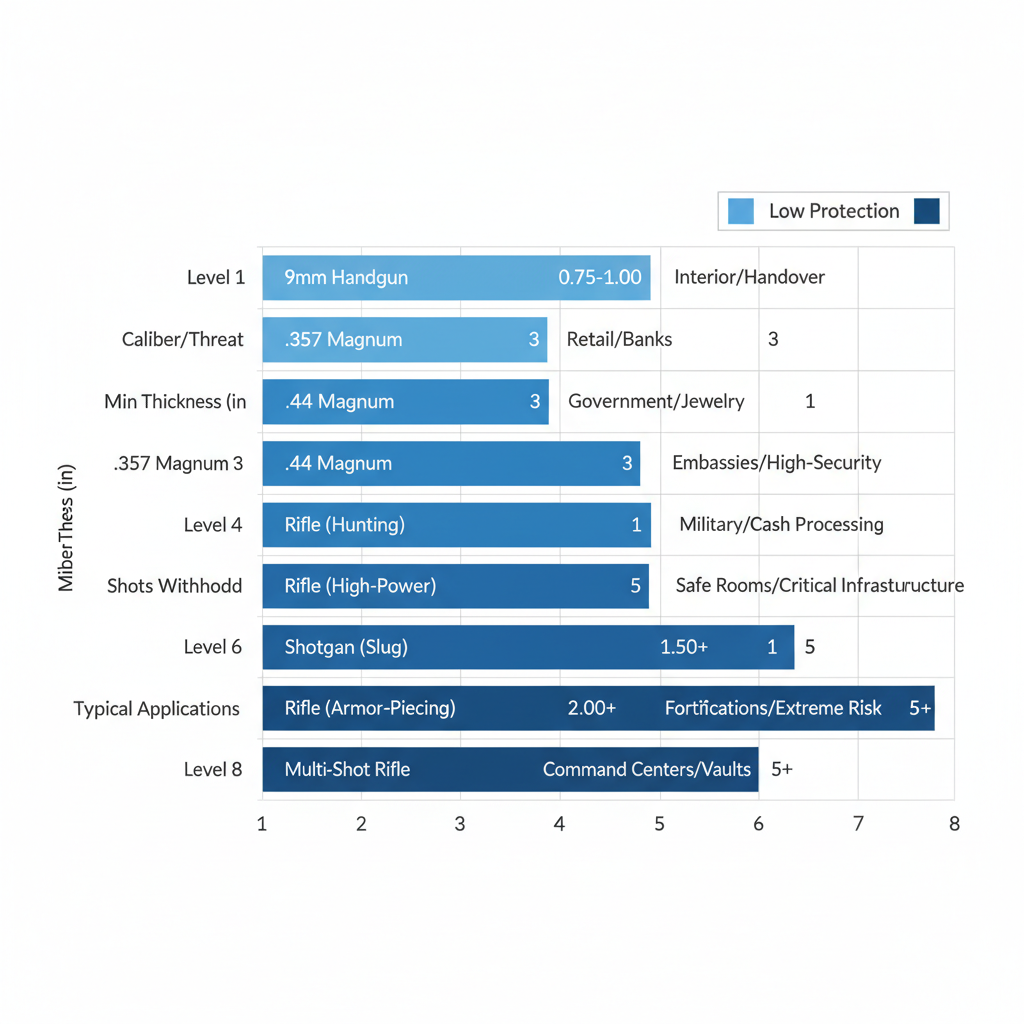
Comparison of UL 752 bullet-resistant glass protection levels 1 through 8
The visual representation above illustrates the escalation in requirements, providing a clear overview for decision-makers assessing options.
Thickness and Performance Correlations
Material thickness directly influences the resistance of bullet resistant glass, with each UL level demanding specific dimensions to absorb and dissipate ballistic energy. For instance, Level 1 typically requires 0.75 to 1.00 inches, sufficient for handgun rounds but inadequate against rifles due to limited stopping power. In contrast, Level 8 exceeds 2.50 inches, incorporating multiple polycarbonate and glass layers to fragment projectiles over greater depths.
Factors like angle of impact play a crucial role; oblique strikes reduce penetration risk by increasing the effective path length through the material. Spall liners, often added to the interior side, minimize fragmentation hazards post-impact, enhancing overall safety. These correlations extend to non-ballistic benefits, such as forced entry resistance, where thicker glazing deters intrusion tools longer than standard windows.
Misconceptions about bulletproof glass often overlook these nuances, assuming uniform invulnerability across thicknesses. In reality, performance scales with layering: a 1.25-1.50 inch assembly for Level 3 handles magnum revolvers effectively, but requires precise engineering to maintain clarity and weight manageability.
When discussing advanced layering, innovative security solutions from providers like Amarok Defense integrate custom spall mitigation, optimizing thickness for site-specific needs without compromising aesthetics.
Bulletproof windows in commercial settings benefit from these tailored approaches, correlating higher thicknesses to reduced vulnerability in medium-threat areas. For high-risk facilities, 2+ inch configurations provide superior defense, though they elevate installation costs and structural demands.
The table below examines thickness impacts alongside other practical considerations:
LevelThickness (inches)Cost EstimateWeight Impact (psf)
| 1 | 0.75-1.00 | $50-80/sq ft | 10-15 |
| 3 | 1.25-1.50 | $100-150/sq ft | 20-25 |
| 8 | 2.50+ | $300+/sq ft | 40+ |
Preceding any installation, Amarok Defense’s six-step process evaluates these factors, recommending levels that align with budget and threat assessments. This ensures long-term performance, as thicker assemblies demand reinforced framing to support added weight.
In a recent case for a Scottsdale-area campus, selecting Level 3 glazing balanced cost with enhanced protection, incorporating angle-optimized designs to cover potential entry points. Such integrations highlight how thickness not only boosts ballistic resistance but also supports broader security objectives, including blast and weather resilience.
Applying Bullet-Resistant Solutions in Real Scenarios
Integrating bullet resistant glass into everyday environments requires careful planning to enhance security without disrupting daily operations. Amarok Defense specializes in tailoring these solutions, such as retrofit films and full replacements, to meet the unique needs of various settings while preserving aesthetics and functionality. By evaluating site-specific requirements, professionals can deploy effective ballistic barriers that provide critical time for response during threats.
Integration in Educational and Commercial Settings
Educational institutions face unique challenges when implementing bulletproof windows, particularly in schools where active shooter scenarios demand rapid protection without extensive downtime. For campuses, retrofit options like adhesive films offer a cost-effective way to upgrade existing glass, adding layers that delay forced entry by 5-15 minutes, as validated by UL testing standards for ballistic certification. The process begins with a thorough site evaluation to assess window sizes, traffic patterns, and vulnerability points, followed by material preparation where films are customized for transparency and durability.
Installation typically involves three key steps: cleaning surfaces for optimal adhesion, applying the film under controlled conditions to avoid bubbles or misalignment, and conducting post-installation testing to verify performance against impacts. In schools, this approach addresses queries like “bulletproof windows for schools” by transforming classroom windows into deployable security windows that maintain natural light while boosting occupant safety. Challenges include coordinating during off-hours to minimize disruptions, but benefits such as enhanced blast mitigation and compliance with safety regulations make it worthwhile.
Commercial buildings, like office spaces, prioritize aesthetics alongside security. Full replacement with bulletproof glass ensures seamless integration, preserving the modern look of lobbies and conference rooms. For instance, in high-traffic Houston offices, these installations resist forced entry, allowing time for evacuation. Retrofit challenges arise in historic structures, where matching original designs is essential, yet the benefits–reduced insurance premiums and peace of mind–outweigh the efforts. Amarok Defense has successfully completed such projects, demonstrating how site-specific ballistic barriers can blend protection with professional environments.
The following table compares practical applications of bullet resistant glass across key environments, highlighting tailored approaches based on Amarok Defense projects. Consult experts for custom assessments, noting benefits like 5-15 minute delay times.
EnvironmentThreat Level RecommendedInstallation MethodKey Benefits
| Schools | Level 3-5 | Retrofit Film + Lamination | Active Shooter Delay, Cost-Effective |
| Commercial Buildings | Level 1-4 | Full Replacement | Forced Entry Resistance, Aesthetics Preservation |
| Homes | Level 1-3 | Adhesive Films | Privacy, Weather Protection |
| Places of Worship | Level 2-4 | Hybrid Solutions | Community Safety, Rapid Deployment |
This comparison underscores the versatility of bullet resistant glass, enabling facilities to select methods that align with their threat profiles and budgets. In educational settings, retrofit films provide immediate upgrades, while commercial full replacements offer long-term durability.
Residential and Faith-Based Applications
Homeowners seeking bulletproof glass for homes often focus on discreet enhancements that double as privacy and weather protection features. Residential installations emphasize adhesive films applied to existing windows, which are lightweight and easy to retrofit without structural changes. The process mirrors commercial steps but scales down: begin with a home assessment to identify entry points, prepare materials for UV resistance, apply films professionally, and test for integrity per UL certification guidelines. This addresses common questions like “bulletproof glass for homes” and “how to install bulletproof windows,” providing layered defense that delays intruders while maintaining views.
Aesthetics play a crucial role, as films can mimic frosted or tinted glass to enhance curb appeal in neighborhoods like those in Scottsdale, Arizona. Benefits include not just ballistic resistance but also energy savings from solar control properties. Cost factors vary: basic films run $5-10 per square foot, far below full replacements at $50+, making retrofits ideal for budget-conscious families. Amarok Defense anonymized case studies show families gaining confidence through these upgrades, turning standard windows into robust shields.
Faith-based venues, such as places of worship, require solutions that foster community safety without altering sacred spaces. Hybrid approaches combine films with reinforced framing to mitigate threats like vandalism or active incidents, focusing on rapid deployment for stained glass or large atriums. Installation involves numbered steps: site evaluation for high-risk areas, material customization to match architectural styles, precise application to avoid visible seams, and final ballistic testing to confirm delay effectiveness. These deployable security windows answer concerns over vulnerabilities in open congregations, offering 10-15 minutes of protection as per UL-validated performance.
In one anonymized Amarok project at a regional worship center, protective window film testimonials highlight how such integrations preserved serene atmospheres while deterring potential harm. Cost insights reveal hybrids at $15-25 per square foot, balancing expense with comprehensive threat mitigation. Overall, these applications demonstrate bullet resistant glass’s role in creating safer havens, with retrofits enabling quick implementations that support ongoing community activities.
To further illustrate, the table below outlines installation methods against associated costs, drawing from Amarok Defense’s expertise in efficient deployments.
Installation MethodEstimated Cost per Sq FtApplicabilityTimeframe for Completion
| Retrofit Film | $5-15 | Schools, Homes, Worship | 1-3 Days |
| Full Replacement | $40-80 | Commercial, High-Threat | 1-2 Weeks |
| Adhesive Lamination | $8-20 | Residential, Retrofits | 2-5 Days |
| Hybrid Solutions | $15-30 | Faith Venues, Mixed Use | 3-7 Days |
This breakdown aids in decision-making, emphasizing how method selection impacts both budget and security outcomes in diverse scenarios.
Advanced Features and Innovations
Bullet Resistant Glass continues to evolve, incorporating smart technologies and sustainable designs that address modern security challenges in high-risk environments. Facilities now demand solutions that not only withstand ballistic threats but also integrate seamlessly with building aesthetics and operations. From embedded sensors detecting breaches in real-time to eco-friendly bio-based interlayers reducing environmental impact, these advancements push beyond conventional laminates.
Key features include sensor-embedded panes that alert security teams instantly upon impact, enhancing response times. Transparency has improved dramatically, with next-gen ballistic shields achieving up to 90% light transmission even at high protection levels, minimizing visual disruptions. Hybrid film-glass combinations offer retrofits for existing bulletproof windows, applying durable layers that mimic full replacement performance without structural overhauls. Pricing for these custom innovations typically ranges from $20 to $100 per square foot, depending on complexity and certification needs.
Pros of these features:
- Rapid detection via sensors reduces vulnerability windows.
- Sustainable materials lower carbon footprints without compromising strength.
Cons:
- Higher upfront costs for smart integrations.
- Requires specialized installation to maintain transparency.
As security needs grow, alternatives to traditional setups provide flexible options. The following table compares key solutions, highlighting how films and hybrids balance protection with practicality.
Solution TypeProtection LevelInstallation TimeCost Range
| Full Laminated Glass | High (Level 5+) | Weeks | $50-150/sq ft |
| Security Window Films | Medium (Level 1-3 equiv.) | Days | $5-20/sq ft |
| Hybrid Polycarbonate | Very High (Level 8+) | 1-2 Weeks | $30-100/sq ft |
Innovations like security window films reduce retrofit disruption significantly, offering up to 80% cost savings compared to full glass replacements, according to Amarok Defense data. These options align with UL testing standards for emerging ballistic equivalencies, ensuring reliability in sensitive facilities. Amarok Defense adopts such tested advancements in its physical security solutions, providing tailored evaluations and installations that integrate films with glass for optimal defense.
Looking ahead, trends point to self-healing layers that repair minor impacts autonomously, further myth-busting notions around bulletproof glass fragility. Advanced protective panes will likely incorporate AI-driven threat prediction, preparing US facilities for proactive protection. These developments ensure bulletproof windows remain a cornerstone of comprehensive safety strategies.
Common Questions About Bullet-Resistant Glass
Where can I source bulletproof windows?
Sourcing secure glazing starts with reputable vendors in the US specializing in security solutions. Companies like Amarok Defense offer consultations to match products to your needs, ensuring compliance and quality for residential or commercial use.
How thick is bulletproof glass typically?
Bulletproof glass varies by threat level, but for homes and offices, thicknesses range from 1 to 1.5 inches using layered polycarbonate and glass. Higher ratings require more layers for enhanced protection without compromising aesthetics.
What are the limitations of bullet-resistant glass?
While effective against handguns and rifles, bullet-resistant glass is not designed for extreme military threats like high-caliber rounds. It prioritizes everyday security, balancing strength with visibility and weight for practical installations.
How do I maintain bullet-resistant glass?
Routine cleaning with mild soap and soft cloths preserves clarity and integrity. Avoid abrasives to prevent scratches; professional inspections every few years ensure ongoing performance, especially in high-traffic areas like schools.
Why consult experts for bullet-resistant glass purchases?
Experts like those at Amarok Defense provide tailored advice on ratings, installation, and integration with existing setups. Their law enforcement background ensures reliable solutions that enhance safety without unnecessary costs.
Key Takeaways on Enhancing Security with Bullet-Resistant Glass
Bullet Resistant Glass stands as a vital layer in modern security strategies, offering layered protection that delays threats while preserving aesthetics. It provides versatile applications across commercial, educational, and residential settings, debunking the myth that it’s fully bulletproof–it’s resistant, buying crucial time for response.
Key insights include:
- Core Benefits: Bulletproof glass employs innovative materials for forced entry resistance and shatter control, enhancing safety without compromising views.
- Level Selection: Tailor resistance levels to specific threats, ensuring optimal performance for your environment.
- Practical Applications: Integrate into bulletproof windows for seamless upgrades in high-traffic facilities.
Amarok Defense’s six-step process–from site evaluations to professional installations–guides informed decisions. Schedule an assessment today to match solutions to your risks and explore strategic security enhancements that protect what matters most.
Key Takeaways on Enhancing Security with Bullet-Resistant Glass
Bullet Resistant Glass stands as a vital layer in modern security strategies, offering layered protection that delays threats while preserving aesthetics. It provides versatile applications across commercial, educational, and residential settings, debunking the myth that it’s fully bulletproof–it’s resistant, buying crucial time for response.
Key insights include:
- Core Benefits: Bulletproof glass employs innovative materials for forced entry resistance and shatter control, enhancing safety without compromising views.
- Level Selection: Tailor resistance levels to specific threats, ensuring optimal performance for your environment.
- Practical Applications: Integrate into bulletproof windows for seamless upgrades in high-traffic facilities.
Amarok Defense’s six-step process–from site evaluations to professional installations–guides informed decisions. Schedule an assessment today to match solutions to your risks and explore strategic security enhancements that protect what matters most.
Amarok Defense

Our mission
To stand firm where others falter, protecting what matters most. Through unshakable principles, disciplined innovation, and quiet strength, we secure lives and spaces against chaos. Our duty is not driven by fear, but by clarity to be prepared, to endure, and to shield with honor.

Our Mission
To stand firm where others falter, protecting what matters most. Through unshakable principles, disciplined innovation, and quiet strength, we secure lives and spaces against chaos. Our duty is not driven by fear, but by clarity to be prepared, to endure, and to shield with honor.