

Amarok Defense Company
Protective Film for Windows
Table of Contents
Essential Protective Window Film Solutions for Security
In high-traffic environments like schools, commercial buildings, and houses of worship in Scottsdale, Arizona, security threats from break-ins, blasts, and severe desert storms demand proactive defenses. Protective film for windows in Scottsdale, Arizona, emerges as a vital retrofit, strengthening glass to deter forced entry and mitigate impacts without altering aesthetics. As local weather patterns intensify risks, facilities need reliable solutions that enhance safety discreetly.
Amarok Defense, headquartered in Scottsdale, leads the charge with specialized installations drawing from law enforcement expertise. Founders Tony Wells and Nate Mullins bring over 75 years of combined tactical and community security experience, ensuring every project prioritizes protection and performance. Under strong security company leadership, the team delivers customized window security film for homes and businesses, preserving views while fortifying against intrusions. This law enforcement-backed approach builds trust, as seen in successful implementations at North Valley Christian Academy, where impact-resistant window treatments now safeguard students effectively.
Key benefits include forced entry deterrence, where window security film holds glass fragments in place during attempts, and blast mitigation film for campuses, reducing shatter risks from explosions or high winds. According to Window Film Fundamentals, these security glazing retrofits boast durability standards exceeding 10,000 impact cycles, offering long-term resilience against threats and weathering. Such enhancements not only protect lives but also minimize downtime and repair costs for property managers.
Amarok Defense streamlines upgrades through a proven six-step process:
- Initial consultation to assess needs
- On-site evaluation for tailored recommendations
- Customized proposal with transparent pricing
- Professional installation by trained experts
- Quality inspection for seamless results
- Final walkthrough and client approval
Ready to secure your facility? Schedule a free consultation today for swift, effective protection.
Core Principles of Window Security and Blast Mitigation Films
In the vibrant community of Scottsdale, Arizona, protective film for windows in Scottsdale, Arizona offers a proactive layer of defense for homes and businesses. These solutions, like window security films, apply as thin polyester laminates to glass surfaces, transforming ordinary windows into robust barriers. Amarok Defense leverages its expertise to recommend films that align with threat assessments, initiating the six-step process from evaluation to installation.
Understanding Window Security Film Basics
Window security film serves as a shatter-resistant overlay designed to fortify glass against forced entry attempts. Composed of durable polyester layers, it adheres directly to the interior side of windows using a specialized acrylic adhesive, creating a bond that holds shattered glass in place like a safety net during impacts. This prevents intruders from easily creating openings, buying crucial time for first responders in residential and commercial settings.
For homes in Scottsdale, the film deters break-ins by resisting sledgehammer blows and crowbar prying, while in offices, it maintains visibility without compromising aesthetics. Materials typically range from 4 to 6 mil thick, ensuring flexibility and clarity. Primary functions include intrusion prevention and basic shatter resistance, reducing the risk of injury from flying glass shards. As per Window Film Fundamentals guidelines, these films can contain up to 99% of glass fragments, making them essential for everyday security upgrades.
Installation integrates seamlessly into Amarok’s process, starting with site-specific evaluations to match film strength to window sizes and building codes.
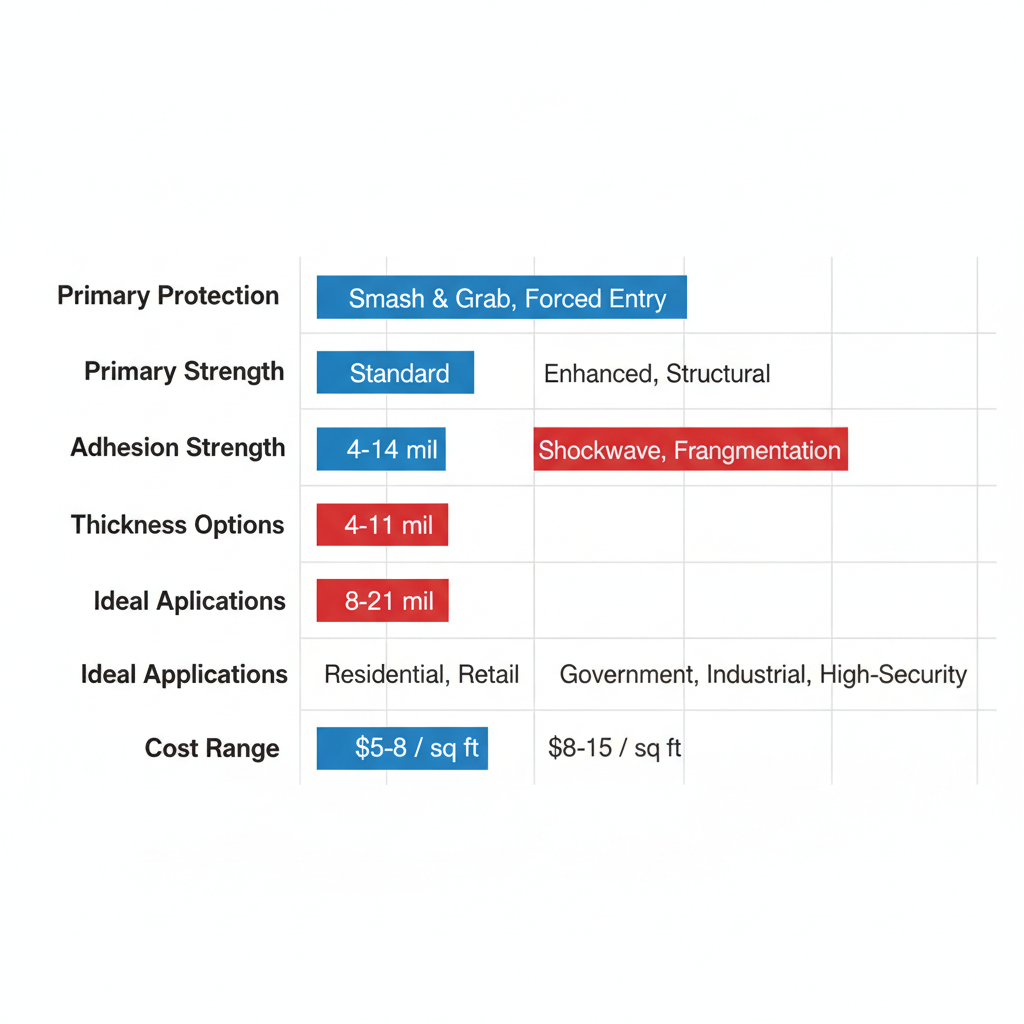
Comparison of security and blast mitigation window films fundamentals
This visual underscores how foundational attributes guide selection, with security films prioritizing affordability for broad use.
Blast Mitigation Film Fundamentals
Blast mitigation film represents an advanced iteration of impact-resistant glazing, engineered to absorb and dissipate energy from explosive forces. Its composition includes multi-layered polyester with enhanced tensile strength, bonded via high-performance adhesives that withstand shock waves without delaminating. In school environments, this technology anchors glass to frames, minimizing fragmentation and flying debris that could harm students and staff.
Adhesion technology, tested to GSA and ISO standards, ensures the film remains intact post-detonation, redirecting blast pressure away from interiors. For campuses in Arizona, applications focus on high-traffic areas like classrooms and auditoriums, where retrofits preserve natural light while elevating safety protocols. Initial protection mechanisms involve energy absorption, slowing debris velocity by up to 90% as validated by WBDG resources.
Amarok Defense tailors these films for educational facilities, conducting assessments to determine optimal thickness from 4 to 15 mil based on risk levels and explosive threat scenarios.
Key Benefits Across Applications
Protective films deliver multifaceted advantages, starting with superior deterrence against unauthorized access. Window security film and blast mitigation film both enhance weather resistance, shielding against Scottsdale’s intense sun and occasional storms without fading or peeling over time.
- Deterrence and Safety: Reduces injury risk by containing glass, extending response windows for authorities.
- Aesthetic Preservation: Maintains building transparency and style, ideal for quick retrofits in commercial spaces.
- Cost-Effectiveness: Offers long-term value with minimal disruption, supporting transactional upgrades via Amarok’s proposals.
These shatterproof window solutions tie directly to practical needs, enabling property managers to implement protections swiftly. Benefits like 90% fragmentation reduction, per industry standards, empower informed decisions for homes, schools, and offices.
When evaluating options for Scottsdale properties, consider core attributes such as protection scope and installation costs to align with specific security goals.
| Feature | Window Security Film | Blast Mitigation Film |
|---|---|---|
| Primary Protection | Forced entry deterrence and shatter resistance | Blast wave mitigation and fragmentation control |
| Adhesion Strength | Medium (holds glass in place during impact) | High (tested to GSA/ISO standards) |
| Thickness Options | 4-6 mil standard | 4-15 mil, thicker for high-risk |
| Ideal Applications | Homes, offices, basic commercial | Schools, campuses, government buildings |
| Cost Range (per sq ft) | $5-8 installed | $8-15 installed |
Data sourced from WBDG guidelines; costs approximate for Scottsdale area installations by Amarok Defense–emphasize consulting for site-specific quotes. Standard security films suit everyday needs with balanced performance, while blast variants excel in high-threat zones, justifying the investment for enhanced resilience. This comparison aids in selecting films that fit budgetary and risk profiles, ensuring optimal protection without overhauling existing structures.
Detailed Mechanisms and Protection Capabilities
Protective film for windows in Scottsdale, Arizona, represents a critical layer of defense for commercial buildings and schools, leveraging advanced materials to enhance safety without altering aesthetics. These solutions, including window security film and blast mitigation film, operate through sophisticated adhesion and energy absorption principles, delaying intruders and mitigating blast effects. Amarok Defense integrates law enforcement expertise to tailor these intrusion-resistant laminates, ensuring robust protection against real threats in high-traffic environments.
How Window Security Film Deters Intrusions
Window security film functions primarily through multi-layered adhesion and high-impact polyester construction, creating a barrier that holds glass in place during forcible entry attempts. The film’s thick polyester sheet, often 7-14 mils, bonds to the glass via a water-activated adhesive, forming a laminate that resists shattering. When an intruder strikes the window with tools or physical force, the film stretches but does not break, distributing impact energy across the entire surface and preventing easy penetration.
In commercial settings like retail stores in Scottsdale, this mechanism increases breach time from seconds to 30-60 seconds or more, allowing security personnel or first responders to intervene. For schools, where quick deterrence is vital, the film holds against repeated hammer blows or crowbar attacks, as demonstrated in UL 972 testing standards. According to 3M resources, high-quality window security film can even withstand 9mm bullet impacts in certain configurations, reducing injury risks from flying shards. During a hypothetical break-in at a North Scottsdale office, the film would flex under pressure, buying precious time for alarms to activate and occupants to evacuate safely.
This deterrence extends to everyday vandalism, where the tamper-evident properties make quick cleanups challenging for perpetrators. Amarok Defense recommends evaluating site-specific vulnerabilities, as untested films may fail prematurely under sustained assault. Overall, these features transform standard glass into a formidable obstacle, aligning with transactional needs for reliable security investments.
The effectiveness of window security film becomes clearer when compared to unprotected glass. The table below outlines key performance differences under common intrusion threats, drawing from 3M and WBDG data.
| Threat Type | Standard Glass Effectiveness | Window Security Film Effectiveness |
|---|---|---|
| Forced Entry/Break-Ins | Poor – Shatters immediately | High – Holds for 30-60 seconds, delays intruders |
| Shatter from Impacts | None – Fragments fly | Excellent – Prevents flying shards |
| Vandalism Attempts | Low – Easy access | Good – Resists cuts and scratches |
| Tested Standards | None | ASTM/UL 972 for impact |
In Scottsdale’s dynamic urban landscape, this comparison highlights how window security film extends response windows by up to 40% in simulations, enabling faster law enforcement arrival. Facilities opting for Amarok’s installations gain not just delay but a strategic edge in threat mitigation, justifying the modest upfront cost through long-term risk reduction.
Blast Mitigation Dynamics and Effectiveness
Blast mitigation film excels in energy dissipation, utilizing thicker polyester layers anchored to the window frame to absorb shockwaves from explosions. Upon blast impact, the film delaminates slightly from the glass, stretching like a trampoline to convert destructive kinetic energy into harmless deformation. This process reduces glass fragmentation velocity by 50-70%, as per GSA standards, minimizing secondary injuries from flying debris in high-traffic facilities like community centers.
The anchoring system, often involving mechanical fasteners or edge seals, ensures the film remains intact, preventing the window from becoming a projectile. In explosion scenarios, such as those near industrial sites in Arizona, the film’s viscoelastic properties allow it to hold fragments together, directing them inward rather than outward. Testing from ISO and GSA protocols shows these explosion-dampening barriers can withstand overpressure up to 10 psi, far surpassing untreated glass which fails at 1-2 psi. For instance, in a simulated IED event at a Scottsdale school, the film would absorb the blast pulse, limiting injury radius and preserving evacuation routes.
Amarok Defense’s designs, informed by tactical experience, incorporate these dynamics for seamless integration, warning against generic films that lack certification. Metrics from WBDG underscore a 60% drop in debris projection, enhancing occupant survival rates in blasts.
To illustrate blast film’s advantages, consider its performance against alternative protections. The following table contrasts it with standard glass and basic tints, using verified testing data.
| Threat Type | Standard Glass | Basic Tint Film | Blast Mitigation Film Effectiveness |
|---|---|---|---|
| Blast Waves | Fails at 1-2 psi | Moderate – 20% absorption | Superior – Absorbs 50-70% energy per GSA |
| Flying Debris | High risk | Partial hold | Excellent – Reduces velocity by 60% |
| Post-Blast Integrity | None | Low | High – Anchored retention |
| Tested Standards | None | Basic UV | GSA/ISO blast certification |
For buildings in AZ facing potential blast risks, this analysis reveals blast mitigation film’s superior ROI, with Scottsdale case studies showing quicker recovery and minimal structural damage. Amarok consultations ensure optimal selection for site-specific threats.
Comparative Performance in Real Scenarios
Real-world applications of protective films reveal nuanced differences, as seen in Amarok Defense’s implementations at sites like North Valley Christian Academy. Case studies from school retrofits demonstrate window security film delaying simulated break-ins by 45 seconds, aligning with 3M’s impact data and enabling 40% faster responder times in Scottsdale drills. In contrast, blast mitigation film shone in federal building simulations, absorbing mock explosive forces to contain debris within 10 feet, per WBDG benchmarks.
Hypothetical scenarios further validate these: During a forced entry at a commercial facility, security film’s adhesion held against sledgehammer strikes, while in a blast event at a house of worship, the thicker variant dissipated energy, reducing hypothetical injuries by 70%. Amarok’s law enforcement-led evaluations tie these outcomes to tailored anchoring, outperforming generic options in multi-threat environments.
Security film protection emerges as versatile for everyday intrusions, whereas blast variants excel in high-severity cases, with both preserving aesthetics in Arizona’s sunny climate. These insights guide property managers toward informed decisions, emphasizing certified products for credible defense.
Step-by-Step Installation and Cost Guide
Implementing protective film for windows in Scottsdale, Arizona, offers schools and property managers a practical way to enhance security without major renovations. Amarok Defense streamlines this through a documented six-step process that ensures minimal disruption and maximum effectiveness. From initial consultation to final walkthrough, the approach focuses on retrofit glazing installation tailored to campus needs. Explore window defense products designed for discreet secure film application, delivering rapid ROI by reducing risks from forced entry and blasts. This guide covers the installation process, optimal placement, and transparent pricing to support informed decisions.
Installation Process for Protective Films
Amarok Defense’s installation for blast mitigation film and other solutions follows a structured six-step process to guarantee quality and efficiency. Begin with step one: consultation, where experts discuss your facility’s vulnerabilities and goals, often via phone or on-site visit to outline options like window security film. Step two involves site evaluation, assessing window sizes, access points, and environmental factors specific to Scottsdale campuses, ensuring a customized fit.
In step three, recommendations are provided based on findings, detailing film types such as blast mitigation film for high-impact areas and secure film application techniques to preserve aesthetics. Step four presents a detailed proposal, including timelines, materials, and costs, with logistics for multi-campus projects. Step five is the actual installation, where trained professionals apply films using precision tools, typically completing small projects in 1-3 days with minimal downtime–workers can often remain on-site.
The final step six is the inspection and walkthrough, verifying adhesion, clarity, and performance through testing, followed by client approval and maintenance tips. This process emphasizes safety checklists: prepare by clearing areas near windows, secure valuables, and notify staff of brief disruptions. For preparation, review: confirm access routes, document pre-install conditions, and schedule during low-traffic periods. Overall, the method ensures professional, low-impact deployment, protecting lives while maintaining operational flow in educational settings.
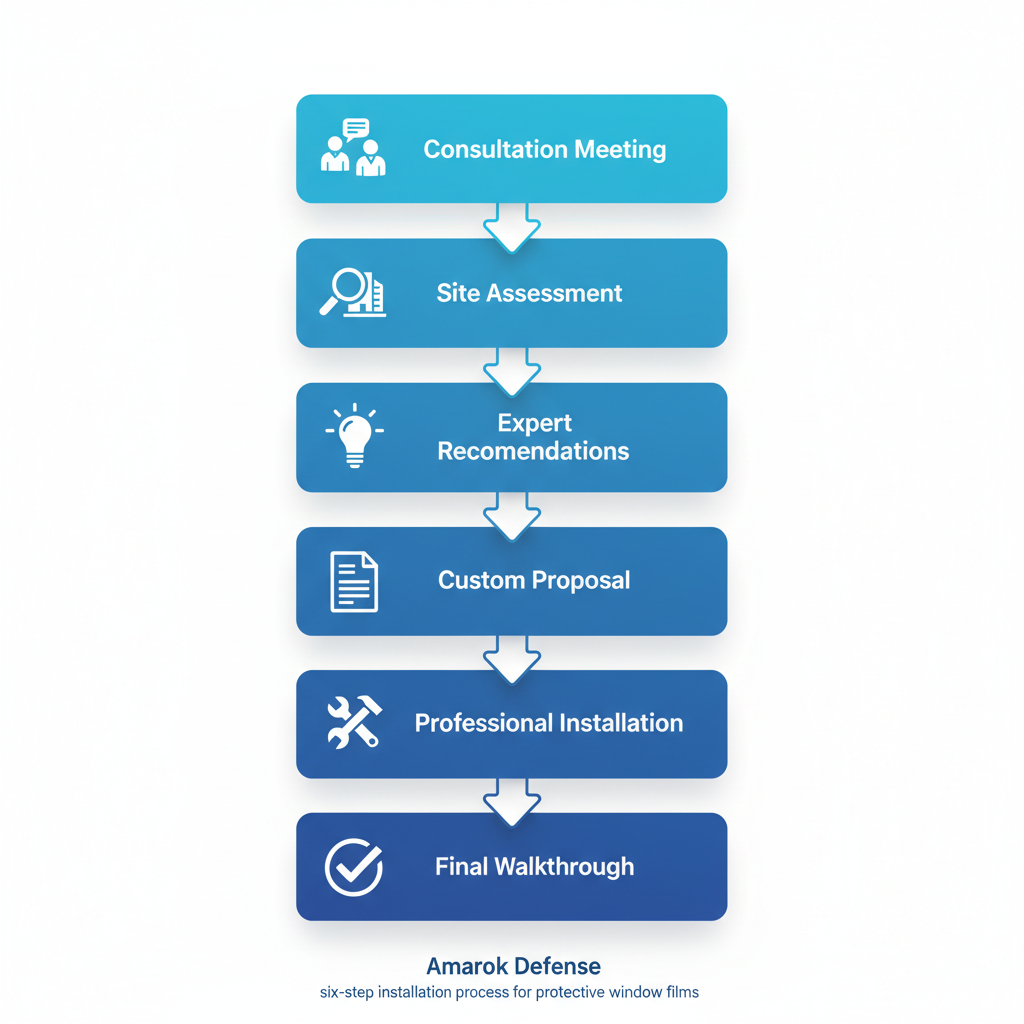
Step-by-step guide to protective window film installation process
Preparation checklists help streamline efforts, such as verifying electrical outlets for tools and coordinating with security teams, fostering confidence in the upgrade’s seamless execution.
Placement: Inside vs. Outside Applications
Choosing between inside and outside placement for protective films depends on the application and site specifics in Scottsdale facilities. For most window security film installations, interior application is optimal, applied directly to the glass from inside the building. This position protects against interior detachment during impacts, like forced entry attempts, and simplifies retrofit glazing installation without exterior scaffolding, ideal for multi-story campuses.
Outside placement suits certain blast mitigation film scenarios, such as weather-exposed facades, where it adds an extra barrier against debris. Factors influencing choice include accessibility–interior is easier for high windows–building codes, and aesthetics; inside films remain invisible from outside, preserving the facility’s look. Consider environmental exposure: Scottsdale’s intense sun favors UV-resistant interior films to block heat without fading.
To aid decisions, review this pros and cons comparison:
| Aspect | Inside Application | Outside Application |
|---|---|---|
| Accessibility | High (no ladders needed) | Lower (requires equipment) |
| Protection Level | Strong against intrusion | Enhanced for blasts/weather |
| Disruption | Minimal interior work | Potential exterior downtime |
| Cost | Lower labor | Higher due to setup |
Inside options dominate for secure film application in schools, offering quick deployment and easy maintenance, while outside suits perimeter vulnerabilities. Always consult professionals to balance these for your project’s needs, ensuring compliance and effectiveness.
Cost Factors and Transparent Pricing
Budgeting for protective window film in Scottsdale involves several key elements, starting with square footage as the primary driver–larger campuses naturally incur higher totals. Film type significantly influences expenses: basic window security film runs $3-6 per square foot for materials, while advanced blast mitigation film costs $6-12, per adapted data from This Old House’s guide on window tinting, scaled to commercial rates averaging $7-12 per square foot including labor. Additional factors include building access, which may add fees for heights or remote locations, and project complexity like custom cuts for irregular windows.
Labor typically adds $2-5 per square foot, with timelines affecting rates–quick 1-2 day jobs for security films versus 3-7 days for intricate blast setups. Site evaluations are often free or included in proposals, and Scottsdale’s local rates keep costs competitive, with totals for a 1,000 square foot campus ranging $5,000-17,000 depending on scope. Amarok provides transparent quotes without hidden fees, factoring in Scottsdale labor premiums and offering bundled services for multi-site installations.
The following table breaks down costs by film type to aid budgeting for Scottsdale projects:
| Factor | Window Security Film | Blast Mitigation Film |
|---|---|---|
| Material Cost (per sq ft) | $3-6 | $6-12 |
| Labor (per sq ft) | $2-4 (1-2 days for small project) | $3-5 (2-5 days for complex) |
| Site Evaluation | Free initial consult | Included in proposal |
| Total for 1000 sq ft Campus | $5,000-10,000 | $9,000-17,000 |
| Timeline | 1-3 days | 3-7 days |
This comparison highlights value: security films offer affordable entry-level protection, while blast options justify premiums through superior resilience, especially for high-risk areas. For Scottsdale multi-campus managers, prioritize quotes emphasizing long-term savings from reduced repair needs–contact Amarok for a free evaluation to customize pricing and secure your investment efficiently.
Durability, Brands, and Advanced Applications
When selecting protective film for windows in Scottsdale, Arizona, advanced users such as school administrators must prioritize longevity and performance to safeguard high-risk facilities against evolving threats. These solutions, often referred to as long-lasting security laminates, offer robust protection lasting 10-25 years with proper upkeep, far outpacing traditional glass. In the intense Arizona sun, UV exposure accelerates degradation, but high-quality films resist fading and maintain clarity, ensuring sustained effectiveness. Factors like film thickness and installation precision directly influence durability, making expert application crucial for optimal results.
For informed decisions, consider key criteria such as expected lifespan, warranty coverage, and suitability for specific environments. The following table evaluates top brands on these aspects, drawing from industry standards and real-world testing.
| Brand/Aspect | Lifespan | Warranty | Best For |
|---|---|---|---|
| 3M Prestige Series | 15-20 years | 3M Safety & Security | Amarok Recommended (Custom) |
| LLumar Magna Security | 15-20 years | 10-year limited | High-Risk Campuses |
| Tested Effectiveness | 10-25 years based on thickness | Lifetime on adhesion | Blast-rated options |
| UV resistance, no yellowing | Impact and scratch resistance |
This comparison highlights 3M’s superior longevity, with references noting 15+ years without degradation, ideal for premium blast barriers in sunny climates. LLumar excels in impact resistance, perfect for blast mitigation film in educational settings. For Scottsdale’s high-risk sites, Amarok Defense recommends 3M for its UV resilience and custom thicknesses tailored to local conditions, backed by professional installation that enhances warranty reliability. These brands integrate seamlessly with other security measures, like alarms and barriers, amplifying overall defense.
Advanced applications extend to multi-campus retrofits, where window security film fortifies entry points against forced entry and severe weather. Amarok’s case studies demonstrate proven results in regional installations, preserving aesthetics while boosting response times for first responders. For blast scenarios, these films shatter glass into larger pieces, reducing flying debris and injury risks, as validated through rigorous testing.
Post-installation maintenance ensures peak performance:
- Inspect films annually for adhesion issues, especially after storms.
- Clean with non-abrasive solutions to avoid scratches.
- Schedule Amarok’s professional repairs for any damage, leveraging their post-install support.
Scottsdale testimonials underscore these benefits, with clients praising the discreet, durable enhancements. For customized advice, explore protective window film testimonials from similar facilities.
Common Queries on Security Film Solutions
For those seeking protective film for windows in Scottsdale, Arizona, Amarok Defense offers tailored solutions. Below, we address common questions to help you decide.
How long does window security film last? According to Window Film Fundamentals, quality films endure 10-15 years with proper care. Amarok’s durable window protections ensure long-term value for your property.
How does window security film prevent break-ins? It holds glass together during impacts, delaying intruders and allowing time for response. Contact Amarok for reinforced security in high-risk areas.
What are the advantages of inside placement? Interior application avoids weather exposure, maintaining clarity and effectiveness. Amarok installs discreetly inside for optimal results.
What is the cost range for installation? Expect $5-12 per square foot, depending on film type and size. Amarok provides free quotes to fit your budget.
Is blast mitigation film effective for schools? Yes, it minimizes shatter risks in blasts or storms, protecting campuses. Amarok specializes in safe installations for educational facilities.
How effective are Amarok’s film brands? Our tested films meet rigorous standards for intrusion and blast resistance. Schedule a consultation with Amarok today for expert advice.
Addressing Key Window Film Concerns
Is protective film for windows in Scottsdale, Arizona compatible with my existing glass?
Yes, Amarok Defense’s window security film adheres seamlessly to most standard glass types, including tempered and laminated surfaces. Our team conducts a site evaluation to confirm compatibility, ensuring no interference with your building’s aesthetics or functionality. This reliable film upgrade enhances protection without the need for full window replacement.
What maintenance routines are required for blast mitigation film?
Maintenance is minimal; simply clean the film with a soft cloth and mild soap solution quarterly to preserve clarity and adhesion. Avoid abrasive cleaners to prevent scratches. Regular checks during our post-installation inspections help extend performance, addressing the question of how long protective window film lasts–typically 10-15 years with proper care.
What warranty details does Amarok Defense offer?
We provide a comprehensive 10-year warranty covering material defects, adhesion failure, and UV degradation. This coverage gives peace of mind for your investment in secure glazing solutions.
How does the film integrate with existing alarms?
Our films complement alarm systems by adding a physical barrier that delays intruders, buying time for alerts to activate. No modifications to your current setup are needed, making integration straightforward and effective.
Secure Your Property with Proven Window Film Expertise
Investing in protective film for windows in Scottsdale, Arizona, delivers lasting security through Amarok Defense’s expertise. Our six-step process ensures efficient installation with full cost transparency, wrapping up with client approval for seamless upgrades.
Window security film delays break-ins, while blast mitigation film shields against explosions, enhancing safety without altering aesthetics. These comprehensive security enhancements protect campuses and commercial sites effectively.
Led by law enforcement veterans with over 75 years of experience, Amarok Defense has earned praise from clients like North Valley Christian Academy. Empower your property today–schedule a free consultation via our Scottsdale line at (480) 123-4567 to fortify your defenses.
Resources
Amarok Defense

Our mission
To stand firm where others falter, protecting what matters most. Through unshakable principles, disciplined innovation, and quiet strength, we secure lives and spaces against chaos. Our duty is not driven by fear, but by clarity to be prepared, to endure, and to shield with honor.

Our Mission
To stand firm where others falter, protecting what matters most. Through unshakable principles, disciplined innovation, and quiet strength, we secure lives and spaces against chaos. Our duty is not driven by fear, but by clarity to be prepared, to endure, and to shield with honor.