
Table of Contents
- The School Safety Glass Hardening Landscape
- Understanding School Glass Hardening Mandates Across the U.S.
- Benefits of Security Window Film for School Compliance and Safety
- How Security Window Film Meets Forced-Entry Resistant Glazing Standards
- Best Practices for Documenting, Testing, and Installing Compliant Glass Hardening
- Protecting Classrooms With Compliant Glass Hardening
The School Safety Glass Hardening Landscape
The school safety glass hardening landscape has evolved rapidly, driven by a broader shift in physical security trends. We are seeing school districts nationwide adopt glass hardening measures as a core element of their comprehensive safety plans. The goal of ‘glass hardening’ is straightforward: to make a school’s glazing more resistant to forced entry. By reinforcing windows and glass doors, we can significantly delay an intruder, buying precious time for first responders to arrive and act.
Recent legislative actions are now turning these best practices into requirements. Mandates like school safety glass hardening mandates have spurred states to adopt forced entry resistant glazing standards for school entryways. Under Alyssa’s law school glass requirements, for instance, many states are leading the charge on this issue. These regulations often reference performance criteria like ASTM F3038 and F3006, which establish a standard for how security films and laminated glass must perform. It is a proactive move that reflects a unified federal perspective, a topic you can read more about in CISA’s K-12 school safety resources.
These mandates have positioned forced entry resistant glazing as a top priority. For many campuses, professional-grade security window film offers a practical, cost-effective retrofit solution that meets these requirements without the need for a complete glazing replacement, embodying our commitment to ‘Safety with Integrity.’
Understanding School Glass Hardening Mandates Across the U.S.
The landscape of physical security for educational facilities is rapidly changing, and school safety glass hardening mandates are becoming a critical compliance factor for administrators nationwide. We are seeing a clear shift from voluntary security improvements to required, state-level legislation designed to protect students and staff. These laws are moving districts toward a reality where reinforcing windows against forced entry is no longer just a best practice but a legal necessity.
Which States Currently Have Glass Hardening Mandates for Schools?
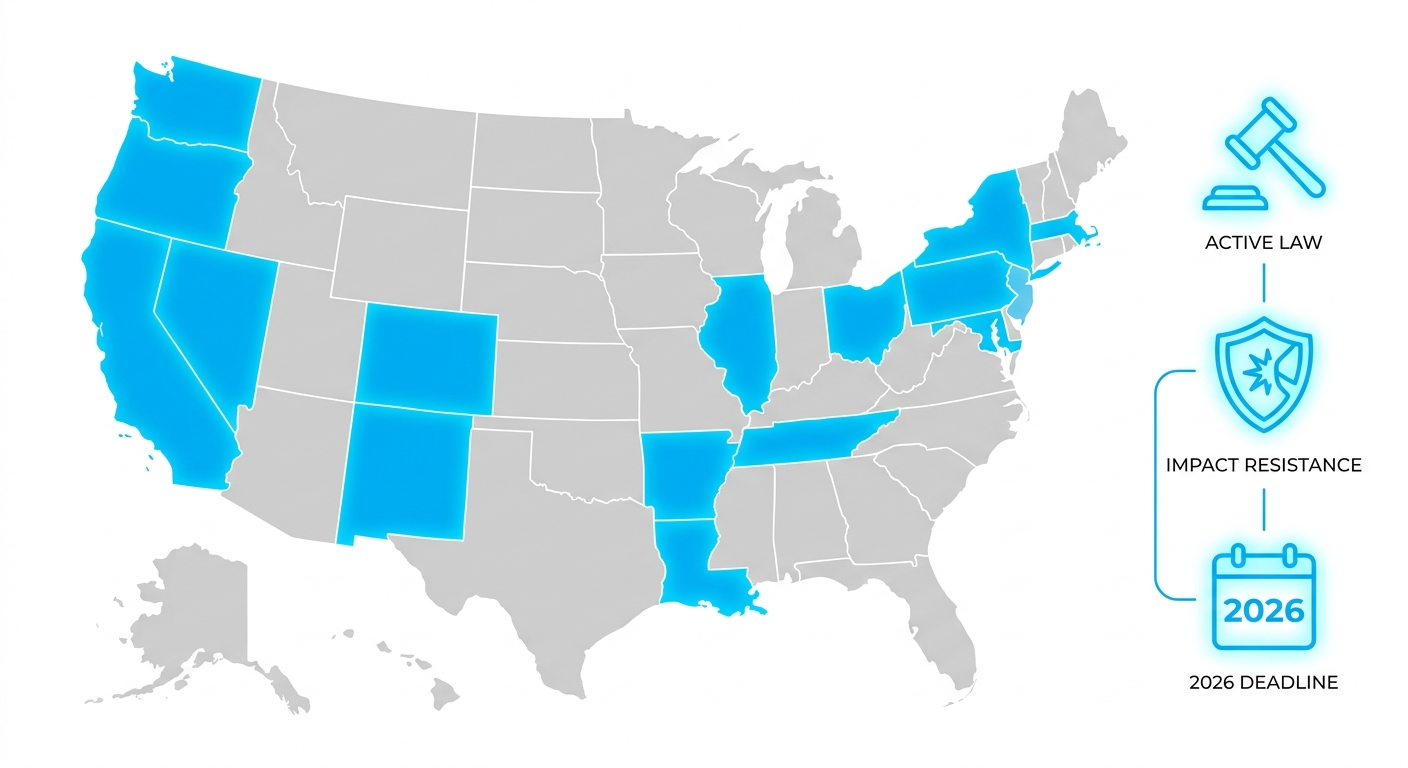
Several states have taken legislative action to harden school entry points, often driven by Alyssa’s Law. This foundational statute, named after a victim of the 2018 Parkland shooting, mandates silent panic alarms, but its scope has paved the way for broader physical security requirements in states like New Jersey, Florida, and New York. As a result, alyssa’s law school glass requirements are expanding beyond alarm systems to include physical barriers. New Jersey’s Securing Our Children’s Future Bond Act is a prime example, funding projects that make schools safer. Similarly, Florida has enacted comprehensive school hardening regulations. While specific language varies, each of these states has recognized that ground-floor glazing is a primary vulnerability that must be addressed.
2026 Requirements and Deadlines for School Window Reinforcement
With mandates in place, the focus for many districts is shifting to the upcoming 2026 compliance timelines. Many state regulations, including those in Florida, contain phased deadlines where new construction and major renovations must meet stringent forced entry resistant glazing standards by 2026. This means that districts cannot wait to start planning. We work with school facility managers to understand that retrofitting must be initiated now to meet these deadlines, as the rulemaking process can be complex. The key requirement is meeting performance standards like ASTM F588 and CPSC 16 CFR 1201. Our team helps schools decipher whether a full, costly glazing replacement is necessary or if a retrofit solution qualifies, effectively buying critical time during a breach.
How Security Window Film Aligns with State-Mandated School Safety Grants
Fortunately, comprehensive security upgrades do not require districts to start from zero. Many state school safety grants explicitly or implicitly cover security window film as a budget-friendly, compliant alternative to full window replacement. For instance, Florida’s School Hardening Grant Program can be utilized for layering forced-entry resistant film onto existing glass. This approach allows schools to meet state window reinforcement regulations and harden their campuses without the immense cost and disruption of construction. To begin the process, school administrators can utilize a physical security site assessment checklist to identify all vulnerable ground-floor glazing. Our focus on campus-specific evaluations ensures that districts strategically use grant money where it is most needed. At Amarok Defense, we are committed to protecting what matters most, ensuring your educational community is prepared and compliant.
Important Disclaimer: Security film is NOT bullet-resistant; do not rely on it for ballistic protection. Understand the limitations of security film and consult a security professional for ballistic-rated solutions or higher-level protection.
Benefits of Security Window Film for School Compliance and Safety
As school districts across the United States face growing pressure to meet new school safety glass hardening mandates, administrators are searching for practical, cost-effective compliance solutions. Recent state laws, including Alyssa’s Law in several jurisdictions, have established stringent school glass requirements designed to delay forced entry and protect students and staff from blast-related debris. These mandates present a clear challenge, but security window film offers a practical, cost-effective compliance solution that avoids the disruption and expense of full glazing replacement.
Achieving Forced-Entry Delay Without Full Glazing Replacement
Security window film can significantly delay forced entry, helping K-12 schools meet forced entry resistant glazing standards without the need to remove existing glass. The installed film, when properly anchored, absorbs and distributes impact force across the pane, buying critical minutes during an intrusion attempt. According to Amarok Defense, internal testing has shown that properly installed security window film can delay unauthorized entry for a crucial period, providing law enforcement additional time to respond. Forced-entry resistance for exterior window systems is evaluated under standards such as ASTM E1886-19, which tests for impact and pressure cycling—criteria that anchored security film is designed to address. By retrofitting existing glazing with film, schools avoid the structural and operational upheaval of replacing every window assembly, making it a practical path toward compliance with hardening mandates for school windows.
Blast Mitigation and Human Intrusion Protection in One Solution
When anchored professionally, security film provides dual protection by mitigating blast debris and resisting human intrusion in a single installation, satisfying two critical school safety priorities at once. Amarok Defense’s blast mitigation FAQ confirms that anchored film retains shattered glass fragments upon explosive impact, reducing the danger zone from airborne shards and maintaining a partial barrier against post-blast environmental hazards. Simultaneously, the same anchoring system reinforces the window assembly against repeated physical attacks, a critical feature for meeting Alyssa’s law school glass requirements in campus building perimeters. We emphasize that security film is NOT bullet-resistant; do not rely on it for ballistic protection. Consult a security professional for ballistic-rated solutions. The films we install are specifically engineered for forced-entry delay and blast debris control, not for stopping projectiles from firearms. This versatile hardening measure, delivered with our commitment to protection with professionalism, helps administrators simplify their safety planning.
Cost Effectiveness and Discreet Installation for Active Campuses
Security window film typically achieves forced-entry delay and blast debris compliance at a 50–70 percent lower cost than replacing all exterior glazing, making it one of the most budget-friendly paths toward meeting school safety mandates. For schools seeking to meet mandates with minimal disruption, working with a professional film installer ensures proper anchoring and warranty. Search for window tinting near me to find Amarok Defense-trained technicians in your area. Our campus-specific evaluations and off-hours installation minimize classroom disruption—most film can be applied during nights, weekends, or school breaks without affecting daily instruction. This discreet yet high-impact upgrade reflects our belief in protecting what matters most. We also provide post-install support and training, ensuring facilities teams understand how to inspect and maintain the film for long-term performance. For school leadership weighing compliance against operational continuity, security film delivers Safety with Integrity at a fraction of the cost and downtime associated with traditional glazing replacement.
How Security Window Film Meets Forced-Entry Resistant Glazing Standards
Windows and glass doors remain the most vulnerable points in any school’s perimeter. When school safety glass hardening mandates drive facility upgrades, administrators and security directors need solutions that deliver measurable delay against forced entry. Security window film, when properly specified and installed as an anchored system, provides that capability—transforming standard glazing into a barrier that resists sustained physical attack and meets recognized forced-entry resistance standards.
Understanding Forced-Entry Delay Standards and Testing Protocols
Forced entry attempts rely on speed and surprise. Industry standards such as ASTM E1886 impact testing establish consistent, repeatable methods to evaluate how long a glazing assembly can withstand a determined assault before the attacker gains passage. According to ASTM International, the test procedure involves a pendulum impact sequence followed by cyclic pressure loading—a simulation that replicates an intruder striking the glass repeatedly and then prying at the weakened opening. To pass, the glazing must remain in the frame for the full rating period, typically requiring delay times of five to fifteen minutes under sustained attack conditions.
Standard annealed or tempered glass cannot achieve these forced entry resistant glazing standards on its own. It shatters or dislodges quickly, providing almost no meaningful delay. For school facility teams evaluating forced-entry delay standards, anchored security film systems offer a retrofit path that works with existing windows. When security window film is mechanically attached to the frame using structural silicone and retention bars, the glass can crack but stays bonded as a cohesive sheet. The assembly continues to obstruct the opening, buying critical minutes for law enforcement response and building lockdown procedures.
The Role of Anchored Security Film in Compliance
Security window film’s performance in these tests depends entirely on anchoring. A film applied only to the glass surface without frame attachment will flex, but a heavy impact can push the entire sheet out of the opening—nullifying the delay. At Amarok Defense, we specify mechanical anchoring for every forced-entry application because the system must be tested as a complete assembly: glass, film, and anchoring method working together.
Independently tested anchored security film configurations have demonstrated the ability to meet the delay requirements defined by ASTM E1886 impact testing. During the pendulum and pressure-cycle sequence, the film layer holds shattered fragments in place while the retention bars prevent the panel from being forced inward. This glass retention barrier does not stop an attack permanently, but it extends the timeline in ways that school safety planning depends on. Our internal testing documentation confirms that properly specified and installed anchored film can achieve the required compliance thresholds. However, we always emphasize that security film is not bullet-resistant and works as one component within a broader, layered security approach.
Alyssa’s Law and School Glass Hardening Requirements
Alyssa’s Law requires K-12 schools to implement classroom door locks, panic alarm systems, and ongoing school safety assessments. While the law does not explicitly mandate glass hardening in every jurisdiction, modern school safety glazing regulations increasingly recognize that unprotected glass undermines the lockdown protocols the legislation establishes. A locked classroom door provides limited protection if an attacker can break the door’s sidelight or a nearby hallway window and reach the locking mechanism in seconds. Hardening those vulnerable glazing surfaces—consistent with alyssa’s law school glass requirements—converts a noncompliant weak point into a passive physical barrier that delays access and preserves the safe room environment until help arrives.
We view this as a natural extension of the “Safety with Integrity” philosophy that guides our work with educational campuses. By combining mechanical anchoring with a comprehensive site assessment—as outlined in our internal school evaluation checklist—facilities teams can identify every glass vulnerability, prioritize treatment based on threat exposure, and document compliance with both current forced entry mandates and emerging school safety glass hardening mandates. The result is a defensible, standards-driven hardening plan that aligns window security with the procedural protections Alyssa’s Law already requires. At Amarok Defense, we approach every school project with the understanding that protecting what matters most means hardening the weakest links first—and in most buildings, those weakest links are made of glass.
Best Practices for Documenting, Testing, and Installing Compliant Glass Hardening
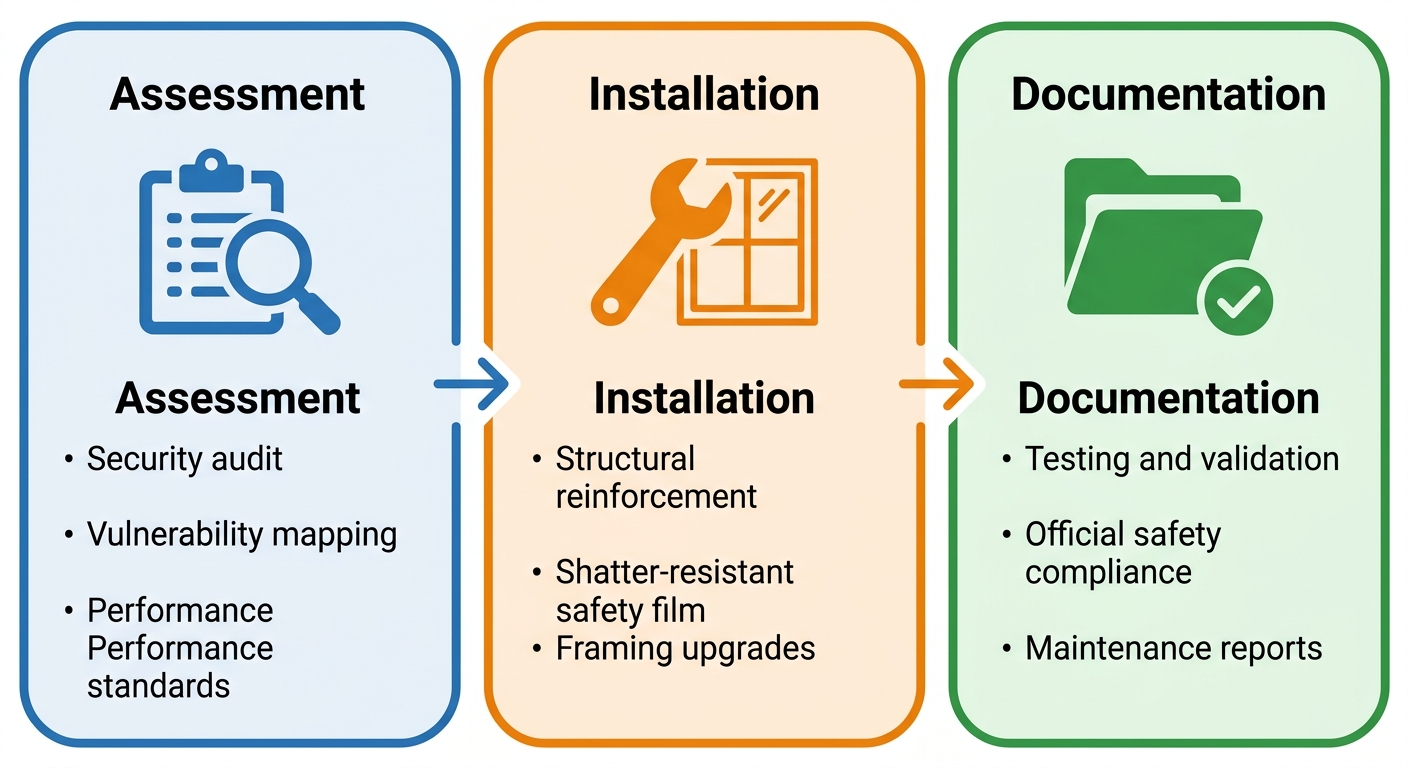
To ensure compliance with school safety glass hardening mandates, schools must implement a structured process covering assessment, installation, and ongoing documentation. Our law-enforcement-led team has refined a methodology that moves from vulnerability identification to certified protection, ensuring every project meets the rigorous forced entry resistant glazing standards that modern mandates demand. We recommend this phased approach to create safer learning environments with lasting, auditable results.
Conducting a Campus Security Site Assessment
Meeting any new school security glass compliance regulation begins with a professional, threat-informed site assessment. Amarok Defense deploys a structured, six-step tactical methodology that applies real-world field experience to identify how an adversary might exploit glazing vulnerabilities — a process required for state-specific mandates under Alyssa’s Law school glass requirements in states like Florida and New Jersey.
The assessment follows three phases:
- Walkthrough and threat modeling: We inspect all ground-level windows, sidelights, and glass doors, documenting glass type, frame condition, and locking mechanisms while mapping threat scenarios such as active assailant forced entry and lockdown effectiveness.
- Vulnerability scoring: Our experts document findings using a risk-level matrix that combines likelihood and consequence, creating an objective hierarchy that guides remediation budgets toward the most critical openings.
- Film system recommendation: Based on vulnerability scores, glazing type, and applicable standards such as ASTM F588, we specify the appropriate security window film gauge, wet-glaze anchoring system, and edge-retention method to meet or exceed prevailing forced entry resistant glazing standards.
Choosing Professional Installation for Code Compliance
Once the assessment is complete, manufacturer-trained installation is essential for warranty, adhesion, and passing the post-installation tests that mandated compliance requires. Campus glass hardening requires much more than simply applying film: our process includes meticulous surface preparation, a structural silicone wet-glaze attachment that chemically bonds film to frame, and post-installation pull-testing to verify anchorage integrity per ASTM F588.
Our installation best practices include:
- Surface preparation per manufacturer specifications: All glass and frame surfaces must be professionally cleaned and prepped to ensure molecular adhesion and prevent edge peeling.
- Wet-glaze anchoring and edge retention: We apply a specified structural silicone bead that locks the film to the frame, preventing an intruder from pushing through even shattered glass.
- Post-installation pull-testing: Each lite is physically tested to confirm that the bonded film meets tensile-strength thresholds, providing measurable evidence of compliance.
- Signed certificate of compliance: We issue a project-specific certificate documenting the film system, anchoring method, testing results, and applicable standards — a critical document for grant reporting.
Security film is NOT bullet-resistant; do not rely on it for ballistic protection. Understand the limitations of security film and consult a security professional for ballistic-rated solutions or higher-level protection.
Maintenance, Documentation, and Grant Reporting
Proper recordkeeping and regular inspections transform a security film project into an auditable, grant-compliant asset. Federal and state grant programs supporting school safety glass hardening mandates typically require a documentation package that demonstrates ongoing compliance, not just initial installation. We structure our documentation to support audit readiness from day one.
Our recommended documentation and inspection schedule includes:
- Project documentation package: Maintain a complete file for every building, including the site assessment report, film specifications, installation photographs, pull-test results, and the signed certificate of compliance.
- Quarterly visual inspections: Facility staff or our team should check for signs of edge lift, film damage, or frame deterioration, logging observations in a standardized inspection form.
- Annual recertification review: We recommend a formal review each year to verify that film systems still meet the original performance specifications, with any remediation documented and certified.
- Five-year comprehensive reassessment: As building use, threat profiles, and Alyssa’s Law school glass requirements evolve, a full re-assessment ensures the protective film system remains appropriate and compliant under current federal and state mandates.
Protecting Classrooms With Compliant Glass Hardening
As school safety glass hardening mandates continue to reshape school security planning, K-12 administrators are urgently seeking practical compliance pathways. Under regulations like forced entry resistant glazing standards and frameworks such as Alyssa’s law school glass requirements, the need to upgrade classroom windows, doors, and sidelights has never been more pressing.
Our compliant glass hardening approach uses security window film to reinforce existing glass, transforming it into a formidable barrier that delays forced entry. This solution buys precious seconds for lockdown procedures without requiring full glazing replacement. By retrofitting the current building envelope, we deliver mandate compliance discreetly, preserving classroom aesthetics and staying within tight school budgets.
Amarok Defense’s law-enforcement-led team conducts campus-specific evaluations to identify vulnerabilities and recommend solutions tailored to each facility. Our professionals ensure that every installation provides robust forced entry resistance. Security window film for mandate compliance must be understood clearly: it is not a singular fix for every scenario but a critical layer in a comprehensive security strategy.
We provide this protection with professionalism, upholding Safety with Integrity. Security film is NOT bullet-resistant; do not rely on it for ballistic protection. Consult a security professional for ballistic-rated solutions.
To stand firm where others falter.
Resources
- Discover AI-Powered Physical Security Trends for 2026
- Explore Amarok Defense Security Film Services and Products
- Discover Window Vulnerabilities and Security Film Solutions
- Discover Expert Tactical Security Site Assessment Methods
- Discover Window Film Pricing and Installation in Arizona
- Find Security Reassessment Frequency and Inspection Guidance
- Discover Anti-Graffiti Film for Quick Vandalism Removal
- Explore CISA School Safety Resources for K-12 Schools
- Discover ASTM E1886 Impact Testing Standards for Windows