
Table of Contents
- Understanding Intrusion Protection Standards for Security Window Films
- GSA Protection Levels and ANSI Z97.1 Impact Safety Ratings
- ASTM F1642 Blast Mitigation Standards and Material Testing Verification
- Selecting Security Films That Meet Intrusion Protection Requirements
- Advanced Considerations for Security Film Selection and Installation
Understanding Intrusion Protection Standards for Security Window Films
To choose the right level of protection, it’s essential to understand the intrusion protection standards that govern film performance. These independent benchmarks define how security window films are tested and what levels of resistance they provide, helping property managers and security directors make informed decisions.
UL 972 burglary resistance is a widely recognized standard that evaluates a film’s ability to withstand forced entry attempts. The test involves dropping a steel ball onto filmed glass from a specified height to simulate blunt force impact. A film passes UL 972 if it prevents the ball from penetrating the glass and creating a hole large enough to allow human entry. This pass/fail criterion provides a clear baseline for measuring a film’s basic intrusion resistance.
Complementing UL 972, ASTM F1233 security glazing is a more comprehensive standard that assesses glazing materials under multiple threat conditions. Testing evaluates resistance to impact, sustained pressure, and thermal stress, simulating real-world forced entry scenarios. This standard ensures that a security film can maintain its integrity across a broader range of attack methods, offering a more thorough evaluation of its protective capabilities.
In the United States, government agencies use the General Services Administration (GSA) classification system to rate security window films on levels 1 through 4. According to Amarok Defense, higher GSA levels correspond to increased protection against progressively more aggressive break-in tools and techniques. Security film is NOT bullet-resistant; do not rely on it for ballistic protection. For protection against surface vandalism, explore our anti graffiti film options.
Our intrusion protection films are designed to meet these industry standards, offering reliable, competitively priced security. To stand firm where others falter, we deliver protection with professionalism and a commitment to Safety with Integrity.
GSA Protection Levels and ANSI Z97.1 Impact Safety Ratings
To quantify a film’s ability to protect against explosive threats, the U.S. government established the GSA protection levels. Facility managers and security professionals rely on these benchmarks, along with related intrusion protection standards, to select the right window film for their buildings. The following table summarizes the four GSA levels defined by the GSA-TS-1-2003 test method.
| GSA Level | Protection Category | Test Method | Explosive Weight (TNT equivalent) | Standoff Distance | Performance Outcome | Typical Applications |
|---|---|---|---|---|---|---|
| Level 1 | Minimum protection | GSA-TS-1-2003 | 2.3 kg | 50 m | Glass may break but film retains fragments; no perforation of glazing | Low-risk interior partitions |
| Level 2 | Moderate protection | GSA-TS-1-2003 | 4.5 kg | 50 m | Glazing remains in frame, some glass breakage allowed, film prevents major fragmentation | Office buildings, reception areas |
| Level 3 | High protection | GSA-TS-1-2003 | 9.1 kg | 50 m | Glass may break; film retains all fragments; no significant opening formed | Government facilities, schools, high-value commercial |
| Level 4 | Very high protection | GSA-TS-1-2003 | 13.6 kg | 50 m | Glazing remains in frame; film retains all fragments; very limited structural breach | Embassies, critical infrastructure, military facilities |
Across all four levels, the GSA-TS-1-2003 test method simulates an external explosive charge at a fixed 50-meter standoff distance, according to Amarok Defense’s documentation on blast-mitigation criteria. This is an open-air blast test, not a ballistic evaluation, and it focuses on how well the glazing system contains glass fragments and maintains structural integrity. For comparison, standards such as UL 972 burglary resistance and ASTM F1233 security glazing address forced-entry resistance rather than explosive threats.
Security film is NOT bullet-resistant; do not rely on it for ballistic protection.
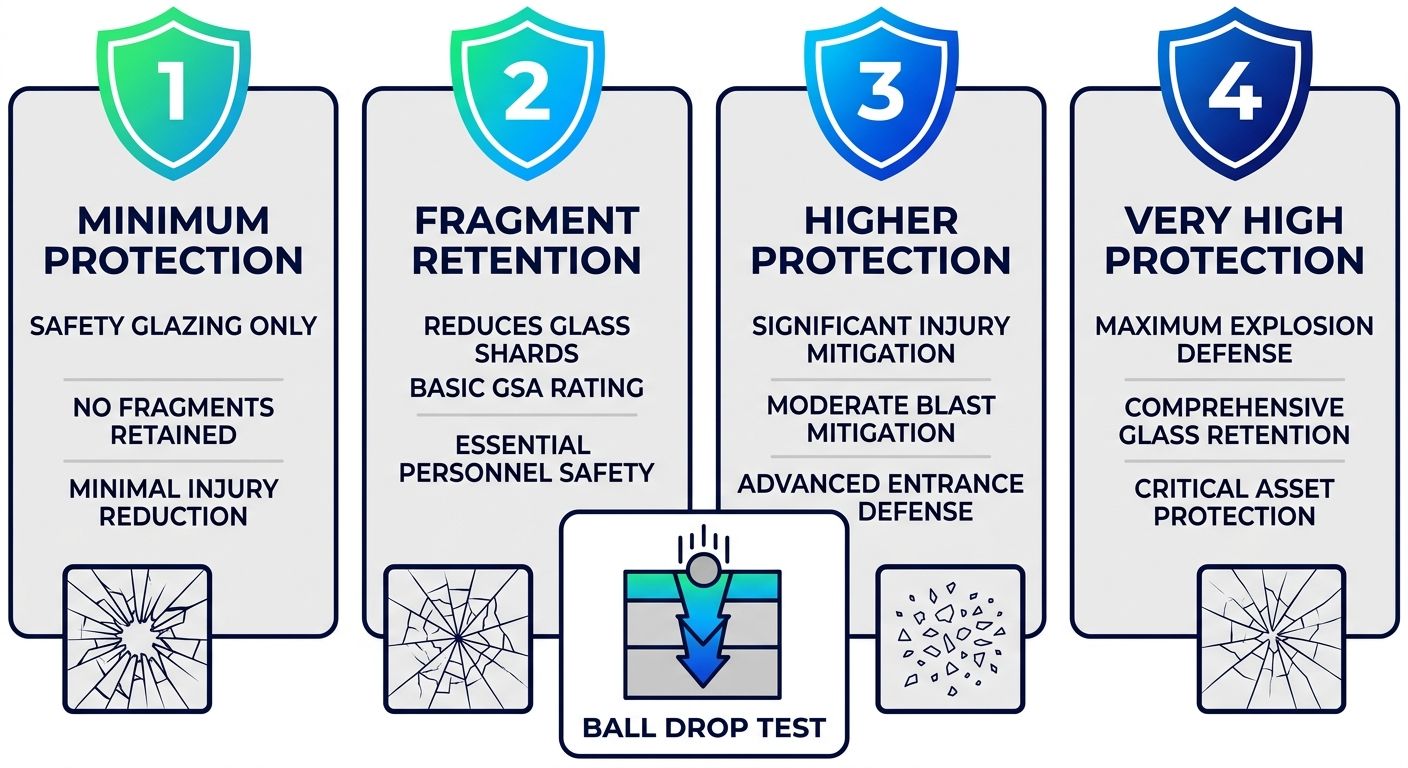
GSA protection levels and ANSI Z97.1 impact test reference.
Beyond blast ratings, the ANSI Z97.1 standard establishes impact safety requirements for architectural glazing. As explained by Amarok Defense, the test uses a 100-pound shot bag dropped from a specified height to classify glass as Type A, which resists fallout, or Type B, which withstands impact but may displace. Understanding intrusion protection standards helps facility managers evaluate these classifications and their implications. Installing a professionally applied security film can upgrade existing glazing so that it complies with Type A or Type B criteria, enhancing occupant safety without requiring full window replacement.
Understanding these ratings is the first step; combining them with a site-specific assessment ensures the right level of security. For a complete understanding of your facility’s vulnerabilities, download our physical security site assessment checklist. We combine law-enforcement experience with rigorous testing, protecting what matters most.
ASTM F1642 Blast Mitigation Standards and Material Testing Verification
Understanding the standards behind these films is essential to choosing the right protection, particularly when evaluating intrusion protection standards alongside blast mitigation requirements. Here we break down the three key test standards that govern blast and intrusion films.
Comparison of Blast and Intrusion Test Standards
The following table provides a compact summary of the three core standards that define performance expectations for security window films:
| Standard | Full Name | Test Methodology | Performance Metric | Typical Film Use | Examples |
|---|---|---|---|---|---|
| ASTM F1642 | Standard Test Method for Glazing and Glazing Systems Subject to Airblast Loadings | Controlled explosive charge generates vented airblast; glazing response observed | Break Condition (BC) 1–5 (BC1 no break, BC2 significant glazing still in frame, BC3 some fragmentation, BC4 major fragmentation, BC5 failure) | Blast mitigation film | Blast mitigation applications for government, military, embassy |
| UL 972 | Standard for Burglary Resistant Glazing Materials | Pendulum impact (steel ball) from specific drop heights simulating shoulder and kick blows; multiple impacts | No penetration or opening through glazing after defined impacts | Intrusion protection film, human intrusion film | Entry doors, ground floor windows in retail, schools |
| ASTM F1233 | Standard Test Method for Security Glazing Materials and Systems | Static and dynamic loads; crowbar, sledgehammer, saw, chemical attacks; timed attack sequences | Time to penetration (seconds/minutes); level of tool resistance | High-security glazing, forced entry resistant film | Prisons, police stations, high-value asset protection |
Note: Security film is NOT bullet-resistant; do not rely on it for ballistic protection. Understand the limitations of security film and consult a security professional for ballistic-rated solutions.
The standards above reflect distinct threat scenarios and testing rigor. Blast mitigation films undergo explosive airblast testing, while intrusion films face controlled mechanical impacts and tool attacks. Amarok Defense relies on these frameworks to match the right film to each client’s risk profile, a process rooted in our commitment to protecting what matters most.
How ASTM F1642 Applies to Blast Mitigation Films
ASTM F1642 is the standard test method for evaluating glazing systems subjected to airblast loadings. The procedure uses a controlled explosive charge to generate a vented airblast, and observers measure the glazing response using Break Condition (BC) levels. These levels range from BC1, where the glass shows no breakage, through BC3 where some fragmentation occurs but significant glazing remains in the frame, to BC5, which indicates complete failure with extensive fragmentation ejected from the frame. This five-tier system should not be confused with GSA performance levels, which follow a separate classification scheme.
Amarok Defense applies ASTM F1642 to qualify blast mitigation films destined for government installations, military facilities, and embassy compounds. The results confirm whether a film can retain shattered glass during an explosive event, a capability rooted in the rigorous engineering we demand.
UL 972 Burglary Resistance and ASTM F1233 Security Glazing
UL 972 burglary resistance testing evaluates a glazing material’s ability to withstand forced entry using a pendulum impact device. A steel ball is dropped from specified heights to simulate shoulder and kick blows, and the material must resist penetration or opening through the glazing after multiple successive impacts. This standard is widely used for intrusion protection films installed on entry doors and ground-floor windows in retail stores and K–12 campuses.
While UL 972 is commonly applied to commercial storefronts, residents pursuing residential window tinting can also benefit from burglary-resistant films that meet this standard.
ASTM F1233 security glazing raises the bar further by simulating prolonged, tool-based attacks. Test sequences expose glazing to crowbars, sledgehammers, saws, and chemical agents under timed protocols. The performance metric is the duration required to penetrate the glazing, providing a reference point for high-security facilities such as prisons, police stations, and high-value asset rooms. Amarok Defense draws on real-world law enforcement experience to interpret these results—a reflection of our belief in Safety with Integrity.
Material Testing and Film Consistency Verification
How does material testing verify film consistency? The answer lies in standardized physical tests that confirm every production batch meets published specifications. Tensile strength is measured according to ASTM D882, ensuring the film can withstand the strain levels specified for its intended use. Adhesion testing, performed per ASTM D3330, verifies that the pressure-sensitive adhesive bonds uniformly, maintaining long-term attachment to the glass. Accelerated weathering, carried out under ASTM G154 or G155, exposes samples to UV radiation and humidity cycles to confirm that clarity and structural integrity persist over years of service.
Amarok Defense integrates these tests into a continuous quality assurance program. Our process includes in-house evaluations that go beyond minimum compliance thresholds as well as third-party verification for blast-rated films. By tracking tensile results and adhesion values across production runs, we confirm that the roll arriving at a Scottsdale job site performs identically to the sample certified in the lab. This data-driven discipline reflects our commitment to protection with professionalism.
With these standards in mind, the next section shows how they apply in actual installations—from government buildings to retail storefronts. Amarok Defense’s law-commissioned team brings over 75 years of tactical experience to every evaluation, ensuring that the right standard, the right film, and the right verification come together in one disciplined installation.
Selecting Security Films That Meet Intrusion Protection Requirements
Once you know the basics, the next step is selecting the right film based on specific standards. Understanding the technical landscape around intrusion protection standards helps facility managers and security directors make informed decisions. At Amarok Defense, we guide our clients through this process by clarifying how different protection categories align with real-world threats and regulatory expectations.
Comparing Intrusion Protection, Blast Mitigation, and Impact Safety Standards
Security film is often discussed under a single umbrella, but three distinct protection categories exist: intrusion protection, blast mitigation, and impact safety. Each addresses a different threat type and is measured against separate testing protocols. Intrusion protection films, for example, are evaluated primarily through UL 972 burglary resistance and ASTM F1233 security glazing standards. These tests simulate forced entry attempts using pendulum impacts and systematic tool attacks to verify that the film can delay or deter an intruder. By contrast, blast mitigation films are subjected to controlled explosive charges under GSA-TS-1-2003 and ASTM F1642, which measure how well the glazing system withstands pressure waves and fragmentation. Impact safety films follow a different path entirely, relying on ball drop tests defined by ANSI Z97.1 and CPSC 16 CFR 1201 to ensure glass does not shatter dangerously upon accidental human collision.
The following table summarizes how these three categories compare across threat addressed, key standards, test methods, film type, and typical cost level.
| Protection Category | Threat Addressed | Key Standards | Test Method Summary | Film Type | Typical Cost Level |
|---|---|---|---|---|---|
| Intrusion Protection | Forced entry, burglary, smash-and-grab | UL 972, ASTM F1233, CPSC 16 CFR 1201 (for safety glass) | Pendulum impact (UL 972), tool attack (ASTM F1233) | Human intrusion / intrusion protection film | Moderate |
| Blast Mitigation | Explosion, pressure wave, fragmentation | GSA-TS-1-2003, ASTM F1642 | Controlled explosive charge (GSA, ASTM F1642), airblast loading | Blast mitigation film | High |
| Impact Safety | Accidental impact, human collision, glass fragmentation | ANSI Z97.1, CPSC 16 CFR 1201 | Ball drop test (shot bag), impact from defined height | Safety / anti-shatter film (often combined with other films) | Low to Moderate |
As the table illustrates, intrusion protection occupies a middle ground in both cost and complexity. It is purpose-built to counter deliberate human threats without the extreme engineering demands of blast-rated systems. Understanding these distinctions helps organizations align their budget with the specific risks they face.
Best Practices for Film Selection Based on Protection Levels
Selecting the right security film requires more than matching a product name to a threat label. We recommend evaluating three critical factors: the existing glass type, the strength of the window framing, and the applicable building codes for your jurisdiction. Even the highest-grade film underperforms if the frame cannot anchor it during an attack. Our team approaches every project with Safety with Integrity, ensuring that the chosen film works in concert with the surrounding structure. For facilities in Scottsdale and beyond, we also consider environmental exposure and long-term durability as part of a comprehensive site assessment.
Budget naturally influences film selection, but cost decisions should be guided by threat level and building use. A retail storefront facing smash-and-grab risks may achieve excellent results with a moderate-cost intrusion protection film, while a government facility in a higher-threat environment may require blast mitigation solutions. We always advise professional consultation because a security professional can identify vulnerabilities that a standard checklist might miss. This commitment to protection with professionalism means our clients receive recommendations grounded in real operational experience rather than generic product sheets.
What About the 2026 Public Safety Standards?
Facility managers frequently ask whether new public safety standards for security window film will take effect in 2026. The short answer is that several organizations, including ASTM and GSA, continue to evaluate updates to forced entry standards and intrusion resistance testing protocols. However, no finalized mandates have been issued at the time of this writing. State-level building codes may also evolve, particularly for schools and critical infrastructure, but these remain in proposal stages. Because the regulatory landscape is shifting, we recommend that clients consult a security professional for the latest guidance tailored to their specific facility type and location.
Moving beyond selection, proper installation is equally critical to achieving rated performance. Security film is NOT bullet-resistant; consult a security professional for ballistic-rated solutions. We encourage every organization to treat film selection as part of a broader physical security strategy rather than a standalone purchase.
Advanced Considerations for Security Film Selection and Installation
Beyond the fundamentals, advanced considerations for security film selection and installation require a detailed understanding of site-specific vulnerabilities, rigorous testing standards, and the inherent limitations of the technology. We believe that true protection is about matching the right solution to a precise threat profile, and this process must be informed by established protocols and industry benchmarks. A foundational step is verifying that any film considered meets recognized intrusion protection standards, which provide a measurable basis for evaluating performance against forced entry attempts.
The Role of a Comprehensive Site Assessment
Effective security begins long before film touches glass. We advocate for a thorough physical security site assessment, such as the six-step process outlined by Amarok Defense. This begins with a full evaluation of the property to catalog potential breach points, then moves through a threat analysis, solution design, and product selection, culminating in professional implementation and a final walkthrough. This methodical approach ensures that the selected film — whether for human intrusion, solar control, or blast mitigation — is applied precisely where it will deliver the most value, accounting for variables like glass type, frame condition, and the surrounding environment.
Understanding Key Industry Standards
- Under UL 972 burglary resistance, glazing materials are tested against a range of impact and prying forces. This standard specifically evaluates a material’s ability to resist forced entry, simulating real-world attack methods to assign a burglary resistance rating.
- The ASTM F1233 security glazing standard focuses on the test methods used to determine the resistance of glazing against physical attack, including threats from blunt objects, sharp tools, and thermal stress. These security glazing test methods ensure that a product can withstand sustained assault, going beyond simple scratch resistance.
By selecting films validated through these standards, facility managers gain an objective, comparable metric for the level of protection they are purchasing.
Installation Best Practices for Peak Performance
Even the most rigorously tested film will fail if improperly installed. At Amarok Defense, our installation protocols emphasize two critical factors. First, proper edge retention is non-negotiable; security film must be bonded to the window frame itself, either through a dry-glaze technique for standard applications or a more robust wet-glaze attachment system for higher-security scenarios, such as blast-rated films. Second, we deploy professional, experienced installation crews who understand the complexities of handling delicate film and the importance of a flawless, bubble-free application. This approach not only maximizes performance but also preserves the manufacturer’s warranty and upholds our commitment to protecting what matters most.
Advanced selection also involves forward-thinking environmental considerations. In regions with intense sun exposure, like our home base in Scottsdale, AZ, coupling security film with UV-blocking properties prevents premature degradation of the adhesive. Similarly, in high-traffic public areas, anti-graffiti surface coatings can be integrated into the specification to reduce long-term maintenance costs and maintain visual clarity. As a service-based organization with deep law-enforcement roots, our pricing remains competitive and is customized to factors such as film type, total square footage, and site complexity.
Important Safety Disclaimer: Security film is NOT bullet-resistant; do not rely on it for ballistic protection. Understand the limitations of security film and consult a security professional for ballistic-rated solutions or higher-level protection.
Understanding these advanced factors ensures an informed decision that genuinely elevates the safety of your facility. We encourage you to consult with a qualified team to design a solution that aligns perfectly with your unique security objectives.
After reviewing the key intrusion protection standards, the following FAQs address common points of confusion.
Frequently Asked Questions About Intrusion Protection Standards
What are intrusion protection standards?
Under intrusion protection standards in the United States, formal test criteria such as GSA and ASTM F1642 measure a glazing system’s resistance to forced entry. Unlike ballistic ratings, these benchmarks assess how security film and framing withstand prolonged physical attack, and we ensure our solutions meet rigorous, complementary benchmarks like UL 972 burglary resistance and ASTM F1233 security glazing.
How do GSA security levels apply to window film?
GSA levels typically range from 1 to 4, each defining escalating forced-entry demands for government facilities. When certified intrusion protection film is properly installed and wet-glazed, it can achieve Level 1–2 performance under these standards, delaying attackers long enough for law enforcement response — protection with professionalism and Safety with Integrity.
What is the ASTM F1642 test for forced entry resistance?
ASTM F1642 simulates blunt-impact, prying, and kicking attacks against glazing to verify how long a system delays penetration. Our film-and-anchoring assemblies meet Level 1 or higher in this method, reinforcing windows against sustained breach attempts without claiming ballistic capability.
Are intrusion protection films the same as ballistic-rated glazing?
No. Intrusion protection standards focus on forced-entry delay, not bullet resistance. Security film is NOT bullet-resistant; do not rely on it for ballistic protection. Understand the limitations of security film and consult a security professional for ballistic-rated solutions or higher-level protection.
Your Path to Comprehensive Intrusion Protection
Our path begins with a thorough physical security site assessment, the foundational step in aligning your property with recognized intrusion protection standards. We evaluate vulnerabilities and then benchmark solutions against proven criteria in UL 972 burglary resistance and in ASTM F1233 security glazing. Our law-enforcement-led experts — bringing decades of tactical field experience — guide you through a structured evaluation, recommendation, and professional installation, culminating in ongoing post-install support. This is a path built on Safety with Integrity, designed to deliver a significant enhancement of intrusion resistance without over-promising absolute outcomes.
Comprehensive Guide Overview
Understanding intrusion protection standards is essential for anyone evaluating security window film as part of a layered physical security strategy. This guide serves as your definitive resource for navigating the key benchmarks that define how protective window film performs under real-world forced-entry conditions. We at Amarok Defense created this educational overview to help facilities managers, security directors, and property owners make informed decisions grounded in verifiable testing data rather than marketing claims.
Our approach to security is guided by Safety with Integrity — a principle that demands transparency about what certified products can and cannot do. We provide protection with professionalism, recognizing that every facility faces unique vulnerabilities requiring tailored solutions. With over 75 years of combined law enforcement experience across tactical, SWAT, and intelligence operations, our team brings field-tested expertise to the conversation. We have seen firsthand how critical seconds saved during a breach attempt can make all the difference, and we want you to understand the standards that validate that performance.
Two foundational benchmarks anchor this discussion. The first, UL 972 Burglary Resistance, establishes testing protocols for materials designed to withstand prying, impacting, and cutting attacks commonly employed in forced entry scenarios. In UL 972 burglary resistance evaluations, laminated glass assemblies — including those enhanced with security film — must demonstrate measurable resistance to repeated, focused assault. This standard matters because it provides an objective, replicable framework for comparing products rather than relying on anecdotal claims.
The second core standard, ASTM F1233 Security Glazing, addresses a different dimension of protection. Under ASTM F1233 security glazing testing, materials undergo rigorous impact and cycling procedures that simulate sustained attack sequences. Unlike single-impact tests, this protocol evaluates how glazing systems perform when subjected to prolonged, determined effort — the kind of real-world scenario security professionals encounter. Security glazing standards help specifiers understand not just whether a material can stop an initial breach attempt, but whether it can continue to resist over time.
It is important to be clear about what these intrusion protection standards do not address. Security window film is designed to slow and deter forced entry; it is NOT bullet-resistant. Do not rely on security film for ballistic protection, and consult a security professional for ballistic-rated solutions when that threat vector is part of your risk profile. This guide focuses exclusively on burglary-resistant testing protocols and protective window film benchmarks relevant to intrusion deterrence.
What you will gain from the sections that follow is a practical, detailed understanding of how UL 972, ASTM F1233, and related protective window film benchmarks translate into real-world performance. We will dissect each standard’s testing methodology, explain how results should be interpreted, and provide guidance on applying this knowledge during product selection and specification. By the time you finish reading, you will have the context needed to evaluate security film certifications with confidence and to ask suppliers the right questions about third-party validation.
In the following sections, we break down each standard in depth and explore how they impact your security choices. This is knowledge built for professionals who need to stand firm where others falter.
Resources
- Get Anti-Graffiti Film Reducing Downtime by 90%
- Get School Security Assessment and Safety Roadmap
- Get Residential Window Tinting for Security and Savings
- Get Pricing for Security Window Film Installation
- Get Residential Window Tinting Cost and Energy Savings
- Get Cost Breakdown for Blast Mitigation Window Film
- Get Security Window Film and Metal Detector Services