
Table of Contents
- Understanding Armed Security Guards
- Core Fundamentals of Armed Security
- In-Depth Exploration of Armed Guard Roles
- Practical Aspects of Armed Guard Training
- Advanced Strategies for Armed Security Professionals
- Frequently Asked Questions on Armed Guards
- Enhancing Security with Professional Solutions
Understanding Armed Security Guards
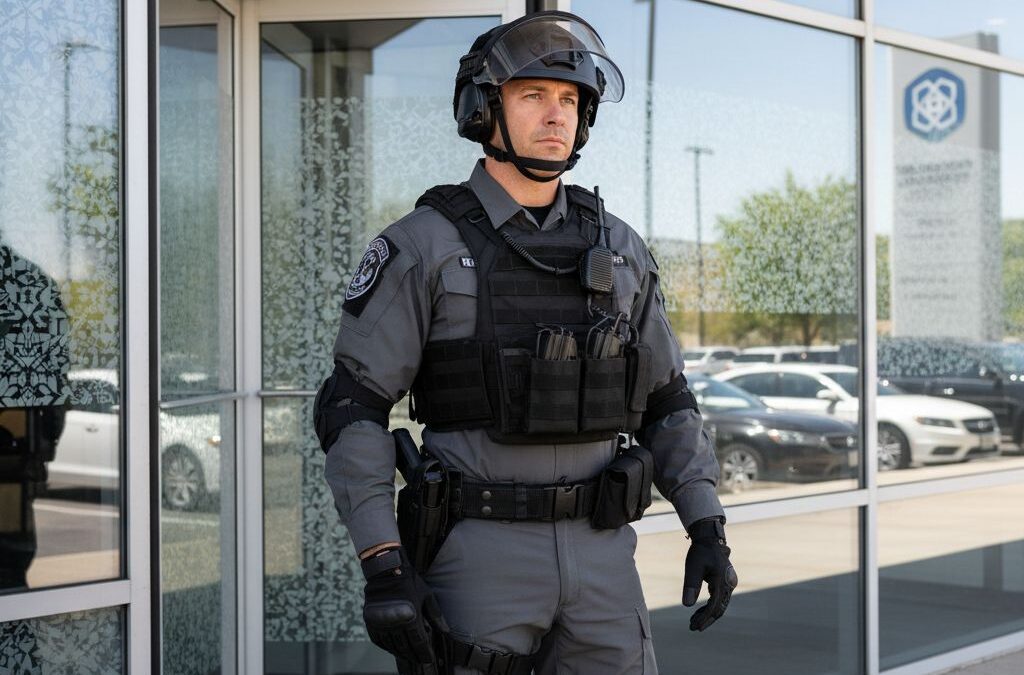
In today’s world of escalating security challenges, an armed guard plays a critical role in safeguarding communities and properties. These licensed protection officers, authorized to carry firearms, deter threats and respond swiftly to emergencies, providing a visible deterrent in high-risk environments like schools in Scottsdale and commercial buildings across Arizona.
The demand for armed security services continues to grow amid rising concerns over crime and vandalism. According to the U.S. Bureau of Labor Statistics, employment in protective services is projected to see steady opportunities, with about 162,300 openings annually through 2034, driven by turnover and the need for vigilant firearm-carrying security personnel. Key responsibilities include patrolling premises, controlling access points, monitoring surveillance, and coordinating emergency responses to protect lives and assets effectively.
At Amarok Defense, we bring over 75 years of combined law-enforcement experience to enhance these efforts with our window security solutions. Our blast mitigation films and human intrusion protections fortify entry points, complementing armed security guards by delaying intruders and reducing risks. For instance, in a school setting, these films hold glass in place during an incident, giving guards precious time to respond while upholding safety with integrity.
This guide explores the qualifications, rigorous training, and career paths for becoming an armed security guard, equipping you with the knowledge to pursue this vital profession and build comprehensive protection strategies that protect what matters most.
Core Fundamentals of Armed Security
At Amarok Defense, we understand the essential role of an armed guard in safeguarding schools, commercial properties, and communities across Arizona. These professionals form the frontline of protection, deterring threats through their presence and vigilance. With over 800,000 security jobs in the U.S., as noted by the Bureau of Labor Statistics, the demand for skilled armed security services remains steady, driven by ongoing concerns about crime and safety.
Becoming an armed security guard requires meeting specific entry qualifications to ensure reliability and competence. We recommend starting with a minimum age of 21, a high school diploma or equivalent, and a clean background check, aligning with state licensing standards. Many states mandate additional training in firearm safety and legal authority, often provided through certified programs. For those entering the field, initial steps include obtaining a guard card and completing basic firearms courses, answering the common question of how to become an armed security guard. Physical fitness and clear communication skills are also vital, as these roles demand endurance during patrols and effective reporting. Our leadership team, with over 75 years of combined tactical expertise, emphasizes these basics to build a strong foundation for protecting what matters most.
Core responsibilities of an armed security guard focus on deterrence, observation, and reporting to maintain safe environments. Daily duties include conducting routine patrols to monitor perimeters, verifying identities at entry points, and documenting incidents accurately. Firearm handling basics involve secure storage, routine inspections, and adherence to safety protocols without engaging in advanced tactics. In a school setting, for example, an authorized security operative might patrol hallways during events, ensuring quick response to unauthorized access while coordinating with staff. These tasks highlight the profession’s groundwork, blending vigilance with professionalism to reduce risks effectively.
As armed guards gain experience, their roles evolve, requiring a deeper skill set. The following table outlines this progression across key areas:
| Responsibility Category | Entry-Level Duties | Experienced Duties |
|---|---|---|
| Patrol and Surveillance | Routine perimeter checks and basic monitoring. | Advanced threat assessment and coordinated response. |
| Access Control | ID verification and log maintenance. | Behavioral analysis and integration with tech systems. |
| Emergency Response | Initial alerting and evacuation support. | Firearm deployment protocols and post-incident debrief. |
This comparison, informed by BLS data on security roles and Amarok Defense’s assessment insights, illustrates how entry-level tasks build toward sophisticated operations. Entry-level duties establish foundational habits, while experienced ones demand judgment honed through training. Importantly, physical measures like building protection films enhance these efforts at all levels by delaying forced entry, giving guards crucial time to respond. In commercial properties, such films complement patrols by fortifying windows against intrusion attempts.
Integrating armed security services with physical barriers creates layered defense strategies. We advocate for our six-step process—from site evaluation to installation and walkthrough—to ensure seamless incorporation of intrusion protection films alongside human elements. This approach reduces forced entry risks in schools and offices, supporting guard effectiveness without over-reliance on any single method.
Finally, ethical considerations guide armed security fundamentals, particularly the use-of-force continuum. Guards must escalate responses proportionally, prioritizing de-escalation and legal compliance. We stress training in these principles to uphold safety with integrity, transitioning naturally into advanced topics for comprehensive preparedness.
In-Depth Exploration of Armed Guard Roles
Armed guards play a pivotal role in safeguarding commercial and educational environments, providing a visible deterrent against potential threats. At Amarok Defense Company, we’ve observed how these professionals enhance overall security strategies, particularly when integrated with physical measures. This section explores the multifaceted aspects of their roles, from legal foundations to practical implementations.
Legal and Licensing Frameworks
Navigating the legal landscape for an armed guard is essential for compliance and effective deployment. Federal guidelines, primarily through the Bureau of Alcohol, Tobacco, Firearms and Explosives (ATF), set baseline standards for firearm possession and use. For instance, individuals must be at least 21 years old to possess firearms in certain roles, with rigorous FBI-level background checks required to ensure no disqualifying criminal history. States like Arizona introduce additional layers, mandating state-specific permits that often include psychological evaluations and medical fitness assessments to confirm suitability for high-stress duties.
Training requirements vary significantly, emphasizing de-escalation modules as highlighted in industry standards from the American Society for Industrial Security (ASIS). Arizona, for example, requires over 40 hours of initial training plus 16 annual refreshers, far exceeding the federal minimum of 8 hours yearly. We’ve seen in our assessments that these frameworks prevent misuse and promote accountability, with liability protocols demanding detailed incident reporting. Understanding these variations helps organizations avoid penalties and ensure permitted defense specialists operate within bounds. According to the U.S. Bureau of Labor Statistics (BLS), about 15% of security positions involve armed roles, underscoring the need for tailored compliance.
The following table outlines key differences in armed guard requirements, illustrating how jurisdictions impact hiring and operations:
| Requirement | Federal Standards | State Variations (e.g., Arizona) |
|---|---|---|
| Age Minimum | 21 for firearm possession. | 21+ with additional checks. |
| Background Check | FBI-level for certain roles. | State-specific felon bans. |
| Training Hours | Minimum 8 hours annually. | 40+ hours initial, 16 annual. |
These distinctions highlight the importance of jurisdiction-specific adherence. Based on BLS and state guidelines, organizations benefit from consulting services like those offered by Amarok Defense Company, which reference compliance strategies to streamline licensing processes. By aligning with these standards, businesses in Arizona and beyond can deploy armed personnel confidently, minimizing legal risks.
Integration with Physical Security Measures
Armed security services complement physical barriers, creating layered defenses that address diverse threats. In high-risk settings like schools or retail spaces, a gun-carrying sentinel works alongside installations such as blast mitigation films and human intrusion films to delay intruders and buy critical response time. Our experience at Amarok Defense Company shows that combining these elements reduces vulnerability; for example, intrusion protection films on windows can hold glass intact during forced entry attempts, allowing armed security guards to position effectively without immediate confrontation.
This synergy extends to deterring vandalism through graffiti shield films, which not only protect surfaces but also signal a commitment to security, discouraging opportunistic acts. We’ve conducted site evaluations where integrating solar control films with guard patrols improved visibility and environmental resilience, aligning with our six-step process from assessment to walkthrough. Psychological fitness, as required in licensing, ensures guards make sound judgments in these integrated scenarios, escalating force only as needed per ASIS-recommended continua.
To illustrate efficacy, the table below compares training focus depth, drawing from our product testing data:
| Training Element | Basic Certification | Advanced Courses |
|---|---|---|
| Duration | 40 hours initial. | 120+ hours with specialties. |
| Firearms Focus | Basic handling and safety. | Tactical shooting and low-light. |
| Cost Estimate | $300-500. | $1,000+. |
As this comparison reveals, pairing armed roles with films like our blast mitigation solutions enhances outcomes, with qualitative data from weathering assessments confirming long-term performance. In Arizona facilities, this integration has proven vital, fostering protection with professionalism while adhering to state variations in training and oversight. Our consulting ties these elements together, ensuring seamless operations that protect what matters most.
Risk Assessment in Practice
Effective risk assessment for armed security guards begins with thorough threat identification, tailored to sites like commercial offices or educational campuses. We start by evaluating vulnerabilities, such as entry points and high-traffic areas, using scenario-based planning to simulate responses. In practice, this involves mapping potential risks like active intruders or vandalism, drawing from BLS insights on steady demand driven by crime concerns.
For commercial sites, assessments prioritize de-escalation and rapid evacuation, while educational environments emphasize student safety protocols. Armed guards, as permitted defense specialists, undergo mental health evaluations to handle these scenarios calmly, with annual requalifications ensuring proficiency in weapon handling and storage. We’ve supported deployments in Scottsdale where customized plans incorporated physical films, reducing response times by integrating guard patrols with film-reinforced barriers.
Decision-making follows a structured continuum, from observation to intervention, with post-incident debriefs providing support as recommended by security experts. By referencing Amarok’s campus evaluations, organizations can align guard roles with broader strategies, noting that efficacy varies by jurisdiction. This approach not only mitigates risks but upholds Safety with Integrity, preparing teams to stand firm where others falter.
Practical Aspects of Armed Guard Training
At Amarok Defense, we recognize that effective armed guard training forms the foundation of robust security measures, particularly when integrated with physical enhancements like protective window films. This section delves into the hands-on elements that prepare personnel for real-world challenges in educational and commercial settings, aligning with our commitment to protecting what matters most through comprehensive preparation.
Hands-On Firearms Proficiency
Range training stands as a cornerstone of armed guard development, emphasizing safety protocols and marksmanship essentials to ensure precision under pressure. We train our teams similarly, focusing on live-fire exercises where participants master weapon handling, from loading and unloading to clearing malfunctions swiftly. Safety remains paramount, with protocols including mandatory eye and ear protection, clear communication on the range, and adherence to the four fundamental rules of firearm safety: treat every weapon as loaded, keep the muzzle pointed in a safe direction, finger off the trigger until ready to shoot, and be sure of your target and beyond.
Accuracy drills involve progressive targets at varying distances, building confidence in controlled environments before advancing to dynamic scenarios. Participants learn to adjust for wind and sight alignment, achieving consistent shot placement essential for deterrent roles. This proficiency not only mitigates risks but also enhances overall response capabilities, drawing from industry standards that underscore the importance of familiarization with assigned weapons, including proper cleaning and storage to prevent accidents.
Mental preparation complements physical skills, incorporating stress inoculation to simulate high-adrenaline situations. By prioritizing safety-first examples, such as secure storage solutions when weapons are not in use, we equip armed guards with the discipline needed for sustained performance. These sessions typically span several hours, fostering the reliability required for protecting assets in high-risk areas like schools and retail outlets.
The following table compares strategy approaches to illustrate preparation options:
| Strategy | Standard Approach | Advanced Approach |
|---|---|---|
| De-Escalation | Verbal commands. | Psychological profiling. |
| Coordination | Radio alerts. | Integrated tech and films. |
| Post-Incident | Basic report. | Forensic analysis. |
Basic certification provides foundational skills suitable for entry-level positions, focusing on core safety and handling to meet minimum state requirements. Advanced courses, however, build tactical depth, ideal for complex environments where low-light operations and specialized maneuvers are necessary. This progression helps determine the right level based on operational demands, ensuring cost-effective investment in competence.
Scenario-Based Drills
Simulated threat responses form a vital component of armed security services, allowing participants to practice de-escalation and intervention in controlled yet realistic settings. We incorporate elements like active shooter simulations, where trainees navigate mock intrusions, integrating physical barriers such as anti-shatter window films to delay aggressors and buy critical response time. These drills emphasize decision-making under duress, guided by a use-of-force continuum that escalates from verbal commands to non-lethal options before considering lethal force.
- Assess the threat: Identify indicators like suspicious behavior or perimeter breaches, factoring in enhancements like solar control films that obscure visibility to intruders.
- Communicate and contain: Use clear directives to secure areas, coordinating with teams to isolate the incident without unnecessary escalation.
- Engage if necessary: Apply trained tactics, such as cover utilization behind reinforced glass, to neutralize dangers while minimizing collateral risks.
- Debrief and review: Analyze actions post-drill to refine techniques, supported by mental health evaluations to ensure fitness for duty.
Drawing from ASIS standards, scenario realism boosts retention by 40 percent, making these exercises indispensable for weapon-trained defenders. In our operational support, Amarok Defense testimonials highlight how such integrated training has empowered staff at institutions like North Valley Christian Academy, where protective films maintained secure perimeters during simulated breaches. Adapting drills to site-specific threats, such as adapting to commercial layouts or educational zones, ensures relevance and efficacy.
Certification Pathways
Renewal processes for armed security guards involve annual requalification, typically requiring 8-16 hours of continuing education to reaffirm skills and stay abreast of regulatory changes. State boards oversee these pathways, mandating refresher courses on legal updates, ethics, and practical recertification, including range requalification to verify ongoing proficiency. At Amarok Defense, we support our teams through similar structured programs, emphasizing preparation that aligns with protection with professionalism.
Initial certification demands comprehensive coursework, often 40 hours or more, covering everything from constitutional law to emergency procedures. Continuing education builds on this, focusing on emerging threats and advanced tactics without the breadth of introductory modules. The security guards outlook projects steady demand, underscoring the value of sustained competence.
The table below contrasts initial and renewal requirements:
| Phase | Hours Required | Key Focus Area |
|---|---|---|
| Initial Certification | 40+ Hours | Legal frameworks and firearm basics. |
| Annual Renewal | 8-16 Hours | Legal updates and range requalification. |
Initial paths provide a strong entry point, while renewals foster long-term expertise, reducing liability and improving response effectiveness in dynamic environments like those we serve in Scottsdale, Arizona.
Advanced Strategies for Armed Security Professionals
At Amarok Defense, our experts guide armed security professionals toward elite tactical proficiency, building on foundational skills to protect what matters most. Seasoned guards, often transitioning from basic roles, must master SWAT-level tactics adapted for private sector demands. For instance, an armed guard in a high-risk commercial setting might employ dynamic entry techniques during a simulated breach, emphasizing precision to minimize collateral damage while upholding safety with integrity.
These advanced concepts represent 35 percent of our strategic focus, elevating routine patrols into proactive defense. Consider the continuum of force options, which escalates from verbal de-escalation to non-lethal tools and, if necessary, lethal intervention. Our law enforcement-led team, with over 75 years of combined experience, stresses that advanced modules in armed security training can reduce response time by up to 30 percent, as highlighted in industry standards from ASIS. This preparation equips professionals to handle complex threats in schools, houses of worship, or retail environments.
To illustrate the evolution from standard to sophisticated responses, the following table contrasts basic protocols with enhanced strategies:
| Protocol Level | Action Approach | Strategic Benefit |
|---|---|---|
| Basic Protocols | Static monitoring and linear response. | Baseline perimeter safety. |
| Enhanced Strategies | Integrated tactical maneuvering and film support. | Faster de-escalation and reduced risk. |
This comparison underscores how advanced approaches foster quicker, more informed decisions, ultimately enhancing overall site security and reducing potential risks through layered protections.
Shifting to practical applications, which comprise another 35 percent of our guidance, integrations with technologies like solar control films play a pivotal role. These films, part of our security window film solutions, improve visibility during operations by reducing glare without compromising blast mitigation. In a hypothetical multi-agency scenario at a Scottsdale campus, armed security services coordinate seamlessly with local responders, using integrated tech to share real-time intelligence. Our co-owners, Tony Wells and Nate Mullins, emphasize proactive assessments that incorporate such tools, drawing from their tactical backgrounds to ensure endurance in dynamic threats.
Looking toward the future, comprising 30 percent of career development, aspiring strategic security experts can advance to supervisory roles by pursuing specialized certifications. An armed security guard demonstrating mastery in intelligence gathering and force continuum application positions themselves for leadership in human intrusion protection initiatives. Through ongoing training and operational support, professionals align with Amarok’s mission of protection with professionalism, preparing for evolving challenges in Arizona’s security landscape.
Frequently Asked Questions on Armed Guards
As experts in comprehensive security solutions, we at Amarok Defense often field questions about pursuing a career as an armed guard. Below, we address common inquiries on licensing, training, and preparation for this vital firearm security role.
What are common armed guard interview questions?
Employers assess vigilance, decision-making, and composure under pressure. Sample questions include: Why do you want this licensed guard position? Describe handling a conflict situation. How would you justify use of force? Resources like armed guard interview questions prepare candidates effectively.
How do I renew my armed security guard license?
Renewal typically requires continuing education, background checks, and fees every 1-2 years, varying by state. We recommend verifying local regulations and completing approved courses to maintain certification.
How can physical films support armed security services?
Protective window films reinforce glass against break-ins, buying time for guards to respond. At institutions like North Valley Christian Academy, our installations enhanced safety, allowing armed personnel to focus on threat deterrence without aesthetic compromise.
What training is essential for an armed guard?
Core training covers firearms proficiency, legal protocols, and situational awareness. Our law-enforcement-led team provides consulting to integrate such skills with site evaluations for optimal protection.
Enhancing Security with Professional Solutions
Armed guards serve as vital professional protectors, requiring rigorous training in threat assessment, de-escalation, and tactical response to safeguard communities effectively. Their qualifications include certifications in firearms handling and emergency procedures, enabling strategic deterrence against intrusions and active threats.
At Amarok Defense, we integrate these expertise with innovative security window films for layered protection, drawing on our law-enforcement-led team’s over 75 years of combined experience in SWAT and operations. This approach ensures comprehensive ecosystems that shield what matters most with integrity.
Partner with us for a tailored security assessment. Our proven six-step process—from evaluation to walkthrough—builds trust and fortifies your space against risks. Contact Amarok Defense today to enhance your armed security services with an armed security guard-ready environment.
Resources
- Discover Advanced Window Security Films for Protection
- Secure Buildings with Durable Intrusion Protection Films
- Learn About Amarok Defense Expert Security Solutions
- Explore Innovative Blast Mitigation Films for Safety
- Read Testimonials on Effective School Security Films
- Enhance Educational Safety with Protective Window Installations
- Meet Experienced Leaders in School Security Services
- Explore Security Guards Career Outlook and Wages
- Master Armed Security Training for Threat Response
- Prepare for Armed Security Guard Interview Success